top of page
TEMAS 2E:
REGRESO AL COLE
Comenzar un nuevo año escolar puede traer tanto emoción como desafíos, especialmente para estudiantes con doble excepcionalidad (2e) y neurodivergentes. Esta colección de recursos está diseñada para ayudar a familias y educadores a facilitar la transición de regreso a clases con estrategias prácticas, herramientas basadas en fortalezas y perspectivas de apoyo. Desde crear una hoja de introducción para estudiantes y establecer una comunicación sólida con los maestros, hasta abordar las exigencias de la función ejecutiva y reducir las batallas con las tareas, estos artículos, plantillas y grabaciones ayudarán a sentar las bases para un año exitoso.
EVENT RECORDINGS
DESCARGAR
Plantilla de hoja de introducción para estudiantes
ARTÍCULOS


Función ejecutiva simplificada: Estrategias prácticas para su hijo de 2.º grado
Si crías a un niño con una inteligencia maravillosa y un funcionamiento un poco diferente, probablemente hayas visto lo increíble que puede ser su mente y lo frustrado que puede llegar a sentirse cuando las tareas cotidianas se vuelven más difíciles de lo que "deberían". Muchos estudiantes doblemente excepcionales (2e) tienen habilidades increíbles, pero aun así enfrentan verdaderos desafíos con el funcionamiento ejecutivo , la comunicación y las rutinas diarias. La buena n


Introducción a 2e: Comprender a los estudiantes brillantes que tienen dificultades
Watch this discussion about the twice-exceptional (2e) learner. You’ll get an inside look into these children’s experiences and learn specific strategies to help them thrive. Speakers will talk about how to reframe the situation, reduce stress, work with unexpected behaviors, and help neurodivergent, 2e children feel supported.


Una mirada al 2025: Los 10 artículos más leídos de REEL
Una mirada retrospectiva a los recursos que ayudaron a nuestra comunidad a prosperar Al finalizar el 2025, quiero reflexionar sobre las historias, guías y recursos que han apoyado a nuestra comunidad este año. Estos artículos fueron guardados por familias, compartidos por educadores y revisados por cuidadores una y otra vez. En conjunto, revelan lo que nuestra comunidad más valora: claridad, conexión y apoyo basado en las fortalezas para estudiantes con doble excepcionalidad.


Crianza basada en el triaje para niños con doble excepcionalidad
Courtney will share insights from both lived experience and professional practice, offering reassurance, perspective, and practical ways to make this demanding parenting journey more sustainable.


Flexibilidad, pertenencia y el poder del DUA para estudiantes de segunda generación
Bienvenidos al primero de una serie de estudios de caso de educadores, donde escucharemos a los líderes escolares sobre lo que están haciendo para apoyar a los estudiantes neurodivergentes y 2e en sus escuelas. Escucharemos consejos prácticos de escuelas públicas y privadas sobre lo que está funcionando en sus comunidades. El primer artículo trata sobre flexibilidad, pertenencia y DUA, de Victoria Trevor, directora de Athena Academy y miembro del Grupo Asesor de Educadores


Repensando la motivación: creando un menú de chispas y obstáculos
How to identify sparks and blockers with your kids and turn into menus you can use as part of your family's motivation cycle. Sparks activate and blockers shut down. This is a great way to understand motivation. Use a downloadable list of ideas.


Ciclo de motivación para niños neurodivergentes
Instead of seeing neurodivergent kids as unmotivated, problem solve using the motivation cycle to identify sparks and blockers. Experiment and reflect to learn what is in the way and how to support them to start on tasks.


Cuando el autismo no lo es todo: Comprender la doble excepcionalidad (2.ª edición)
Cuando el autismo no lo explica todo Cuando mi hijo tenía dos años, era Solo usaba un puñado de palabras y había comenzado a caminar a los 18 años. Meses. Debido a que tenía más de un retraso, nos animaron a que lo evaluaran. El diagnóstico en ese momento fue TGD-NOS, que posteriormente se actualizó a autismo. Pero ese diagnóstico no explicaba todo lo que veía. No explicaba cómo escribía la palabra "avión" con letras de espuma en la pared de la bañera a los dos años, ni cómo,


La IA y tu escritor 2e: cuándo usarla y cuándo rechazarla
Llevo 20 años enseñando escritura y les cuento: la IA generativa ya está aquí y puede escribir cualquier cosa . Puede reproducir el estilo y el tono de autores famosos e incluso puede entrenarse para que suene exactamente como un estudiante en particular. Simplemente suban algunas muestras de trabajos escritos (con errores incluidos) y, ¡listo !, ChatGPT puede completar las tareas con la voz de ese estudiante. Las escuelas están en una especie de crisis. Algunas están pro


Señales de que su hijo podría ser doblemente excepcional
Wondering if your child is 2e? Discover early signs of twice-exceptionality—gifted but struggling in school, social, or emotional areas—with guidance for parents.


¿TDAH y superdotación? ¿Cómo pueden ser ambas cosas ciertas?
Our twice-exceptional (2e) journey of discovery: How our highly curious and extremely smart son could also have ADHD.


Comprender el desarrollo asincrónico en niños superdotados
Understand asynchronous development in gifted and 2e children. Learn how uneven growth impacts school, emotions, and daily life, plus strategies to support them.


Mitos comunes sobre los estudiantes doblemente excepcionales (2e)
Mitos sobre los estudiantes doblemente excepcionales Porque doblemente excepcional Aunque los estudiantes tienen puntos fuertes notables, han surgido varios mitos sobre ellos: Mito n°1 : “Simplemente son perezosos o difíciles”. Myths about Twice-Exceptional (2e) Students Un estudiante podría hablar apasionadamente sobre la Segunda Guerra Mundial, recitando batallas, hechos, cifras y matices políticos con la profundidad de un profesor de historia. Sin embargo, cuando se l


Detrás de la máscara: comprender la ansiedad, el perfeccionismo y el enmascaramiento en los niños de la segunda generación
Jamie and Rainn’s talk, “Behind the Mask,” explored how 2E kids manage anxiety through masking, often appearing high-achieving while struggling internally. They shared personal stories as late-diagnosed neurodivergent adults and stressed the need for safe spaces where children can unmask and be themselves.


¿IA para la escritura? Ventajas y desventajas para los estudiantes de segunda generación
Discover how AI can support—or hinder—2e students’ writing. Learn when AI helps, when it harms, and how to foster joyful, strengths-based writing skills.


Apoyo al funcionamiento ejecutivo en el hogar y la escuela: una perspectiva 2e
Learn how to support executive functioning in twice-exceptional (2e) learners with expert Rachel Kapp. This online talk offers practical strategies, tailored tools, and school advocacy tips to help 2e students thrive by leveraging their strengths and understanding their unique learning profiles.


2e Autorregulación
Self-regulation through the twice-exceptional lens is layered and complex. Many 2E kids feel deeply—whether it’s excitement, frustration, injustice, or curiosity—and that intensity is part of their gift. But without the right tools, that energy can be misdirected, leading to exhaustion, shutdowns, or misunderstandings. As Teresa Nyer explains, “This intensity is magnificent. So let’s make sure we can help with the right regulation tools to show up as the child they want to be


2.º Panel de Escuelas Privadas y Opciones Educativas (2025)
The panel, hosted by REAL, explored educational options for twice-exceptional (2E) learners. Speakers outlined REAL’s parent and educator resources, then discussed public school supports (universal accommodations, SST, 504, IEP), private school pros/cons and types (2E, specialty, gifted, micro, mainstream, hybrid), and homeschooling as a flexible, strength-based path. Q&A covered advocacy, fit, transitions, and prioritizing emotional well-being when choosing environments.


Columna mensual de Ask Lucy: Análisis literario y redacción de ensayos
Pregunta de un padre: A mi hijo de 2.º grado le encanta leer, pero tiene dificultades con la escritura analítica, sobre todo en las...


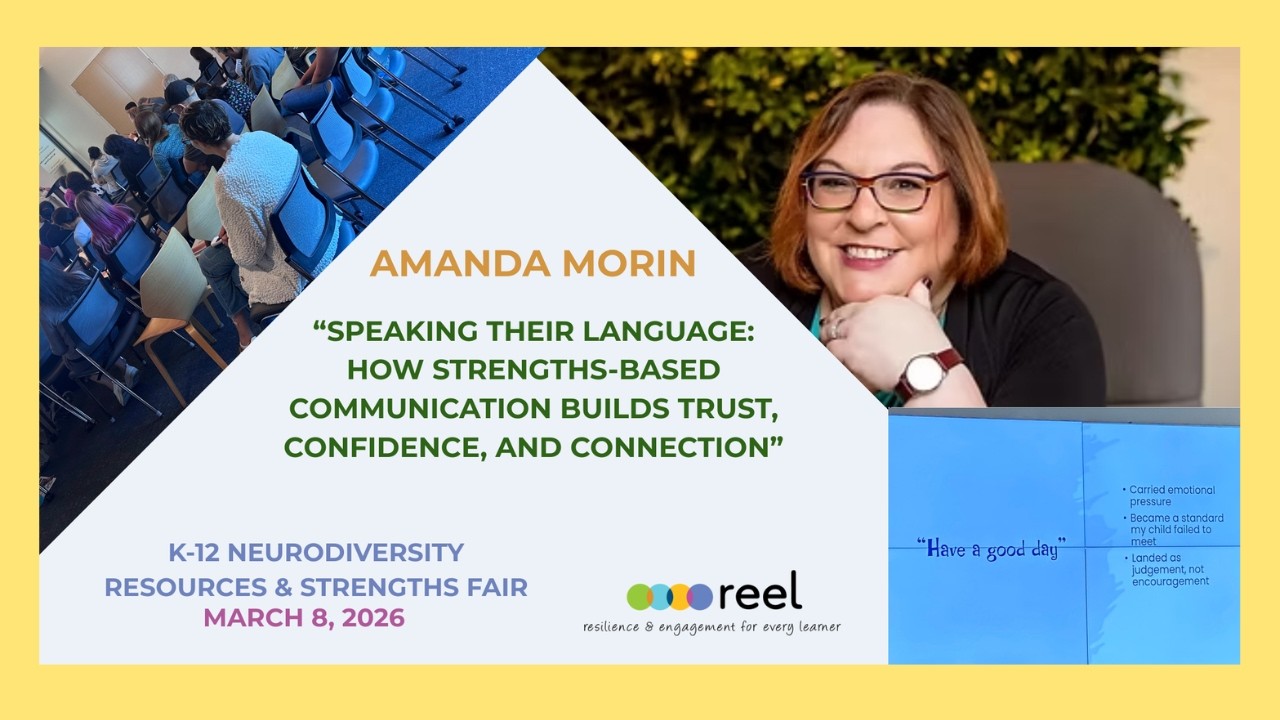
Panorama del niño en su totalidad y comunicación escolar basada en las fortalezas
Cuando cambiamos la forma en que hablamos de nuestros hijos, cambiamos la forma en que el mundo los ve y cómo ellos se ven a sí mismos. ...


Enmascaramiento autista 2e
Mi meme favorito sobre el autismo es una foto de un controlador de videojuego con una leyenda que dice: “Autismo: donde la vida es un...


REEL en la Cumbre de Neurodiversidad de Stanford 2025
La Cumbre de Neurodiversidad de Stanford , celebrada a principios de este mes, reunió a profesionales, cuidadores, padres, empleadores,...


La importancia de la autodefensa: vídeo y guion descargables
Cuando enseñamos a nuestros hijos a comprenderse a sí mismos y a compartir sus necesidades, les damos herramientas que duran toda la...


Cómo ayudar a los estudiantes a escribir: Apoyo a estudiantes de "2e" y otros estudiantes reticentes con la Dra. Austina De Bonte
Aprende sobre las cinco causas fundamentales de los problemas de escritura, además de los impactos adicionales de la ansiedad y el perfeccionismo. Analizaremos cómo identificar la causa y cómo abordar cada problema. Esta sesión sintetiza diversos métodos de especialistas y tutores particulares de escritura, y está repleta de consejos y técnicas prácticas.


Ser consciente: herramientas para comprender y gestionar la ansiedad
Learn clear and useful strategies for addressing anxiety. Get advice to address high anxiety situations with your children. Hear strategies for self-regulation and co-regulation, which are so important in the parenting journey.


Trabajando el sistema: Aprovechar las escuelas públicas para la evaluación y el apoyo a los estudiantes 2e
Understanding and getting support for 2e learners can be complicated. The public education system is sometimes unwieldy and confusing. When parents suspect their child’s challenges (academic and/or social-emotional) may stem from an as yet undiscovered diagnosis, they often don't know how to start the process of requesting accommodations, assessments, and services. As a result, parents frequently do not leverage the resources of their public schools, which can lead to delays


¿Qué puedes pedirle a tu escuela?
What is reasonable and likely to be accepted and what is not? Our panel of two parents and a neuropsychologist discussed and suggested concrete support and accommodation options as well as answered questions from our parent community.


Cómo afrontar la ansiedad en estudiantes de 2.ª generación: opciones terapéuticas y estrategias para el hogar
Dr. Kari Berquist will discuss the SPACE program, Dr. Bradley Siu will introduce DBT (Dialectical Behavior Therapy), and Toni Ratzburg, LMFT, will share insights on integrative perspective therapy, , where therapists interweave different approaches based on the specific needs and personalities of the client.


Vídeo: Serie de conferencias REEL: Dra. Susan Baum: Estrategias para inspirar al escritor reticente
Writing almost always tops the list of challenges for all types of 2e learners, who have both high ability and potential as well as complex challenges such as specific learning disabilities (e.g. dyslexia), autism, ADHD, and anxiety. Parents and educators need tips to help these students experience success with writing. Renowned 2e expert Dr. Susan Baum joined REEL for a creative and pragmatic discussion on ways to support writing development for 2e learners.


Habilidades sociales y el niño 2e
Social skills and social anxiety rank as a top concern for parents of 2e learners. Parents worry their child doesn’t have enough friends, doesn’t attend enough social events, or only engages socially online.


Vídeo: Introducción a 2.ª edición: Cómo comprender a los estudiantes inteligentes y con dificultades
an interactive overview of 2e - what it is, why it matters, and effective approaches for supporting 2e learners. 2e students experience both high ability and learning challenges, which presents unique challenges in the classroom, including asynchronous development that may lead to anxiety and behavior issues. Explore strategies to help your child thrive at school.


Vídeo: Estrategias para la ansiedad en niños con doble excepcionalidad
Students who are twice-exceptional (2e) have tremendous intellectual gifts alongside a wide range of possible learning challenges — attention differences, slow processing speed, social immaturity, and/or weak executive function skills, just to name a few of the possibilities.


Vídeo: Ad Astra: Cómo criar a un niño con neurodiversidad
In this uplifting workshop, Abby Kirigin shares how to help neurodivergent students thrive by celebrating their unique brains. She offers strategies to build confidence and self-efficacy, separate content goals from expression challenges, and integrate strength-based learning into daily life—all to help students re-engage, shine, and face challenges with renewed energy.


Panel de autodefensa 2e: ¡Ayude a su estudiante a comprender su cerebro y a sus maestros también!
students should develop. 2e kids often lose self-esteem when they aren’t able to learn the way the classroom or assignments are organized. Students gain confidence with the success that comes with having their environment or assignments adjusted so they can access their learning abilities. Explore the prerequisites to self-advocacy, discover how to help students understand what their brain needs to succeed at school, learn specific developmentally-appropriate techniques to tr


¿Tiene dificultades para cumplir con los requisitos de elegibilidad? Infórmese sobre el IEP y el apoyo 504.
Learn about 504 plans and IEPs and how to push for eligibility even when the district mentions that your student is performing at grade level and is thus not eligible. Learn various support options available under a 504 or IEP. Learn how to work with teams to creatively extend learning beyond grade-level curriculum. And lastly, learn how Advocates can support your journey.


2e Regulación emocional
Emily will break down the 4-step process of emotional regulation so we can help our kids who are "a little bit extra" find healthy ways to manage their emotions.


2e y funcionamiento ejecutivo
in this talk our panelists focused on planning and prioritizing, task initiation, and organization. Experts Sam Young, Marcie Habell, and Mason Tudor provided tips on how to support your 2e student through a strength-based lens, including what accommodations to ask for at school as well as strategies for tackling tasks such as homework, note taking, project planning, task management, and goal setting.


Feria de Fortalezas REEL 2025 "Neurodivergentes y fuertes: Desarrollando nuestros superpoderes"
Sam Young of Young Scholars Academy talks about focusing on the strengths of the child to develop positive learning outcomes.


Reinicio de regreso a clases de la función ejecutiva de la escuela secundaria 2.ª edición
La preparatoria conlleva un aumento en las exigencias de EF, ya que se espera que los estudiantes asuman mayor responsabilidad en el...


Aprender habilidades sociales desde una perspectiva que afirme la neurodiversidad
A los 18 años, me inscribí en un curso intensivo de habilidades sociales. La clase era exhaustiva y exigente. Memoricé diálogos completos...


Ansiedad en el espectro autista, parte 2: Cómo afrontarla
Si alguna vez has viajado a un país extranjero, sabes lo estresante que es entrar en un entorno desconocido. Todo es diferente: las...


11 consejos para criar niños neurodivergentes y 2e para el éxito escolar
Como aparece en la revista Bay Area Parent Aquí presentamos nuestros mejores consejos para criar a estudiantes neurodivergentes y...


Panel de discusión sobre dislexia doblemente excepcional (2e)
After the screening of Left Behind we hosted a powerful panel conversation about the intersection of dyslexia and giftedness. This panel brings together leaders in the field of learning differences:
--Dr. Fernette Eide, international expert on dyslexia and co-author of The Dyslexic Advantage and The Mislabeled Child, co-creator of the forthcoming movie, The Dyslexic Advantage.
--Anna Cencioso, Founder and Head of School at Touchstone Learning
--Mandy Hoff, Learning Specialist


Ansiedad en el espectro autista, parte 1: Análisis de la alexitimia
De adolescente, casi siempre estaba ansiosa, pero no siempre lo sabía . Sentía mi ritmo cardíaco acelerado, mis pensamientos...


Columna mensual de Pregúntale a Lucy: Adicción a la tecnología y perfeccionismo neurodiversos
Lucy the writing tutor focuses on supporting 2e/neurodivergent students and her dog ¿Tiene alguna pregunta que le gustaría que la...


Construyendo una comunicación colaborativa con los docentes
En nuestro grupo de apoyo de septiembre de 2025 para padres de niños 2e, Heather, madre y defensora profesional, explora maneras...


Cerrar la brecha, construir el año
Hemos trabajado arduamente para desarrollar nuevas herramientas, recursos y eventos para lanzar el año escolar con nuestra campaña "Cruza...


Estado de la neurodiversidad de Silicon Valley 2025: Toma de conciencia de los educadores
The 2025 Silicon Valley State of Neurodiversity: Educator Pulse Check provides a clear view into how Silicon Valley educators understand and support neurodivergent and twice-exceptional (2e) students, spotlighting successes, identifying gaps, and outlining what’s needed next. Download your copy to explore the current landscape and see how REEL can help drive change.


Desde la educación en casa hasta la educación sin escolarizar: planes educativos personalizados para estudiantes de 2.ª generación
REEL was excited to host independent educational planner Teresa Nair, who shared her experiences helping families, in particular those with 2e and neurodivergent learners, explore non-traditional schooling pathways.


¿Qué es 2e y el modelo DEAR REEL?
The DEAR REEL Model equips educators with powerful strategies to transform the classroom experience, not just for 2e students, but for every learner. By focusing on strengths and addressing challenges with empathy and flexibility, we create a space where all students can fulfill their potential and thrive.
bottom of page