top of page


GETTING REEL
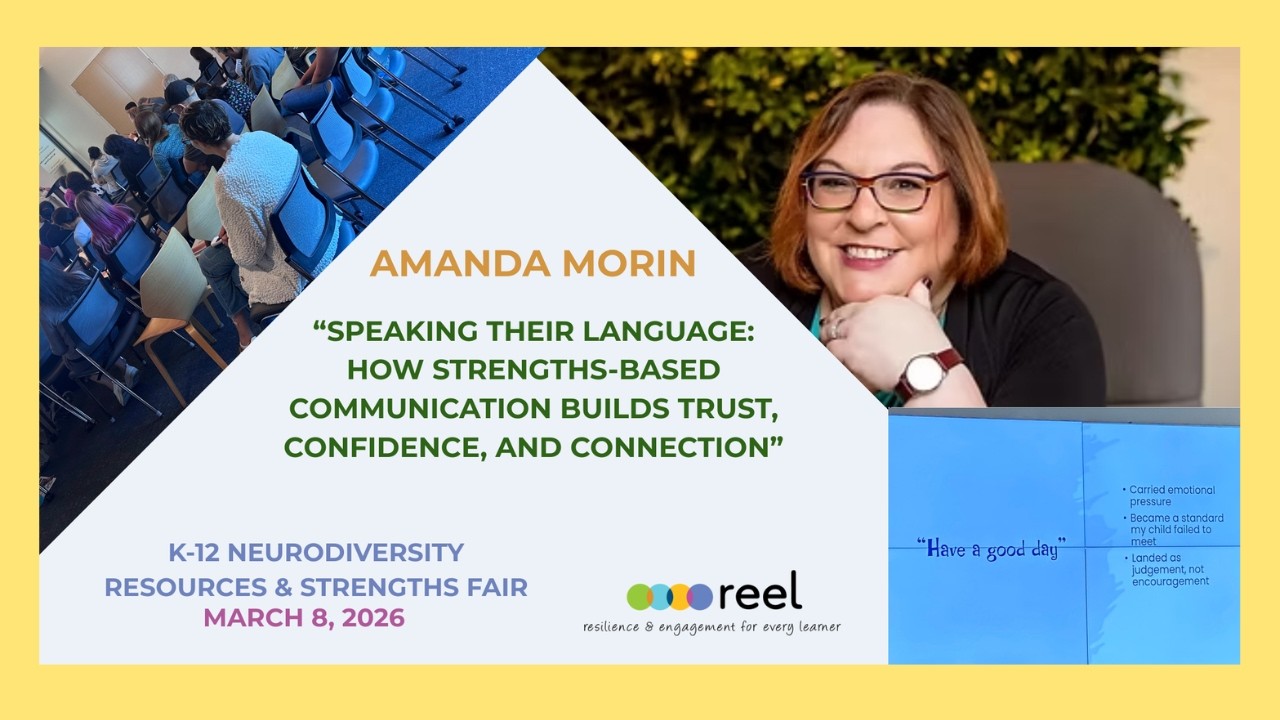
Speaking Their Language: How Strengths-Based Communication Builds Trust, Confidence, and Connection
In this keynote address from the 2026 REEL Strengths Fair, neurodiversity activist and author Amanda Morin explores the transformative power of strengths-based communication. Drawing from her personal journey as a mother of neurodivergent children and her professional expertise, Morin argues that traditional "inherited" language often places undue emotional pressure and judgment on neurodivergent individuals.
Mar 11

Neuropsychological Assessments for 2e Learners with Dr Jessica Snowden Patel
Join Dr. Jessica Snowden Patel for an essential guide to neuropsychological evaluations. Learn when to test, why schools miss 2e learners, and what to ask.
Mar 6


Navigating the Storm: Supporting 2e Students Through Political and Systemic Anxiety
We work with hundreds of K-12 faculty from schools all around Silicon Valley each month. If I had to boil down the most common theme that’s come up lately, it’s all about anxiety. We hope this resource serves as a starting point to think about how you can serve as a guide through turbulent times for your community.
Feb 26


Where Strengths Shine, Futures Grow: Unlocking the Potential of Twice-Exceptional (2e) Learners
Parents of twice exceptional (2e) learners often notice early on that their children understand things deeply, even when everyday tasks don’t come easily. Conversations can move quickly into big ideas or detailed interests, yet school participation may be inconsistent from one day to the next. Many families spend time trying to make sense of how both can be true at once. After decades of working closely with highly gifted and 2e families, I have watched this same pattern emer
Feb 19


Why Telling Your 2e Kids What to Do Backfires (And What to Say Instead)
As parents, we’re full of knowledge, know-how, wisdom, and solutions, and when our kids are infants and toddlers, we respond in a compassionately curious way, trying to understand what they need or how to help them. As our kids get older, our expectations increase in line with their age but even more so with their verbal abilities: the higher their verbal abilities, the higher our expectations. When they aren’t meeting those expectations, we don’t naturally respond
Feb 4


Seeing Our Kids Through a Strengths-Based Lens
As parents and educators, we have traditionally been trained to look at our neurodivergent children through a deficits-based lens, focusing more on what they struggle with than on the unique strengths and cognitive abilities that can contribute to their personal growth and success. In part, that’s because it’s easier to see what’s difficult. We know when reading or focus is hard for our children. We see the frustration that comes with having difficulty managing transition
Jan 27


Dyslexia and Giftedness
Meet Caleb. He’s gifted, with extremely high verbal comprehension, while at the same time, his dyslexia, dysgraphia, and ADHD means he struggles to read, write, and act like everyone else. This results in an interesting mix - he is fiercely independent, creative, and inquisitive. He’s always coming at things from a different angle, and putting disparate things together - both physical things and abstract concepts. He loves to think, talk, and make connections, but resists put
Jan 26


Independent Educational Evaluations (IEEs): What Parents of Twice-Exceptional Students Should Know
TL;DR An IEE is a parent-requested second opinion when they disagree with a school evaluation. The school must either fund the IEE or file for due process. IEEs are especially important for twice-exceptional students whose needs are often masked by strong grades. Families are not limited to a district’s preferred evaluator list. Schools must consider IEE findings, even if they do not adopt every recommendation. One of the most important protections available to families navig
Jan 24
bottom of page