top of page


GETTING REEL


Dyslexia & Music from a 2e Violin Teacher’s Perspective
Growing up in the late 80s as a gifted girl, I carried not just my Trapper Keeper and a hair scrunchie, but also a myriad of unidentified learning differences. There were things I was darn good at and areas where I struggled. When all the kids on the blacktop were learning the “cabbage patch” dance move in P.E., I quickly discovered my own attempts elicited laughter. Trying to ride my bike to a friend’s house a few streets over, I would get lost. I’m talking really lost. I co
4 days ago


Passion Over Conformity: Raising a 2e Child in a 'Fix-It' World
July 31, 2026 — Las Trancas, Chile As I write this, Alexander is in Chile, doing his elite summer training alongside top-notch athletes from Europe and the US who compete in the Freeride World Tour (FWT) and IFSA (The International Freeskiers and Snowboarders Association). Meanwhile, I am trapped in a bureaucratic rabbit hole with his school regarding his physical education (PE) placement. Almost everyone in the freeride community loves Alexander. They recognize his support n
Aug 21


The Coyote Curriculum: How Autistic Special Interests Become Strengths, and What Parents Can Do
I spent my childhood convinced I was from another planet. Decades later, I stood in my own kitchen saying, "Please don't pretend to be a dog." My child looked up, offended. "Coyote,” he corrected me. Then he howled—not in anguish, but with the strained urgency of a creature trying to cross a communication barrier I had not, until recently, known existed. A few months earlier, we had both been identified as autistic, six weeks apart—a revelation that reframed my own childhood
Jul 15


Three Strategies for Strengths This Summer
Sarah hated school and resisted writing, leaving teachers frustrated. Yet, she stayed up all night writing a script and directing neighborhood kids in a play. Reframed around her interests, her motivation soared. As noted by REEL, "Magic happens at the intersection of strengths and interests." Once you understand what makes a child light up, you can nurture it.
Jun 12
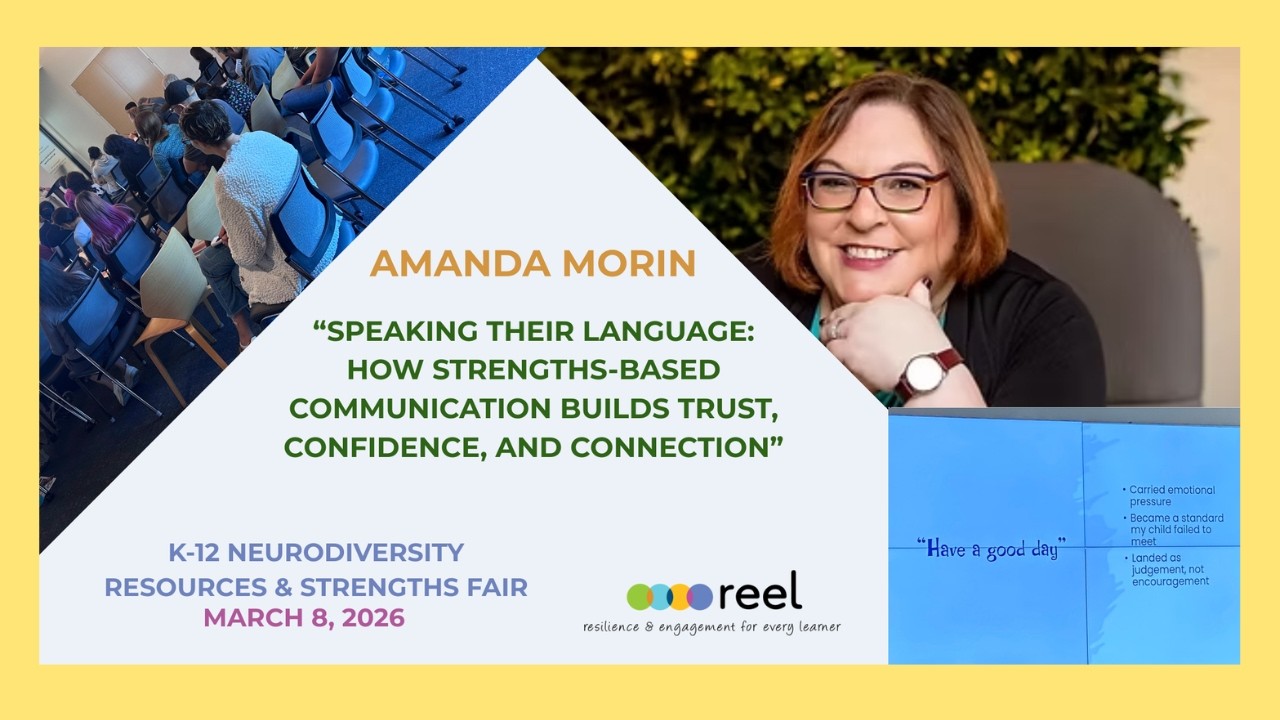
Speaking Their Language: How Strengths-Based Communication Builds Trust, Confidence, and Connection
In this keynote address from the 2026 REEL Strengths Fair, neurodiversity activist and author Amanda Morin explores the transformative power of strengths-based communication. Drawing from her personal journey as a mother of neurodivergent children and her professional expertise, Morin argues that traditional "inherited" language often places undue emotional pressure and judgment on neurodivergent individuals.
Mar 11


Where Strengths Shine, Futures Grow: Unlocking the Potential of Twice-Exceptional (2e) Learners
Parents of twice exceptional (2e) learners often notice early on that their children understand things deeply, even when everyday tasks don’t come easily. Conversations can move quickly into big ideas or detailed interests, yet school participation may be inconsistent from one day to the next. Many families spend time trying to make sense of how both can be true at once. After decades of working closely with highly gifted and 2e families, I have watched this same pattern emer
Feb 19


Seeing Our Kids Through a Strengths-Based Lens
As parents and educators, we have traditionally been trained to look at our neurodivergent children through a deficits-based lens, focusing more on what they struggle with than on the unique strengths and cognitive abilities that can contribute to their personal growth and success. In part, that’s because it’s easier to see what’s difficult. We know when reading or focus is hard for our children. We see the frustration that comes with having difficulty managing transition
Jan 27


Activity: Flipping Expectations
The Hard Things Are Easy and the Easy Things Are Hard Many 2e children experience a mismatch between what the world expects them to be able to do and what actually comes easily. A child may struggle with “easy” tasks like tying shoes or organizing a backpack, while soaring in “hard” areas like mental math or storytelling. This reversal can lead to frustration, misunderstanding, and burnout—for kids and caregivers alike. Activity: Flipping Expectations Use the chart below to r
Jun 5, 2025


Growing with Strength: Fun Ways to Reflect, Celebrate, and Build Confidence
As the school year winds down and summer begins, it’s natural to reflect on the past year—its challenges, milestones, and surprises. For families raising neurodivergent children, that reflection can often feel weighted toward what was hard. But here’s a powerful shift: What if we used this transition to focus on strengths instead? At REEL2e and Young Scholars Academy, we believe a strength-based, talent-focused approach isn’t just feel-good language—it’s a foundation for help
May 16, 2025


REEL’s Inaugural K-12 Strengths Fair: A Celebration of Neurodiversity and Connection
A heartfelt thank you to everyone who joined us for our inaugural K-12 Strengths Fair on Sunday, March 9! The event was a huge success, with hundreds of attendees exploring a variety of exhibitors, kids diving into hands-on projects, and parents connecting with one another while hearing from our incredible speakers. The energy in the room was unforgettable —families found a space to be themselves, celebrate their children’s strengths and interests, and engage with valuable
Mar 15, 2025

2025 REEL Strengths Fair "Neurodivergent and Strong: Developing Our Superpowers"
Sam Young of Young Scholars Academy talks about focusing on the strengths of the child to develop positive learning outcomes.
Mar 15, 2025
2025 REEL Strengths Fair, How to build a "can’t help but thrive" task management system w/ Sam Young
In this recording from the 2025 REEL Strengths Fair, Sam Young discusses ways to help your student plan and organize. Link to resource at the end: https://youngscholarsacademy.org/courses/self-paced/demo-optin
Mar 15, 2025

2025 REEL Strengths Fair "Neurodiversity Unleashed: Turning Dyslexic Traits into Tools for Success"
Gil Gershoni of Dyslexic Thinking and Gershoni Creative discusses strengths of the dyslexic mind.
Mar 12, 2025


5 Questions to Ask Your Child to Focus on Strengths This Year
As one year ends and another begins, it’s natural to reflect on the challenges and victories of the past twelve months. Raising a neurodivergent child can often feel like navigating a labyrinth of ups and downs, leaving many parents focusing on struggles instead of strengths. But here’s the good news: You can shift that mindset. One of the most powerful things we can do for ourselves and our kids is to adopt a strength-based, talent-focused approach to the new year. This mean
Jan 20, 2025


Cultivating Strengths: A New Era for Twice-Exceptional Learners
We are amid a recultivation in the ever-evolving ecology of education, particularly for twice-exceptional (2e) students. An ecosystem...
Aug 16, 2024


Strength-Based Assessments Help Your Children Thrive
During this season of IEP renewal meetings and the never-ending search for the elusive “perfect educational fit” for our 2e children, we...
May 14, 2024


Maximizing Student Success: A Strength-Based Pyramid
At REEL, we are passionate about helping parents, students, and teachers build bridges in support of maximizing each child’s potential. This includes neurodivergent and twice-exceptional learners, who often fall through the cracks. When everyone works together, amazing things can happen! We are inspired by a graphic of Dr. Robin Schader’s which visualizes teachers, students, and parents working together towards a common goal. She starts by drawing a triangle with the teacher
Feb 10, 2024


How Puzzles Directly Support 2e Students
Creative thinking sparks innovation and problem-solving. When coupled with perseverance, creativity becomes an unstoppable force. For 2e children, whose minds are brimming with potential, fostering creative thinking, engagement, and perseverance is paramount. Especially when their school days often push against their deficits. The Significance of Creative Thinking, Engagement, and Perseverance Creative Thinking ignites innovation. It enables children to approach problems from
Feb 6, 2024


Beat the Winter Blues with These Family Activities For All Ages
Happy new year! As families return to their routines after the winter break, many of us are already glancing longingly at our calendars...
Jan 16, 2024


Ask for Strengths to Shine this School Year
As we kick off another school year, I was pondering what most makes my 2e kids look forward to school, especially because their days are...
Jul 27, 2023
bottom of page