SEARCH RESULTS
Search this site
243 results found with an empty search
- Maximizing Student Success: A Strength-Based Pyramid
At REEL, we are passionate about helping parents, students, and teachers build bridges in support of maximizing each child’s potential. This includes neurodivergent and twice-exceptional learners, who often fall through the cracks. When everyone works together, amazing things can happen! We are inspired by a graphic of Dr. Robin Schader’s which visualizes teachers, students, and parents working together towards a common goal. She starts by drawing a triangle with the teacher, student, and parent at each point. As she explains, rather than pushing and pulling against one another in a 2-dimensional triangle, the collaboration needs to be made 3-dimensional (here she draws a point up above) with everyone looking up towards the common goal of maximizing the potential of the student. REEL loves Dr. Schader’s graphic because it helps people visualize the success we can achieve when we work together. We wanted to take Dr. Schader’s concept a step further by placing it on top of a solid foundation of strengths & interests, interventions & accommodations: At the base of this foundation is an understanding of, appreciation for, and commitment to develop each child’s strengths and interests. As Kimberlee Joseph, 2e Educational Consultant and REEL team member, says: “When strengths and interests are attended to in the classroom, more students will experience self confidence, enjoyment in learning, and a greater acceptance of self and others. In addition, research indicates that strength based approaches improve academic performance and engagement and lower incidences of challenging behaviors, absenteeism, and tardiness. Strength-based approaches are especially critical for the 2e, who spend a high degree of time focused on shoring up weaknesses or struggling with environments that are not designed for their learning profiles, but rather to a ‘norm’ that doesn’t align to their needs and strengths.” It is critical for parents and educators to take the time to understand what lights a child up and sustains them, and then to provide each child with opportunities to spend time in those spaces every day. Making sure kids know what they’re great at, and giving them time to do it and share it builds their self-efficacy and self-confidence. Not only does it give them time to hone and improve themselves, doing something they enjoy makes them feel good. Research shows that these types of positive experiences help build a wellspring of inner resources that an individual can draw upon throughout their lives, as well as improves their ability to attend to executive function, emotional regulation, and social attention in the here and now. (For more information, see the ‘for further reading’ section at the bottom of this post.) Those good feelings buoy students against challenges in other arenas - it fills their bucket so they are better able to take on challenges in their areas of weakness. Which, as it happens, is the next layer of the pyramid: interventions & accommodations. Interventions include services such as pullout support, specialized tutoring, and therapists, as well as medications that can alleviate some of the challenges the child experiences. For example, a dyslexic student might receive phonemic awareness tutoring or work with an Orton-Gillingham tutor. A student with ADHD might take stimulant medication or meet regularly with an executive function coach. An autistic student might spend time with an occupational therapist or speech and language pathologist. Accommodations are the tools and supports that a child needs in order to be successful. For example, dyslexic students may use audiobooks to supplement their reading. Many autistic, ADHD, and dyslexic students benefit from dictation tools for writing. Dysgraphic students should have the option to type (rather than hand write) their work. Accommodations should never alter the core purpose of any unit and therefore never ‘lower the bar.’ They are simply alternative means for allowing all students to achieve the same goals. Too often, though, students’ strengths and interests are left behind. Interventions and accommodations work best when a student’s strengths are incorporated and prioritized. For example, let’s imagine a 5th grade student and call her Fern. Fern is a little Egyptologist. She has studied Egypt extensively on her own, through videos, audiobooks, and websites. Plus, Fern is very creative and has a lot of ideas. She makes interesting and insightful connections in class and likes to participate in group discussions. She is dyslexic and faces challenges when reading long texts and getting her thoughts into organized, written work. A reading specialist working with Fern could incorporate strengths by choosing readings on Egyptian gods, and adding words like ‘sarcophagus’, ‘papyrus’, or ‘scarab’ into word list practices. This same specialist should be mindful of when during the school day Fern gets pulled out for tutoring, recognizing the child’s strength priorities, and finding a time where Fern will not miss her favorite history lessons or art class (where she’s working on a model pyramid!) The specialist asks Fern for a few suggestions on good times to meet - Fern discusses it with her parents, and then suggests during Tuesday morning music class (she’s more focused then, and she takes piano after school so doesn’t mind missing this class), or during half of her Thursday afternoon double period math class (she feels that missing only half the class would leave her time to catch up when she returns). Fern’s reading specialist knows that she is very creative, so they make sure to leave time in their sessions for her to ask questions about any of the words she comes across, or just talk about ideas that excite and interest her. Fern enjoys all of her classes because she can tell that the teachers appreciate her contributions, but she loves history class especially. In history she has been following along with the texts and doing her own research using audiobooks and watching videos online. She has learned a lot about the economies of ancient Egypt. For her next assignment, she is going to show all that she knows about the economics of ancient Egypt without having to write an essay! (She has to work on her writing all the time in her English class.) Instead, her teacher has given students the option to propose alternative ways to show what they know, so Fern is creating a role-playing game that simulates a market bazaar for her classmates. Fern has drawn up characters, recorded a ‘background info’ video for her classmates to watch, and is excited to explain the roles, customs, and norms to her eager participants. You can see that Fern is actively working on shoring up her deficits: she is working with a reading specialist, and she is practicing essay writing in English. Even though she may struggle to read and write as fast and as fluently as her peers, she is valued (even in English class!) for her strengths such as her strong discussion abilities and creative out-of-the box ideas, connections, and thinking. Her interests are also allowed to shine, with several teachers enabling her to incorporate her Egyptologist interests into all sorts of activities. Fern, her parents, and her teachers are working together to create an environment where Fern can maximize her potential in all aspects of her academic life. And this, then, supports the big picture goal, which is to be sure Fern has the skills, knowledge, and confidence to bring her unique strengths, interests, and abilities to the world. Attending to strengths and interests on their own as well as finding ways to infuse them into a child’s interventions and accommodations can propel the learning experience for the child, aligning them with their long-term goals, increasing motivation in the here and now, and providing those positive experiences that create a strong foundation across their lifetime. Acknowledgements Thank you to Kimberlee Joseph and Callie Turk for their contributions to this post. For further reading… Chaves, C. (2021). Wellbeing and flourishing. In M. L. Kern & M. L. Wehmeyer (Eds.), The Palgrave Handbook of Positive Education (pp. 273–295). Springer International Publishing. https://doi.org/10.1007/978-3-030-64537-3_11 Das, K. V., Jones-Harrell, C., Fan, Y., Ramaswami, A., Orlove, B., & Botchwey, N. (2020). Understanding subjective well-being: Perspectives from psychology and public health. Public Health Reviews, 41(1), 25. https://doi.org/10.1186/s40985-020-00142-5 Edie, B. L., and Edie, F. F. (2012 - Updated Edition 2023). The dyslexic advantage: Unlocking the hidden potential of the dyslexic brain. Plume. Foss, B. (2013). The dyslexia empowerment plan. Ballantine Books. Fredrickson, B. L. (1998). What good are positive emotions? Review of General Psychology, 2(3), 300–319. https://doi.org/10.1037/1089-2680.2.3.300 Fredrickson, B. L. (2007). Broaden-and-build theory of positive emotions. In R. Baumeister & K. Vohs (Eds.), Encyclopedia of Social Psychology (1st ed., pp. 126– 127). SAGE Publications, Inc. https://doi.org/10.4135/9781412956253 Wood, R. (2019). Autism, intense interests and support in school: From wasted efforts to shared understandings. Educational Review, 73(1), 34–54. https://doi.org/10.1080/00131911.2019.1566213
- 8 Strength-Based Activities to Kick Off the School Year
Finding and nurturing student strengths is a critical part of supporting twice-exceptional learners, who are both incredibly bright AND experience learning differences (e.g., autism, ADHD, dyslexia). Too often, the adults in their lives focus on shoring up their deficits, ignoring their immense talents and capabilities. Education professor M. Elizabeth Nielsen and educator L. Dennis Higgins observe “Many gifted students with disabilities view themselves as primarily disabled. So much attention has been focused on the things they cannot do well, they find it almost impossible to believe that they are bright, capable learners.” Education leaders, teachers, and parents play a pivotal role in flipping this script. And a new school year presents a great time to start! Strength-based activities set the stage for a positive school year. Research shows that focusing on student strengths, integrating their interests, and developing their talents will energize their motivation, help them to build self-confidence and self-determination, and create authentic ways to build skills even in areas of challenge. Plus, integrating strength-based activities can help to: Identify ways to build students’ strengths and interests into curriculum and activities Provide the opportunity for teachers and parents to talk about and integrate their own strengths and interests Create a strength-based community culture for learning and growth We’ve assembled 8 strength-based activities to uncover and tap into the strengths and interests of students. Try one and then come back and let us know how it went! “Business Card.” Have kids create their own “business card” with their name, images, and lists of hobbies, interests, favorite things, curiosities, values, etc. Then invite them to present these to their classmates and display them so that everyone can have a sense of one another’s strengths and interests. (Adapted from Susan Baum, 2021.) My Way Expression Style Inventory . 2e expert and strength-based leader Dr. Robin Schader noted in a recent teacher workshop that four choices in exit points can cover a wide range of talents: building, drawing, performing, and writing. Explore student preferences and strengths for showing their mastery with this worksheet from the University of Connecticut that gives students a tool to identify their favorite ways to express themselves, including written, oral, artistic, computer, audio/visual, dramatization, musical, commercial (entrepreneurial), and service. Visualization Board. Provide a wide range of materials (such as posters, glue, magazines, photos, markers, crayons, pencils, paint, access to a computer to complete the project if desired) and have every student create a display of what their vision is for their year, including up to three goals. The board can also include representations of their interests and curiosities. 3eMe Join the Dots. Create a document or use this template with three words in a triangular shape: “Excel”; “Excited”; “Enjoy”. Ask students to create their own lists of subjects, activities, and interests for each of the three categories. Any one item can and should be included in each of the columns if the category applies. Then, ask students to look for common items and draw lines between them—those with the most connections are the highest areas of strength and interest. (Adapted from Galloway et al., 2020.) Body Tracings. Use large pieces of paper and pens or chalk and sidewalks to trace each student’s body. Have them decorate their outlines with their strengths using images and words that resonate for them. Then do a gallery walk to see each other’s work. (Adapted from Rawana et al., 2014.) Strengths Journal/Notebook. Taking time to notice when we are at our best, happiest, and in a state of flow, can help to build resilience and a growth mindset, as well as understand what to advocate for in our learning and work environment. Each student creates a journal (in a written notebook OR an online tool) to be used throughout the year to capture new strengths and interests, complete strength-based activities, and reflect on what they’re learning about their own strengths and talents. Treasure Chests. Have everyone create a personal Treasure Chest or create a class Treasure Chest that includes mementoes, pictures, drawings, objects, positive and uplifting quotes, and anything else that reminds students of their own strengths, flow, creativity, and/or positive experiences. Add to the Treasure Chest throughout the year. Revisit the Treasure Chest at the start of a lesson, before a quiz/test/creative project, or when the day has been more difficult than expected. (Adapted from Eades, 2005) Mood Boosters. Identifying strengths and interests across a group builds community as well. Work together with your children to create a list of all the books they love, the songs they like to sing or listen to, etc. UK educator and author of the book Celebrating Strengths: Building Strengths-Based Schools advises to “Build this resource throughout the year as you notice what they particularly enjoy, what calms them down, what cheers them up. You invite them to choose one for the start of a lesson, to prepare for learning or after a bad lesson, to repair everybody’s mood.” (Adapted from Eades, 2005) Starting the year with strength-based activities can help educators and parents identify strengths and interests, setting the stage for growing those strengths and interests into talents. Goal-setting and planning activities, where students work with teachers to create an action plan for reaching their goals for the year, can follow many of these activities. For instance, the insights gleaned can be used to create a learning commitment from each student that lists their strengths with at least one specific, SMART learning goal based on their individual strengths. The plan can include personal goals set by the student and assigned/suggested goals from the teacher. Teachers can use this to help students create a pathway from where they are today to where they would like to be in the future, from their “Now Self” to their “Tomorrow Self.” (Adapted from Galloway et al., 2020 and Lopez & Louis, 2009.) Sources & Additional Info: Baum, S. M. (2021). IEC 511/611 Cognitive Diversity and Strength-based, Talent-focused Education. Bridges Graduate School of Cognitive Diversity in Education . Eades, J. M. (2005). Celebrating strengths: Building strengths-based schools . CAPP Press. Galloway, R., Reynolds, B., & Williamson, J. (2020). Strengths-based teaching and learning approaches for children: Perceptions and practices. Journal of Pedagogical Research, 4 (1), 31-45. https://doi.org/10.33902/jpr.2020058178 Kettle, K. E., Renzulli, J. S., & Rizza, M. G. (n.d.). My way: An expression style inventory . Renzulli Center for Creativity, Gifted Education, and Talent Development. https://gifted.uconn.edu/wp-content/uploads/sites/961/2015/10/myway.pdf Lopez, S. J., & Louis, M. C. (2009). The principles of strengths-based education. Journal of College and Character , 10 (4). https://doi.org/10.2202/1940-1639.1041 Nielsen, M. E., & Higgins, L. D. (2005). The eye of the storm: Services and programs for twice-exceptional learners. TEACHING Exceptional Children, 38 (1), 8-15. https://doi.org/10.1177/004005990503800102 Rawana, E., Brownlee, K., Probizanski, M., Harris, H., & Baxter, D. (2014). Reshaping school culture: Implementing a strengths-based approach in schools. The Centre of Education and Research on Positive Youth Development. Rawana, E., Latimer, K., Whitley, J., & Probizanski, M. (2009). Strength-based classroom strategies for teachers. Canadian Teacher , 6 (2), 16-17.
- Anxiety on the Autism Spectrum, Part 2: Coping
If you’ve ever traveled to a foreign country, you know how stressful it is to enter an unfamiliar environment. Everything is different: the customs, the language, the social norms, the mentality. You’re stressed and overwhelmed. The novelty makes your head spin. This anxiety is very familiar to me–not because I travel, but because I have autism. Social norms and cues that most people seem to grasp intuitively have never come naturally to me. I had to piece them together laboriously, and even then, I make blunders. I’m frequently overwhelmed by sensory stimuli that most people seem not to notice, and internal aspects of autism–cognitive rigidity, atypical interoception, detail-oriented thinking–make anxiety even tougher to manage. For me, these struggles with anxiety also fit into the spiky cognitive profile that characterizes 2e learners. Twice-exceptional kids and teens are highly advanced in some areas and struggle significantly in others. In my case, learning Russian felt much easier than naming basic emotions. Nevertheless, I’ve developed solutions over the years. Anxiety remains a part of my life, but I’ve learned to change it when I can and accept it when I can’t. In my last post, I shared my experience of learning to recognize anxiety. In this one, I’ll outline the tactics that help me manage. I divide my anxiety solutions into two core categories: maintenance and coping strategies. Maintenance Strategies Maintenance strategies help me stay at a steady baseline. I practice them regularly to keep overwhelm at bay. They include: -Physical activity: Exercise is a form of sensory regulation for me, and each activity offers unique benefits. In high school, yoga helped me improve my balance and interoception and become approximately 28% less clumsy. Rollerblading provides a satisfying sense of power and acceleration, and swimming is rhythmic and calming. My latest favorite, weightlifting, is oddly similar to my weighted blanket; my muscles relax fully after. -Meditation-like experiences: I’ve never been a fan of true meditation, but I’ve found mindfulness more palatable. Lately, I’ve been doing lots of progressive muscle relaxation, which involves systematically tensing and releasing muscle groups. Other options include deep breathing, body scans, and yoga. -Managing my social battery: This became a point of considerable confusion before I received an autism diagnosis. Therapists and psychiatrists typically interpreted my preference not to socialize as a sign of anxiety or depression. Avoidance reinforces social anxiety, so treatment involves challenging those fears by exposing oneself to social situations. I do experience social anxiety, perhaps because I find social interactions so befuddling, but I also have a lower capacity for socializing. Think of it this way: everyone has a social battery. Once the battery dies, you need to recharge it. Most people’s batteries recharge to 100%, but mine never seems to go above 30%, no matter how long I “charge” it by resting and being alone. This isn’t a temporary hurdle that I can overcome with exposure therapy; it’s an unfortunate limitation that I’ve learned to work around. I space out social activities and schedule downtime in between, and I try to notice the signs of social fatigue before my battery goes dead. Coping Strategies Coping strategies are targeted and tactical. They help me handle acute stressors. I think of them as tools in a toolbox: I might technically “have” a strategy accessible to me, but it takes practice to wield it effectively. Trying a strategy once usually isn’t enough to determine whether it works for me, and I’ve learned to keep persisting even if I’m not sure I’ll be successful. Perspective-taking: In moments of stress, I try to remember past situations when I panicked over an imagined scenario that never actually happened. I also ask myself, “Will I be worried about this in a week? A month? A year?” Usually, the answer is no. Deep breathing: Deep breathing activates the parasympathetic nervous system, which is responsible for the body’s rest-and-digest functions. Online GIFs can help with pacing. Sensory input: Intense sensory input, like a cold shower or a few drops of hot sauce, can provide a shock to the system that interrupts the anxiety spiral. Music: Somebody once suggested creating a playlist that begins with one emotion (e.g., panic) and gradually shifts to another, song by song. I’ve never gotten around to implementing this, but it could be a fun project. Until then, I’ll stick with my Garden Indie Spotify playlist. One thing at a time: When I feel an anxiety spiral accelerating, I try to set aside worries about the future and focus on what I can do in the short term. I tell myself I have plenty of time to worry about the rest, which is true, but for now, I might as well control what I can. Dog: Canines have remarkable anti-anxiety properties. My dog seems to identify as a lap dog, so she functions as a portable weighted blanket, sitting on top of me when I need her to–and also when I don’t. She licks my hands to ground me (or perhaps because I taste like food), and she gets me outside regularly. She does, however, occasionally create enormous anxiety by eating tennis balls and requiring expensive surgery. She gets away with it because she’s cute. Conjugating Russian verbs: An unorthodox tactic, perhaps, but it’s highly effective, and I bet you could find equivalents for most 2e kids’ hyper-specific interests (listing video game characters? naming types of trains?) About Lucy: I graduated from Stanford in 2024 with a degree in psychology and Slavic Studies. I currently live in Boston and work as a writing tutor with a focus on supporting 2e/neurodivergent students. I've been involved in the neurodiversity world since I was diagnosed with autism at age 18. I hope to pursue a PhD in psychology and develop evidence-based interventions to help neurodivergent students write. For tutoring inquiries, please check out my website !
- Anxiety on the Autism Spectrum, Part 1: Unpacking Alexithymia
As a 2e teenager, I was almost always anxious, but I didn’t always know I was anxious. I felt my rapid heart rate, my thoughts racing, the fluttering in my stomach, the dizzy spells–but these perceptions never cohered into an overarching sense of emotion, and I couldn’t connect them to anything that was happening in my life. If you asked me how I felt, I probably would have just said, “Fine,” “Bad,” or simply “I don’t know.” This lack of emotional awareness wasn’t specific to anxiety. I couldn’t identify sadness, either, nor did I have a grasp of more nuanced gradations like disappointment, irritation, or envy. Positive feelings were equally baffling. I couldn’t make sense of the bright, fizzing sensation that I now call joy. Even unambiguously positive emotions became too overwhelming to handle. In short, I was overwhelmed with emotions that I couldn’t quite put into words. Scientists have a word for this. It’s called alexithymia. Alexithymia, explained Alexithymia isn’t a clinical diagnosis, although it shows up in many physical and psychiatric conditions. Instead, it’s thought of as a personality trait, akin to extraversion or neuroticism. Alexithymia has three facets, or core components: Difficulty identifying one’s own emotions: “Am I angry, sad, frustrated, scared, or something else altogether?” Difficulty describing one’s emotions: “How do I put this feeling into words?” A tendency not to focus on one’s own emotions: “It’s weird for me to think about my feelings, so I try to avoid them.” Someone who strongly agrees with these sample survey items would be said to have high alexithymia. High alexithymia is particularly prevalent in the autistic population, with 30% to 60% of autistic individuals exhibiting clinical levels of alexithymia. I don’t know of any research on alexithymia in the 2e population, but I suspect that many 2e learners struggle to name and understand their feelings. As a result of asynchronous development, 2e kids’ intellectual abilities often outpace their emotional intelligence. Until just a few years ago, I was the poster child for autism-alexithymia-2e crossover. These struggles made it challenging to cope with all emotions, but anxiety proved especially problematic, perhaps because I experience it almost constantly. Learning to identify anxiety was the first step to managing it, and I suspect this may be true for other 2e kids and teens, as well. What causes alexithymia? As with most questions in psychology, there are no definitive answers but lots of possibilities. One explanation relates to interoception , the ability to perceive bodily sensations. These include hunger, thirst, and pain, as well as the physical feelings linked to emotions. To understand our emotions, we need to pay attention to and interpret physical cues like a pounding heart, tingling hands, or fluttering stomach. Autism and alexithymia have been linked to a phenomenon researchers refer to as "interoceptive confusion," which is the difficulty in making sense of physical sensations. Does my stomach hurt because I’m anxious, or is that just hunger? Is the tightness in my chest a sign of sickness or dread? These types of questions can befuddle high-alexithymics and autistics. Other studies suggest that autistic people and those with high alexithymia tend not to notice sensory input until it becomes overwhelming. Someone might go an entire day without eating, unaware of their hunger. They might not notice pain or injury, or they might not recognize anxiety until it escalates into full-blown panic. Both of these interoceptive issues make it hard to interpret the physical sensations that signal our emotions. In my case, physical sensations were confusing enough that just thinking about them increased my anxiety, which made it even harder to understand my feelings. A second explanation involves emotion knowledge. According to this hypothesis, kids start out with broad, undifferentiated emotional terms: good or bad, happy or sad, upset or calm. As kids get older, they flesh out these categories. “Happy” becomes “excited,” “content,” and “overjoyed.” “Sad” expands into “disappointed,” “lonely,” and “hurt.” These additional shades of nuance help kids describe their feelings more precisely and accurately. It could be that people with high alexithymia, though, haven’t developed their emotional vocabularies in this way. They only have a few words to describe their feelings. If other people see the whole rainbow of emotions, high-alexithymia individuals live in grayscale. A third possibility suggests that alexithymia might represent both a lack of ability to understand emotions and a coping strategy. When someone struggles to comprehend their feelings, they may push those emotions away and focus on more concrete matters. Psychologists call this avoidance alexithymia. Over time, a long-term pattern of avoiding feelings can hinder a person’s ability to develop emotional awareness, as they miss valuable opportunities to practice understanding their emotions. Consequently, this reduced emotional awareness can drive the individual to continue ignoring or suppressing their feelings, perpetuating the cycle of alexithymia. (I should clarify that this framing represents my hypothesis, not a scientific finding, though I wouldn’t be surprised if this speculation were borne out in the data.) What do we do? Scientists are still in the early stages of developing solutions for individuals with high alexithymia, so while I can’t offer a bulletproof, scientifically backed solution, I can share what worked for me. I started tackling alexithymia by becoming more aware of physical sensations. The yoga classes I took throughout high school proved enormously beneficial. To follow an instructor’s directions, you have to attach words and concepts to physical sensations. I gradually learned to feel the difference between muscle tension and relaxation. Later, I found a similar benefit in a very different activity: weightlifting. Every weightlifting session feels like an embodied anatomy lesson. I do a series of exercises, and I can feel exactly which body parts are working. Over time, this experience has built up and clarified my sense of physical sensations, teaching me to interpret these sensations by inducing them under controlled circumstances. Most recently, I’ve started practicing mindfulness (or trying to) throughout the day. It turns out that all the mindfulness hype is well-deserved. In particular, progressive muscle relaxation has been a game-changer. By systematically tensing and relaxing each muscle group, I can calm myself down immediately, something I’d never managed to do before. If this video hits a million views, I think I deserve partial credit. Alongside physical activity, I also experimented with outsourcing emotion recognition. I’d talk to people I trusted, people who had known me for most of my life, and they would help me put the pieces together. Gradually, I learned that dizziness in the context of stressful life events usually indicated anxiety; that heat and adrenaline signaled anger; and that the bright, effervescent, shaken-bottle-of-Kombucha feeling equated to joy. If you or your child experiences similar struggles with recognizing emotions, the following tips may help: -Take this questionnaire to measure your levels of alexithymia. Your responses can offer insight into specific challenges. -Keep a feelings wheel on hand for easy access to emotion terms. -Check out the following resources to learn about physical manifestations of emotion: Science Bulletins: Mapping Emotions in the Body Can You Physically Feel Emotions? | Psych Central Mapping Emotions On The Body: Love Makes Us Warm All Over : Shots - Health News : NPR -Explore mindfulness activities such as body scans and progressive muscle relaxation. These practices are especially beneficial if done regularly. You’ll start to notice patterns and become more familiar with your feelings. About Lucy: I graduated from Stanford in 2024 with a degree in psychology and Slavic Studies. I currently live in Boston and work as a writing tutor with a focus on supporting 2e/neurodivergent students. I've been involved in the neurodiversity world since I was diagnosed with autism at age 18. I hope to pursue a PhD in psychology and develop evidence-based interventions to help neurodivergent students write. For tutoring inquiries, please check out my website !
- High School 2e Executive Function Back to School Reboot
High school brings an increase in EF demands, as students are expected to take more responsibility for tracking assignments, managing their workload, and juggling more challenging classes. With the right strategies in place, the high school transition can be a valuable opportunity to level up your 2e teenager’s EF skills. Tip 1: Adopt Simple Organizational Habits I’ve squandered countless hours on elaborate, overly ambitious organization schemes and time management approaches that last a week or two before becoming too cumbersome to sustain. Thus, I’ve learned to appreciate the value of small, simple actions repeated consistently. The following habits each take under two minutes, and they can have enormous benefits for overall organization. Take two minutes in the evening to lay out the next day’s clothes. You could even pack a bag/backpack if you’re feeling ambitious. Place a whiteboard next to the door and list 3-5 essential items (keys, backpacks, lunchboxes, headphones, phones, etc.). Before leaving, check to make sure you have said items. Tip: Any statement that begins with, “You need to…” will almost certainly be ignored. These strategies will be more effective if you implement them with your kids: “Let’s take a minute to [insert thing here]...” Tip 2: Get a Planner High school is the perfect time for teenagers to start tracking their homework independently. I recommend starting with a simple, low-friction planning system–no need to get lost in the online rabbit hole of hypercomplicated productivity methods. The first question to ask is whether you want a digital or physical planner. Each option has pros and cons. Digital systems are higher-capacity, accessible across devices, and hard to lose. Todoist, Google Keep, MyHomework Student Planner, TickTick, Any.do , and Minimalist are great options. Physical planners often provide a sense of calm to teenagers who get overwhelmed easily. Visual layouts are especially beneficial for those with ADHD or time-blindness. Teens who enjoy arts and crafts might have fun customizing and color-coding, and a more aesthetically pleasing planner is more likely to be used. Tip: Beware the Canvas illusion. Learning management systems (LMSs) like Canvas, Blackboard, and Schoology resemble planners in that they aggregate and organize school assignments. Thus, I have the following conversation at least once a month: Lucy: I would recommend using a planner. Student: I don’t need a planner. I have Canvas. My response is always the same. Canvas and the like create a false sense of organization, but they aren’t adequate substitutes for planners. Here’s why: These systems only show tasks assigned by teachers. Students can’t add or remove additional to-do items. Not only does this reduce the LMS’s functionality, it also removes an opportunity for students to develop EF skills. Teachers use these systems differently. Some might upload work at the last minute; others have the full semester’s worth. Some might not even use the online platform at all. As a result, it’s possible for a student to do every assignment on Canvas and still miss crucial tasks. Some students use Canvas as a cop-out or an excuse for not being on top of homework: “Well, my teacher didn’t post it in the normal place, so how was I supposed to know?” In some cases, this really is on the teacher, but generally, high school students are responsible for knowing what work is assigned. The bottom line: Get a planner! Tip 3: Set Up A Shared Family Calendar These tools are convenient, as they allow you to have a family calendar, a household calendar, a kid-specific calendar, and more. They also help facilitate the shift from parents managing schedules to kids taking responsibility for their own. For example, during the first semester of high school, you might handle entering your kids’ activities, but by the next semester, they can start taking on that task. You can also set a good example by adding relevant details (flight boarding passes, addresses, tickets) to calendar events. Or you can be like my dad and entertain the family by occasionally adding your personal events to the shared calendar. It seems that I’ll be having “lunch with Steve” next Tuesday and an ambiguously named “appointment” on September 16th. I’m not sure who Steve is, but he sounds great. Tip 4: Encourage Good Study Habits The study habits that were effective in middle school often aren’t suitable for the heavier workloads in high school. These tips will help rising freshmen establish a solid study foundation. Take a 30-minute break between school and homework. Very few high schoolers have the stamina to go straight from a day of classes to homework. Half an hour should be just enough to relax and reset. Set up the environment. Our physical and digital surroundings have an enormous impact on our state of mind and behavior. The following changes can help teenagers enter and stay in homework mode: Close distracting tabs and applications Mute notifications Put away potentially distracting items–but note that one kid’s distractor is another’s accommodation. Stim toys can provide helpful sensory input Have a visual timer of some sort handy Lay out necessary supplies Put up a politely phrased “do not disturb” sign Map out the day’s work visually: a physical planner, whiteboard, or Google Spreadsheet can help teenagers map out exactly what they need to do. With practice, 2e teens will also get better at estimating how long a task will take and planning accordingly. Take breaks. Many of the students I work with are reluctant to take breaks once they get started. I usually make the case like this: “You can’t focus indefinitely because nobody can. At some point, your concentration will wane, and you’ll find yourself drifting off to another task. That means you have two options. You can either 1) schedule a break proactively and be in control or your attention, or 2) keep going until you’re too tired to focus, at which point it becomes harder to return to the task.” Many high schoolers also benefit from identifying things to do during breaks. Stretching, fidget toys, going on a quick walk, working on a puzzle, eating a snack, doing origami, and petting a dog are all great options. Petting a cat works, too. Tip 5: Explore Other Resources For all its pitfalls, the internet is a phenomenal source of EF guidance. Here are some of my favorite sites, YouTube channels, and browser extensions: Understood.org – Offers tools, articles, and resources specifically focused on executive functioning, ADHD, and learning differences. ADDitude Magazine – Covers ADHD and related executive function challenges with tips for teens and their parents. I don’t have ADHD, and I still find many of these tips invaluable. How to ADHD – Offers digestible, practical videos on executive function, time management, and organization. I especially love this video on procrastination. Solving Procrastination – A phenomenal science-based resource that breaks down different types of procrastination, explains underlying mechanisms, and lays out solutions StudyHacks – Blog by Cal Newport, who writes about deep work, slow productivity, avoiding digital distractions, and more. I consider this an advanced EF resource, best suited to those who have solid skills in place and are ready for hard-core planning and organization. Apps, Extensions, and Sites Take a Five – Automatically closes a tab after a predetermined time, letting you take a quick break without getting sidetracked. PomoFocus – Uses the Pomodoro technique, interspersing 25-minute work intervals with five-minute breaks. Unhook – Removes YouTube distractions, including recommendations and autoplay. SelfControl – Free Mac app that blocks websites for customizable intervals. Goblin Tools – Cuts through task paralysis by breaking big tasks into smaller steps, scaffolding decision-making, estimating how long activities will take, and more. Written? Kitten! – For every 100 words you write, the site shows you a kitten! Note: This works best if you like kittens. About Lucy: I graduated from Stanford in 2024 with a degree in psychology and Slavic Studies. I currently live in Boston and work as a writing tutor with a focus on supporting 2e/neurodivergent students. I've been involved in the neurodiversity world since I was diagnosed with autism at age 18. I hope to pursue a PhD in psychology and develop evidence-based interventions to help neurodivergent students write. For tutoring inquiries, please check out my website !
- Learning Social Skills in a Neurodiversity Affirming Way
At age 18, I enrolled in an intensive social skills training course. The class was thorough and demanding. I memorized entire dialogues to incorporate into conversations. I learned how to introduce myself, write an email, make a phone call, wish someone a happy birthday, order a meal, or ask for directions. I wrote scripts and rehearsed them until I had them down. I recorded myself performing full monologues and received detailed feedback on my pronunciation and inflection. After each lesson, my mouth felt full of marbles, and I was exhausted from trying to keep every detail straight in my head, but my efforts paid off. I was no longer tongue-tied at the start of a conversation. I could express myself with relative confidence, and I was proud of what I had accomplished. What was the name of this magical course, you ask? SLAVLANG 181, also known as third-year Russian. I’m sure my professor had no idea that she’d become my de facto social skills coach. I didn’t expect it either. I signed up for the class for the same reasons everyone else did: 80% love of learning and 20% masochism. However, along the way, I learned invaluable lessons in the fine art of interacting with other humans. I’m still quite awkward, but somehow, I'm less awkward in a foreign language than in my native one. My love of Russian has also motivated me to step outside my comfort zone in everyday life. I built close relationships with professors and classmates in college. I'm hesitant to meet new people, but I don't think twice before booking a virtual Russian lesson with a stranger. I've even started conversations with Russian speakers in real life. To many, that might seem trivial, but to me, it's huge. I call this a strengths-based approach to social skills. It’s based on interests. It offers natural scaffolding. And perhaps most importantly, instead of aiming to make an autistic person "normal," this approach prioritizes interests, values, and self-advocacy. For years, adults in my life had recommended that I "take a social skills class," and for years, I'd resisted this well-intentioned advice. Social skills training just sounded bad. I imagined being scrutinized and dissected, my every word and gesture taken apart and corrected until I was finally resculpted into a less autistic version of myself, one that would be more palatable to those around me. Don't get me wrong; it's not that autism doesn't confer impairment. I wish social interactions came naturally to me. I'd love to be able to strike up conversations with strangers, fluidly shift in and out of eye contact, or understand a group chat without constantly googling slang. I consider autism a disability because it makes everyday life more difficult. These social struggles are frustrating and isolating. If there were a quick, easy fix, I'd sign up in a heartbeat. But there's no quick fix, and many of the solutions that are offered to higher-functioning autistic individuals like me come at an enormous cost. Inadvertently or otherwise, these interventions convey the message that there's something wrong with the way autistic people naturally communicate and that without becoming indistinguishable from neurotypicals, people on the spectrum will never be liked or accepted. Moreover, social skills training and therapy can lose sight of an autistic person's actual preferences, focusing instead on what providers think a person should want. In my teenage years, I was never going to be a stereotypical adolescent who posted on Instagram, obsessed over TV shows, and enjoyed midnight pizza parties–and yet, these were precisely the goals that my therapists prioritized. These goals were pushed on me so fervently that I began to doubt my own sense of what I wanted. Maybe the professionals were right. Maybe I would be happier if I were more normal. I went through a brief phase of trying to conform to these expectations. I learned the lyrics to several Shawn Mendes songs (not Shakespeare, but catchy for sure). I created an Instagram account and posted a selfie or two, feeling like an alien trying to blend in with another species. I even watched Mean Girls, which I'll admit was enlightening. Pretty soon, though, my attempts at normalcy fell apart because I'm not typical. I'm a geek who never stays up past 10 pm and hasn't attended a party since 2017, and I'm okay with that. Abandoning the social skills I don't need has helped me focus on the ones that really matter to me: having deep conversations; supporting my students in tutoring sessions; being there for my friends when they need me; and memorizing important Russian phrases like, "Have you seen Uncle Vanya?" and "Where is the potato?" Best of all, my Russian-based social skills training didn't involve any judgment or criticism of my natural ways of being. I was there because I wanted to learn, not because something about me needed to be fixed. I had agency and ownership, and that made my learning infinitely more meaningful. I know others on the spectrum who have developed their own versions of strengths-based social skills training. A college classmate was coxswain on the rowing team, meaning that she literally steered her team's ship. Her coach helped her modulate her voice, choose the right words, and read her teammates' nonverbal cues so she could lead effectively. Another acquaintance tackled her autism-related social anxiety by joining an improv troop. Forcing herself into the spotlight made day-to-day social interactions less scary. To help an autistic youngster discover their version of strengths-based socializing, start with their interests. What makes them tick? What do they love? What could they talk about endlessly? From there, consider how other humans are involved in that passion. Is there an online community where they could participate in conversations and answer questions? Can they join an online fan community to connect with others who share their hobby? Could they attend an online meet-up? If they love video games, anime, or other fictional worlds, could they look to their favorite characters to better understand social relationships? (I could do a whole separate post on learning social cues from sitcoms.) Don't underestimate the power of non-human socialization, either. Dogs and cats may not talk, but they're very capable of social cognition, and animal interactions can feel more manageable to some autistics. Once you've identified interest-based opportunities to socialize, you can start looking for ways to develop social skills. Semi-structured activities like language classes, martial arts, dance, and theater all naturally incorporate social rituals and awareness. Fandoms and subcultures often have their own norms and conventions that, once mastered, can help autistic participants feel more at home. Volunteering is also a fantastic way to connect to local communities and build social skills in the process. And of course, you could always take a Russian class. About Lucy: I graduated from Stanford in 2024 with a degree in psychology and Slavic Studies. I currently live in Boston and work as a writing tutor with a focus on supporting 2e/neurodivergent students. I've been involved in the neurodiversity world since I was diagnosed with autism at age 18. I hope to pursue a PhD in psychology and develop evidence-based interventions to help neurodivergent students write. For tutoring inquiries, please check out my website !
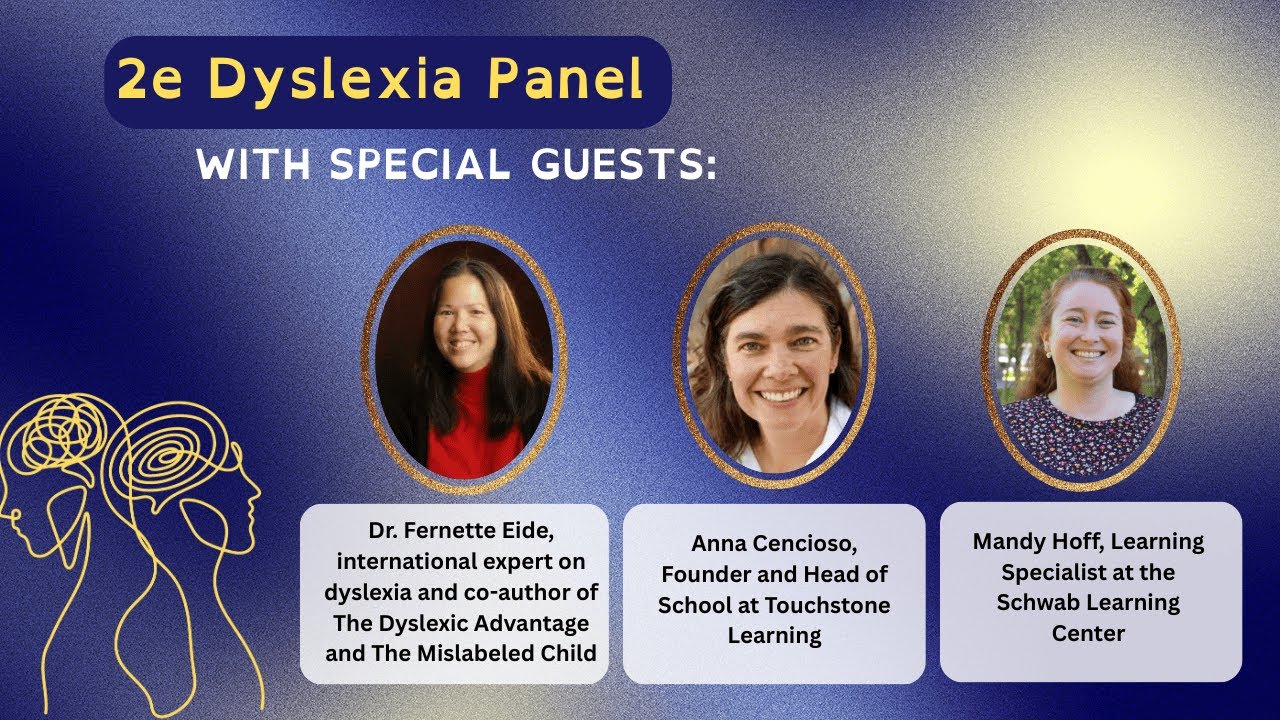
- Twice-exceptional (2e) Dyslexic Discussion Panel
After the screening of Left Behind we hosted a powerful panel conversation about the intersection of dyslexia and giftedness. This panel brings together leaders in the field of learning differences: --Dr. Fernette Eide, international expert on dyslexia and co-author of The Dyslexic Advantage and The Mislabeled Child, co-creator of the forthcoming movie, The Dyslexic Advantage. --Anna Cencioso, Founder and Head of School at Touchstone Learning --Mandy Hoff, Learning Specialist at the Schwab Learning Center Together, they’ll explore why dyslexia is often misunderstood or missed entirely in 2e (twice-exceptional) learners, how traditional identification methods fall short, and what kinds of supports truly help these students thrive. The conversation will address what effective, affirming support can look like across the K–12 journey, how to advocate for appropriate accommodations and instruction, and how a strengths-based view of dyslexia changes everything. Video Transcript: Video Transcript: Yael Valek: So, Fernette began her career as a neurologist and scientist, and it was only when her children had learning challenges that she and her husband, Dr. Brock Eide, became interested in using neuroscience-informed, strength-based strategies to encourage and support students and their families. Conventional ways of testing and education overlooked strengths. Dr. Fernette Eide is the co-author and co-founder of Dyslexic Advantage—the book, the nonprofit, and now the movie—as well as co-founder of NeuroLearning.com. Anna began her career in the early '90s as a public school elementary teacher in Palo Alto, California. Always passionate about literacy, when her bright son struggled to learn how to read, she was on a mission to help him. That was the beginning of her journey to understand the strengths and challenges of a dyslexic learning profile and the science-based methods that lead to grade-level reading. Anna ultimately founded Touchstone Learning in Redwood City, California, a small school designed to meet the unique needs of gifted dyslexic students, preparing them to transition to a school of their choice. With over 11 years of experience as a public school teacher, Mandy brings a deep understanding of education and student development to her current role as a learning specialist at Schwab Learning Center, part of the Children's Health Council. She works closely with high school students and adults, offering personalized strategies for learning and executive functioning, particularly for individuals with ADHD, dyslexia, and other learning differences. Her approach is rooted in the belief that every person has unique strengths, and Mandy is passionate about helping each learner unlock their full potential through tailored support that honors who they are and how they learn best. Yael Valek: Welcome, we're so excited to have you here. Audience, feel free to put questions in the chat, and we will ask them after we ask a few questions of our own. So, you are all former teachers and scientists. What struck you about this film, and what kinds of experiences that it touches on led you to do the work that you do today? Anna Cencioso: I really resonated with those women. My son, who ended up being dyslexic, was a super bright kid, and yet he was not learning how to read. I was using everything I had learned in teacher college—practically hitting him over the head with it—and it wasn't working. I didn’t understand why. When I asked the school, they didn’t want to test him. They said there was no problem. And when they did test him, I said, “His dad is dyslexic. I think he’s dyslexic.” They said, “We don’t like to use those labels because that really pigeonholes kids.” This was so typical. They looked at the data and said, “He’s average intelligence. It’s going to take him a while to figure out how to read.” But I’d been a teacher for a long time, and this didn’t strike me as an issue of intellect. That threw me into a place of realizing the school wasn’t the answer. They didn’t understand what I was seeing, and they weren’t listening to me. They made it seem like I wanted him to be dyslexic. What I wanted was for him to be recognized. That got me started with a reading therapist. I saw what she was doing with him, and I could see the progress. Then I thought, “You know what? I want to change the focus of my teaching because I want to help these kids.” Fernette Eide: It’s so crazy. It’s really common, but there can be variations that mess people up—whether it’s more writing, more reading—it changes over time. But the lack of awareness, identification, and importantly, teachers being able to teach the right methods is just shocking. Even in private schools, even in areas with a lot of money invested in education, there’s this philosophy: “Don’t say it’s dyslexia.” As far as I can tell, it came from neuropsychologists. They said, “Don’t say it’s dyslexia. Say it’s a reading achievement problem.” But that disconnects from the science. There’s a wealth of research about the strengths in people with dyslexia, and if you don’t identify it specifically, you don’t get targeted intervention. Reading difficulties that aren’t dyslexia often require different approaches. Lumping all these different kids together—especially in twice-exceptional situations—means they don’t get their strengths recognized, or their weaknesses. These kids are perceptive. They know something isn’t making sense. If you don’t explain why certain things are hard, they internalize it. One kid in our movie said, “I guess I must be one of the dumb kids.” That’s one of the most common things we hear. Anna Cencioso: The movie really resonated. The slowness of trying to get ahold of people—it was painful seeing the mom with all the cards, not knowing how to break things down. She’d never been told. Why? There are books and step-by-step guides now, but no one talked to her. And yet, so much money was spent on education. Mandy Hoff: One quote from the movie really stood out: “Kids excel where they find joy.” I’d add, “Where they feel like they belong.” That was a huge part of why I loved teaching—creating a classroom where everyone belonged. Maybe they didn’t like math, but I’d say, “Let’s try this anyway.” I loved creating that family. But with 30 kids, there’s only so much time. I valued working one-on-one and seeing that growth. That’s why I became a learning specialist.When kids act out, it’s a sign that a need isn’t being met. Especially for kids with dyslexia, school can be procedural and hard. It doesn’t fit their strengths. They act out and get penalized, when really adults need to ask, “What does this behavior mean?” Anna Cencioso: Yes! They’re trying to get their needs met. “I’m not learning, so what can I do to not feel dumb?” They act out, become the joker, pretend they’re bored. What they’re really saying is, “Can somebody help me?” Yael Valek: Why is dyslexia so misunderstood or missed in the 2E population? How do traditional identification methods fall short? Anna Cencioso: Smart kids compensate. They might have great background knowledge and guess what a passage says. They can make it seem like they understood, even if they couldn’t read multi-syllable words. Writing about it is even harder. Reading tests often don’t pinpoint phonological awareness. And if the screener doesn’t have good phonological awareness themselves, they can’t identify it in others. Kids with stealth dyslexia are bright and compensate well. But when they hit science in middle or high school, they face long words they can’t decode. They haven’t been given the tools. It’s not rocket science—it’s the science of reading. But not enough teachers are trained. Fernette Eide: Screening in schools is helpful but not comprehensive. DIBELS is often used to say whether you’re “in or out.” Comprehensive testing is expensive and time-consuming. There’s concern about privilege—should resources go to students who can’t read at all? But I think all students should get what they need. It’s unfair when systems pit one group against another. Students with high IQ and low performance due to dyslexia experience existential angst. Doctors might see a kid and think they’re fine, but parents see the long-term struggle. Some parents go nuclear—homeschooling, charter schools—because they see their kids disappear. It’s shocking. Mandy Hoff: Many fall through the cracks due to past ignorance. Even now, they mask so well. Adults in top colleges have dyslexia and don’t know. They blame themselves. When they’re finally diagnosed, it’s a revelation. They memorize word shapes. That’s why testing nonsense words is important—it reveals whether they’ve truly learned to decode. Everyone deserves to have their needs met. 2E learners may seem fine, but dropout rates are high. As school gets harder, gaps widen. Anna Cencioso: School screenings aren’t the end-all. Private testing is expensive, but dyslexia screenings are more affordable. With that knowledge, parents can move forward confidently. They can say, “I’m not crazy. This is what’s happening.” Yael Valek: What happens when you don’t screen and support kids early? Anna Cencioso: Most kids enter our school in fourth grade. That’s late. The developmental window for adult literacy starts closing around age 9. It’s not impossible, but it’s improbable they’ll reach adult-level reading without remediation. Teachers mean well, but they say, “They just need more time.” No! Early intervention is critical. If remediated by first or second grade, the sky’s the limit. Their self-esteem is intact, and they can reach their potential. By fourth grade, they feel bad about themselves. They think they’re lazy or immature—labels teachers give them because they don’t understand why smart kids aren’t reading. Trust your gut. If you think there’s a problem, there probably is. Dyslexia runs in families. If one child has it, check siblings too. Mandy Hoff: In third grade, kids shift from learning to read to reading to learn. If they can’t read, they fall behind. The gaps grow. High school is already hard. Add in negative self-talk from teachers and parents—it’s heartbreaking. Fernette Eide:I'm all for early intervention, totally for that. But I also want to say—because there are some parents out there who maybe weren’t identified themselves, or they have kids who are in high school, or even college. The movie touched on concerns about the prison pipeline, but there are also many adults who were never identified. That’s just the name of the game. Some people look back and say, “There were all these doors that were closed to us.” But because we had an eclectic community of dyslexic adults through Dyslexic Advantage, I was able to interview many of them. Some, just by pure grit and refusal to take no for an answer, were able to get their education and make breakthroughs. Some made it through higher education, though there were sticky points—college, grad school. I interviewed one of the central scientists at Genentech who helped develop recombinant DNA for insulin. His name is Dennis Clyde. He nearly didn’t get his PhD because he struggled with writing his thesis. His sponsor had to appeal on his behalf. There’s also Kathy Drennan, an MIT professor. She reads by the shape of words. She was told she wasn’t college material. These stories are rare, but they’re powerful. They show that even if you’re late to the game, it’s not over. These individuals ignored bad advice and found their strengths through doing—not reading about it. Kathy learned best in the lab, through experiments, discussions, and hands-on learning. So yes, early intervention is ideal, but lack of it doesn’t mean the path is closed. Anna Cencioso: I’m so glad you said that, Fernette. My own son wasn’t remediated, and he’s a very successful adult. He did things his own way. The concern is that not every personality type can persevere like that. But I have to say, the dyslexic students I’ve worked with are some of the most persevering people I’ve ever met. They’ve always had to work harder, and they know how to overcome obstacles. Still, some kids aren’t wired that way. That’s why early screening is so important. Many parents say, “I’m dyslexic—I never knew until now.” And they’re attorneys, physicians, successful professionals. They just hope their kids have it a little easier. There are lots of successful dyslexics who were never remediated—Charles Schwab, Gavin Newsom, and many others. But we know about them because they’re visible. It might seem more common than it actually is. Mandy Hoff: I was intrigued by the statistic in the movie about self-made millionaires. I hadn’t heard that before. And yes, the Schwab Learning Center is endowed by Charles Schwab, who didn’t know he was dyslexic until his child was diagnosed at Stanford—where he also went. So it’s absolutely possible to thrive without early intervention. But supporting self-esteem from a younger age makes a huge difference. Yael Valek: I love this conversation. Let’s shift to the strength part of this discussion. Why is it critical to have a strength-based view of dyslexia? Fernette Eide: We believe the fundamental presentation of dyslexia is a strength. In our book, The Mislabeled Child, Brock came up with the “telescope” metaphor. Depending on which end you look through, you either see things in sharp focus or distorted. Dyslexia has a two-sided nature—strengths and challenges are often two sides of the same coin. Why focus on strengths? Because it’s all about strengths. Sometimes the challenges are what lead to breakthroughs. I coined the term “Einstein’s folly.” Early in his career, Einstein worked in a patent office, doing spatial-visual work. Later, he developed the theory of relativity. But he spent the rest of his life trying to prove things algebraically—focused on his weaknesses—and never had another breakthrough. If you’re someone who wants excellence, you can get stuck focusing on weaknesses and forget to nurture strengths. Remediation is important, but joy and mastery matter too. Strengths in childhood may differ from those in adulthood. A child might excel in sports or music, and that’s valuable. It may become an adult gift or simply a source of confidence. Anna Cencioso: For young kids, school is seven to eight hours a day, filled with reading and writing. It’s easy for them to focus on what’s not going well. Dyslexics may be musically talented, athletic, artistic, or great at 3D building. Exploring those strengths gives them a sense of identity and value—not just “I’m a terrible student.” These kids are movers and shakers. We want to support them so they can fulfill their potential. Parents can get frustrated when their child struggles with reading or writing. It’s natural to focus on those deficits. But kids also need to feel that their strengths matter—especially in their parents’ eyes. Parents are their mirror. Mandy Hoff: Many dyslexic students I’ve worked with are incredibly strong in higher-level thinking—like inferencing and getting the gist. Meanwhile, some kids decode perfectly but don’t understand a thing they’ve read. It’s all about framing. Strengths and weaknesses are intertwined. Focusing on strengths leads to better outcomes. Fernette Eide: In our book and movie, we talk about “MIND strengths”—Material reasoning, Interconnected reasoning, Narrative reasoning, and Dynamic reasoning. These clusters show up strongly in dyslexic learners. Verbal reasoning is often high in twice-exceptional kids. If you could design your brain, you’d want those higher-order thinking skills. Support the early years, give it time, and things come together. The contrast between high intelligence and frustrating clerical skills—like transcription—is striking. These kids may show deep insights before school, then struggle with classroom tasks. It’s a strange profile, but it’s real. Anna Cencioso: That reminds me of math. Dyslexics who aren’t dyscalculic can grasp math concepts quickly. But if you ask them to show their work, they might get the wrong answer by the time they finish. They knew the answer, but the process tripped them up. There are so many strengths to celebrate. These kids don’t get celebrated enough. Fernette Eide: Agree. Yael Valek: So I’d like to move us to some of the audience questions, which tie into what we’ve been discussing. What do you do with your school? What should we ask for? How do you talk to teachers who don’t understand dyslexia—especially when your child is profoundly gifted and compensating so well that they’re still high-achieving? Teachers often don’t believe you. And what are some strength-based assessment tools, models, templates, or guides that teachers can use? Fernette Eide: There’s a free Mind Strengths screener at NeuroLearning that you can take. Brock has also quietly launched a new platform that ties together strengths and applies them to different types of curricula, mnemonics, and learning strategies. It’s part of the Dyslexic Minds community. People of all ages—from 7 to 70—can take the screener, and it generates personalized suggestions based on your strengths. It even includes a video library with hundreds of resources. Anna Cencioso: It can be really hard. Most classroom teachers don’t understand the complexity of twice-exceptional dyslexic students. Public schools are especially tough because teachers often lack practical experience with these learners. As parents, you have to advocate—and sometimes take on the support yourself. If your child is supposed to read a book, get the audiobook. Most 2E kids I know love audiobooks. It’s a way for them to access content that matches their intellectual level, even if they struggle with decoding. Mandy Hoff: When working with schools, start by assuming you’re a team. But also protect yourself—ask for things in writing and know your rights. Document everything. The squeaky wheel gets the grease. Even if a teacher wants to help, it often comes down to the administration. So knowing your district’s policies and requesting accommodations formally is key. Fernette Eide: NeuroLearning also offers a more in-depth screener for about $80. It’s not a full comprehensive test, but it can identify stealth dyslexia by analyzing gaps between vocabulary and decoding. It generates a 15-page report and has been used by over 8,000 people—including at Stanford. It’s helped many families secure 504 plans and even some IEPs. There’s also a writing assistant built into the platform that helps parents draft letters for schools. IEP meetings can be intimidating, and this tool helps you articulate what you’re asking for. If you work with a tutor, bring them to the meeting—they can be a powerful advocate. And one more thing: that screener qualifies for Bookshare, which provides free electronic books for students with documented reading disabilities. It’s one of the few screeners that meets their criteria. Yael Valek: That’s incredibly helpful. And yes, the hope of the Dyslexic Advantage movie is to raise awareness and give parents and educators tools to support these learners. The film is expected to release in early October, and we’ll be hosting screenings. Final question before we wrap: Mandy, can you speak to supporting twice-exceptional dyslexic kids in high school? Most resources focus on younger kids, but older students struggle with reading volume, note-taking, and executive functioning. Mandy Hoff: Definitely. First, use the tools available. If Bookshare feels robotic, try Speechify—many students prefer it. Break reading and writing into manageable chunks. Teach executive functioning strategies like task segmentation and time management. Self-advocacy is huge in high school. Help students draft emails to teachers if assignments don’t align with their accommodations. If speaking in person is hard, writing can be a great alternative. Normalize using accommodations—compare them to wearing glasses. I tell students, “Would you expect me to read the board without my glasses?” They get it. Accommodations aren’t cheating—they’re tools for equity. Yael Valek: Thank you all so much. This was an amazing conversation. We hope to continue it, especially when we screen Fernette’s movie. If anyone wants to connect with our panelists, let us know—we’re happy to facilitate. Anna Cencioso: Thank you. It was great to get together. Fernette Eide: Thank you—this was a lot of fun.
- Ask Lucy Monthly Column: Neurodiverse Tech Addiction, Perfectionism
Lucy the writing tutor focuses on supporting 2e/neurodivergent students and her dog Do you have a question you’d like the column to answer? Email asklucy@reel2.org. Parent question: There's been a lot of discussion about the effects of technology on teenagers' attention spans and mental health. I'm wondering if you have thoughts on how tech use impacts 2e teens in particular. I can tell that social media and technology are detracting from my son's ability to concentrate, but I'm not sure what can be done about it. I don't want to police screen use or fight about it endlessly, but I do worry that constantly being on YouTube, TikTok, Instagram, etc. is harming him. How would you approach this? The effects of technology on teenagers are indeed well-documented. While I don't have scientific data to support this, my instinct is that teenagers with executive function issues are even more vulnerable. The good news is that there are lots of solutions to try. Here are just a few: Switch your phone to grayscale. I tried this recently, and I was amazed. Distractions are now far less distracting. Explore browser extensions that target specific attention-grabbing features. I like Unhook , StayFocusd , and LeechBlock . Learn about others’ experiences. It can be isolating to feel like the only person who’s trying to get away from social media. Visiting sites like #MySocialTruth and LogOff can help alleviate the shame that often accompanies problematic tech use. I was especially relieved to learn that even experts in persuasive technology struggle to resist the pull of social media. Expand your repertoire of free-time activities and add them in before adjusting your tech use. If you quit social media without finding something to replace it, you might end up bored, which could lead you right back online. Instead, start by seeking out alternative leisure activities. Cal Newport, one of my favorite podcasters, recommends the following six high-quality leisure areas: Reading books Watching high-quality video material, such as movies, documentaries, and TV shows (rather than more mindless content) Pursuing skill-based hobbies that provide a sense of accomplishment Exercising in whatever form you prefer Joining communities that meet regularly: a friend group that gets together every week, a club with scheduled meetings, an online meet-up, etc. Seek out adventures that involve exploring new places and engaging with the world. To these, I would add one more item: service. Volunteering benefits everyone involved, and it provides a unique sense of fulfillment. For a deeper dive into digital minimalism and high-quality leisure, check out r/digitalminimalism and r/nosurf . Yep, you can join Internet communities to get off the Internet. How’s that for irony? Parent Question: My daughter, a rising eighth-grader, is very smart, very anxious, and very perfectionistic. It takes her a long time to complete relatively simple assignments because even though she's more than capable of doing the work, she keeps iterating out of fear that she hasn't done enough. She ends up running out of time to do the rest of her homework, which creates more anxiety. Eighth grade will bring a much heavier workload, and I'm worried about her ability to cope. What can I do to help her? Your daughter sounds just like me! I was a raging perfectionist in middle and high school, and I've slowly, painfully learned to interrupt the endless iteration cycles. Here's how I think about this type of problem. Imagine setting a thermostat to 72 degrees. To accomplish that goal, the system must continuously monitor the temperature and act based on that feedback. If the temperature is under 72 degrees, the heating continues. If the temperature is at or above 72, the system stops heating. In an ideal scenario, we use a similar feedback loop to accomplish tasks. If I'm grocery shopping, I'll ask myself, "Do I have everything I need?" If I don't, I look for the remaining items on my list. If I do, I head for the checkout line. That's what a functional feedback loop does–but there are many ways for it to go wrong. Perfectionism often involves two issues related to the good-enough threshold. The first is that the threshold is set too high, making it time-consuming or even impossible to reach. The second is that there is no threshold. I grappled with this challenge in high school, when my MO was, "I'll keep going until my work is good enough." But my work never seemed good enough, so I didn't stop until I ran out of time or could no longer keep my eyes open. Whether your daughter's good-enough threshold is too high, constantly changing, or nonexistent, the solution is the same. Setting the threshold in advance will help her avoid getting stuck on assignments. Her threshold could be time-based: I'll work on this for 20 minutes, then stop. It could be task-based: I'll write two paragraphs. However she wants to frame it, she needs a discrete goal. Stopping when she reaches that threshold will be difficult at first. Her inner critic will likely start shrieking: "What? No! This is nowhere near good enough! If you stop now, terrible things will happen!" With practice, though, she can get comfortable with setting realistic good-enough thresholds–and she'll discover that by spending less energy on some tasks, she'll have more fuel in the tank for others. Do you have a question you’d like the column to answer? Email asklucy@reel2.org. About Lucy: I graduated from Stanford in 2024 with a degree in psychology and Slavic Studies. I currently live in Boston and work as a writing tutor with a focus on supporting 2e/neurodivergent students. I've been involved in the neurodiversity world since I was diagnosed with autism at age 18. I hope to pursue a PhD in psychology and develop evidence-based interventions to help neurodivergent students write. For tutoring inquiries, please check out my website !
- Writing Solutions for 2e Learners
Twice exceptional learners often face unique challenges when it comes to writing. Despite their vast knowledge, they may struggle with aspects of the writing process, which can lead to frustration, underachievement, and diminished self-confidence. But why are writing difficulties so common in 2e learners, and what makes writing such a complex task? This panel will delve into the intricacies of writing challenges faced by 2e learners, exploring how writing draws on multiple cognitive, linguistic, and motor skills that can be impacted by a variety of exceptionalities such as ADHD, dysgraphia, or executive functioning difficulties. We’ll explore the mismatch between their creative or analytical thinking and their ability to express those ideas in written form. Our panel of writing experts - Dr. Austina De Bonte from Smart is not Easy, Shu-Hsien Ho and Royd Hatta from Beyond the Box Learning, and Jay Dunlap from Learning Farm Educational Resources - will provide practical strategies to support your learner at home and in the classroom.
- Bridge the Gap, Build the Year
We’ve been hard at work developing new tools, resources, and events to launch the school year with our Bridge the Gap, Build the Year campaign. This initiative brings families, educators, and students together from day one, with one clear goal: ensure every student is seen for their strengths, not just their struggles. We’re focusing on three core commitments: See their Strengths – Recognize each child’s unique abilities, not just their challenges. Grow Together – Build strong, trusting networks between families, educators, and advocates to prevent anxiety and depression. Share the Tools – Equip parents, caregivers and educators with strategies and resources that foster consistent, strength-based support at home and school. When these three pillars are in place, students don’t just survive the school year—they thrive. They enter classrooms with confidence, knowing the adults around them are united in supporting their academic growth and emotional well-being. To help make this vision a reality, we're thrilled to share these new resources: See their Strengths – A short, powerful video that highlights the impact of REEL’s strength-based community, showing parents and educators the impact of looking beyond deficits and seeing potential. Watch Here The REEL 2e Journey Toolkits – Practical resources for parents and educators, including strength-based strategies, communication templates, and checklists designed to foster understanding from day one. Get the Toolkits Here The Fall 2025 REEL Signature Speaker Series – Virtual events connecting and empowering parents and educators on topics from anxiety and dyslexia to self-regulation strategies. RSVP Here 2025 Silicon Valley State of Neurodiversity: Educator Pulse Check – Our Bay Area findings report on the current state of educator knowledge, needs, and experiences in supporting neurodivergent learners. See the Report Here The Neurodiversity/2e Collaborative for School Counselors and School Psychologists – A free online community to share strategies, access expert support, and strengthen collective expertise. Join the Collaborative When families and schools work together, students thrive. We invite you to join this movement with us by watching and sharing the video, downloading the toolkits, registering for an event, and starting conversations with your child’s teachers. Every action you take helps create a school year where twice-exceptional students are understood, supported, and celebrated. Let’s bridge the gap, together, and give every 2e learner the chance to reach their full potential.
- Supporting Executive Functioning at Home and in School: A 2e Perspective
For 2e learners executive functioning skills can be harder to develop with traditional methods. We’ll explore why these learners may resist common approaches and offer tailored solutions that leverage their strengths. Join us for an insightful online talk with experienced board certified educational therapist, Rachel Kapp of Kapp Educational Therapy Group ( www.kappedtherapy.com ) and co-host of Learn Smarter: the Educational Therapy podcast ( www.learnsmarterpodcast.com ). This talk is designed to help you navigate the unique challenges of developing executive functioning skills in twice-exceptional (2e) learners. Learn practical strategies for supporting your child at home, including foundational systems for managing tasks and improving organization. Hear how students can actively participate in their own growth by understanding their unique learning profiles and advocating for the support they need. Discover what requests you can make of your school to ensure your child's needs are being met. This talk will provide valuable insights into helping 2e learners thrive. Expand to read the transcript: Yael Valek: Welcome everyone. I'm Yael Valek, one of the co-founders of REEL, and we're so excited to have you here tonight to learn more about supporting executive functioning for 2e learners. If you'd like to hear this on the Spanish channel, you can click interpretation in the buttons at the bottom of the screen, and Michelle will translate for you. REEL is a local nonprofit based in Silicon Valley, and we want to ensure that all twice-exceptional students in our area thrive in school by raising parent and educator awareness and understanding of practical research-based strategies. For educators, we create resources and workshops, which I'll show you more about. For parents, we host events such as this among many other things. What is 2e? If you're here, you probably know, but just in case, the way that we think about it is based on the Bridges model, which is that there is a yellow distinguishing strengths, high abilities, or potential, and blue complex challenges such as ADHD, autism, dyslexia, anxiety. These two combine to create what we call a green 2E student who has both high potential and complex challenges at the same time, which makes them a unique profile that needs special supports, and traditional methods to learn about executive function may not work for 2e learners. That's one of the things we're going to discuss tonight. So REEL for parents: we host this expert speaker series. We also have a parent support group. In fact, it's meeting tomorrow night, which is free. We go online and go into breakout rooms, and everyone can ask each other questions and get support. We also have a private Google group . Kelly, if you want to put that one in the chat, you can sign up and join over 850 local parents and ask questions and get resources. We have a lot of online resources at REEL2e.org , including an IEP guide , and articles about every area you can think of, and recordings of previous talks such as this one. We also have a list of schools that you can look through to see if you want to find a different fit for your child, as well as a couple of paid services. All of those that I mentioned are free, and we do one-on-one consultations and small facilitated group learning if you want to go a little deeper. As I mentioned, we have this free 46-page guide to IEPs for twice-exceptional learners. Although it is targeted for the Bay Area in California, most of it is relevant anywhere. So you can download that on our site. We also have services for educators . We create custom professional development. One of our most popular things that we do at schools is the learning different simulations where we come and help educators feel what it might be like to walk in the shoes of a 2e learner. We have a lot again of online resources, recorded talks, and an educator newsletter as well. So please reach out if you'd like us to come to your school. We work with educators based on our model, the DEAR REEL model, which addresses developing connection, embracing flexibility, attending to strengths, and reframing behaviors. And you can download this model for free on our website, including practical tips at every age and stage to address these areas on our website as well. Our events are about wrapping up for the school year, but check our website soon. We will announce the fall events. But we do have two more support groups over the summer, and you can see the recordings of the previous events from this year as well on our site. We are also part of the neurodiversity education series. So you can visit this website to see a lot of other talks from well-known speakers on many different topics related to neurodiversity. If you'd like to join the Google group that I mentioned before or follow REEL on socials, we are on a few of them. And on YouTube, you can find on our channel all of our previous recordings of all events such as this one. And this one will be there too shortly. And now I would like to introduce our speaker, Rachel. Rachel Kapp: Thank you so much for having me. And before we just get started with all the things, I just wanted to thank the REEL team. This truly is an incredible resource to have, and the fact that it's free and accessible is very much in alignment with my mission of expanding awareness and access to the work that we do as educational therapists. That's one of the reasons we have the podcast. Not everybody has access to the work that we do. So I'm thrilled to be here and collaborating with you guys, and I'm really excited to walk you through all things executive functioning. So let's dig into it. Let me just pull it up here. Okay. So today I'm going to sort of walk you through a little bit of what we're going to talk about, and I'm going to introduce myself. I'm going to give some sort of guidelines and a basic level of understanding about educational therapy and the perspective from which I come. We're going to talk about executive functioning skills through ages and stages. It's an extremely common question that we get asked all the time as educational therapists: what should my child be doing? And just to answer that question right now is whatever they are is what they're doing. So that's where we're that's the mindset that we're going to start with. We're going to talk about general guidelines for improving executive functioning skills, key executive functioning skills challenges that emerge, and we'll talk through some case studies. I'm really excited to leave time also at the end for questions. I know we gathered a ton of questions prior to the start of this, and we'll dig through that. But like I said, the majority of you are here and wanting to get some answers. You will have a lot of answers tonight. You will also have a lot of things to think about in terms of your own executive functioning too. So we're going to dig right into that. A little bit about me that was already shared. I own KAPP Educational Therapy Group , a virtual practice of clinicians and educational therapists that specialize in executive functioning skills challenges. I'm a board-certified educational therapist, and I co-host and co-founded Learn Smarter, the educational therapy podcast. If you are interested in digging deeper into almost any of these topics, we have an episode on it. And if we don't have an episode on it, we will create an episode on it. You do not have to listen to the podcast in order. You can go to whatever episode feels meaningful for you at that particular moment. And also, we have some really amazing authors and thought leaders in the field who have joined us on the podcast. If you are interested in hearing about the impact of educational therapy specifically, I would encourage you to listen to some of our student success stories. We have our learners, our clients come on the podcast themselves. It's kind of like congratulations, you've made it to the point that you can be on the podcast. And so they all get very excited, and it's actually wonderful to hear these kids and teenagers and young adults and adults—because we work with learners fifth grade through adulthood at my practice—kind of verbalize their own journey and their own story and their own growth. So we love those episodes. So a little bit about what educational therapy is. We often get confused with tutoring, and we are not tutors. We are primarily interested in how learners are acquiring information and then demonstrating their knowledge. We're not subject specific. We're not content specific. And so our goal is also to work ourselves out of a job. So the goal of good educational therapy intervention, I like to say, is really twofold. One, it always improves family and home life and quality of life. But the goal is also to be done, and it's to have independence and autonomy in your life, in your learning, and in school. We like to give learners at my practice a sense of control over their time and their learning rather than feeling like their time and learning is controlling them. And we do this in a very methodical way, which we'll talk a little bit more about tonight. I always love to share sort of my philosophy, which is that all learners are trying to please their parents, the adults in their lives, their coaches, their teachers. Even if you have an apathetic student—who we can talk about the word lazy—no learner who has first of all, no learner is lazy. No kid comes out of the womb lazy. They all want to please. And we don't even like the word lazy. It's a signal for us to get curious about what's going on and not punitive. And that's where we want to have that idea that what should they be doing? My learner should be doing this. Their older sibling was doing this at this age, and they're not. We're not going to we're going to be careful to not should all over ourselves. And I wish that was my own line, but I stole it from some good friends, so I'm just giving them credit, Elaine and Diane. But if you notice yourself "shoulding" all over yourself a lot, that's really a signal to get curious about what's not happening and what needs to happen. I'd love to give sort of a baseline of understanding of what executive functioning skills are. First of all, you'll hear a lot of different definitions in the field. There is not consensus in the field about what executive functioning skills are. And also I want to point out that one of the thought leaders of executive functioning skills is a woman named Peg Dawson. And when she came on our podcast, she kept—we had referred to it for years as executive functioning and kind of left it at that. Every time she mentioned executive functioning, she added skills on. And so we asked her about it because it was notable to us. And she said, "These are skills that can be learned and acquired, and we should say it every single time. It's not something inherent, but it's never really explicitly taught." You also cannot really teach executive functioning skills in isolation, meaning signing your learner up for an EF workshop where they're given the full scale and scope of what it is, and like one day they're going to work on task initiation and one day they're going to work on working memory. For learners who are 2e, they need to be practicing these skills in the real world, in real life. So that's why it's not a quick fix. It's something that will take persistence and consistency and prioritization from the family, but they are achievable and skills that can be acquired. So I'm going to just go through them. The first is organization. And some of these I'm not going to go into great detail because I can assume that everybody knows what organization means. The second is metacognition, which is really an awareness of your own thinking. The third is planning and prioritization. And this is really, really tricky for learners who are 2e specifically because they go really deep on one or two things. Sustained attention. And we're really talking about sustaining attention on non-preferred activities. Every client who calls the practice and I have a conversation with will tell me the same story, which is they don't have an attentional problem because they can play video games for hours and hours and hours. That does not mean that there's not attentional issues. That is something that is highly engaging, highly rewarding, gives a lot of dopamine release. And so we're looking for sustained attention on things that aren't as fun, frankly. Working memory. There's three types of memory. So you have long-term memory, which I always relate to. We all know exactly where we were on 9/11. That's something that is stored in our long-term memory or the birth of your children. You remember extreme detail as the mother about what happened on that day that you gave birth. And then you have short-term memory, which are the things that really aren't important for our brain to remember, like what you had for breakfast. It's not critically important usually unless there's like a feeding issue, but in general it's not important for me to remember what I had for breakfast today. And then you have the working memory, which is the somewhere in between. So these are those middle-range skills that get built upon or that get assessed by a teacher. So math is a really good example of working memory in action. We all had to scaffold our learning and learn each step of the process for whatever level of math we were. And we were required to remember what happened before in order to be successful about what's going to happen. And then we forgot it. Most of us, unless you're someone like me who kind of never walked away from it because my learners are constantly learning the same material, so I'm constantly being re-exposed to it. Then we have flexibility, which is the ability to switch between tasks. We have task initiation, which is a really, really nice engaging lovely way of saying procrastination. Again, we want to make our language not punitive, and that's a word that we hear a lot. So if you hear you're if I know you're here your learner struggles with task initiation most likely of getting started, and again it's getting started on things that are non-preferred. Goal-directed persistence, and a really easy way of sort of thinking about that is grit. Time management—we'll talk more about time blindness tonight, which is the idea that we're not all feeling time correctly and in the same way in the same home. So if any of you have a husband like mine who likes to wait until the last minute to go to the bathroom, even though I said we're going to leave the house at 9:15 in the morning, that's that's a mismatch on our time sense and our time management and our time awareness. And then response inhibition, which is the ability to regulate your behavior and your responses. Here's what's really, really fun about executive functioning skills. They are located in the frontal lobe of the brain, which does not fully develop for neurotypical learners until the age of 25. There is a lot of life that is lived before 25 in a lot of states—not in California. People are getting married before 25. We're graduating from school and starting our careers before 25. And here's what's even more fun. For learners who are 2e or who have some sort of learning difference or medical diagnosis, they tend to be two to three years behind their peers. So when you are wondering why your learner isn't doing something yet—and you see how I added on yet because that makes it a hopeful growth mindset statement—you need to deduct two to three years from their age. Okay, let's go on. I wanted to share a little bit about what the research has said on giftedness and EF skills. I will abbreviate executive functioning skills to EF skills because I just it's a mouthful every single time. So twice-exceptional students will often show significant information processing deficits and highly uneven achievement patterns. This means they will have strengths in some domains, and they will go all in on that because it's fun, it's easy, it's comfortable for them, and they can go really, really deep. Then you will have children who are gifted with ADHD who can sustain better attention than their average IQ ADHD peers. So we can channel these strengths—I always say we want to channel the good and avoid the evil. So we can channel these strengths in a really positive way. And then there's the twice-exceptional paradox, which is they can have extremely high intellectual strengths and understanding verbally with pronounced executive functioning skills deficits. And this is very frustrating often for teachers, for parents, but also it's really frustrating to the learner when their grades are not reflective of their knowledge, and we're going to talk more about that tonight too. So there is an intersection of twice-exceptional learners with executive functioning skills. So they are consistently inconsistent students. We like to talk about students as a verb—the idea of student-ing, which we'll talk more about tonight. Self-regulation and intellectual reasoning will develop at different rates. EF weaknesses can be masked for a very long time by intellect. And by the way, going back to this, girls can mask them generally longer than boys. And the research is not evenly distributed between male executive functioning skills and female executive functioning skills weaknesses. So that I'm just sort of laying it out there. They can demonstrate an extremely high commitment to their task if it's of interest and it's in their zone of proximal development and comfort. And there is a mismatch between their understanding and their demonstration of knowledge. So why do these challenges emerge with students who are gifted? Learners who are gifted overly rely on their intelligence and working memory and never learn compensatory academic strategies like note-taking, studying, calendaring, writing, math skills—any opportunity to show their thinking on the page. These are the kids who sit. They're paying attention to the teacher if it's a class of high interest, but they're not documenting anything because it has worked for them in the past. Oftentimes, one of the reasons in my practice we start with learners in fifth grade is because we know that the leap going from elementary school to middle school—and I know we have some people in some different countries, and I'm not 100% familiar with expectations of other countries—but when it goes from one teacher to multiple teachers, the executive functioning skills demands on learners tremendously increases. I actually think from an executive functioning standpoint, the leap from elementary school to middle school is much more traumatic and dramatic than the leap from high school to college. And these are all skills that are implicitly required. They are dependent upon good executive functioning skills, and they're never explicitly taught, or they will be taught in a study skills class. But like I shared previously, just exposure to the idea is often not enough for learners who are 2e. I think it's really important to talk about the executive functioning impact on students who are gifted on their self-esteem. They are aware of their own intelligence, and this is a huge part of their identity. They're often told they're very, very smart, and they should be told that if it's the truth of them. When they begin to falter in school because they lack those compensatory strategies and expectations have sort of gone beyond being able to overly rely on their working memory, their self-esteem gets impacted. Their self-concept gets impacted. They have a struggle connecting the dots between their learning and their grades. Grades are never ever just about the information that they learned. Studenting is never about the information that is learned. There's no perfect way to assess a student on their knowledge without executive functioning skills playing a part in the assessment. Strategy, test-taking skills, academic skills, time management skills—those are all things that are consistently persistently assessed. And knowledge is just one component of the puzzle. So some baseline tips for EF skills. If they can do something independently, they need to do it independently. This means if for me, I have a 3-and-a-half-year-old, almost four-year-old. He's completely capable of carrying his backpack in from the car every day from school. Is he doing it yet? Not yet, but we'll get there. You have to pick your battles as a parent. We have to stop "shoulding" all over ourselves as the adults in the room. We have to only tackle one thing at a time. I think this is one of the trickiest pieces of advice and recommendations I as a board-certified educational therapist can make to parents of 2e kids because there is such a high level of aptitude, and we have to make it match the achievement. But we really can only do one at a time. One step at a time. We always talk about we're at the bottom of the staircase. There's a lot of steps to get to the top of the staircase. And often times parents are talking to me about the top of the staircase things. We want to use the language of growth mindset. And then I'm going to be transparent. I went over this talk today with my co-host for my podcast, Stephanie P. She's another board-certified ed therapist. She thought I should take this one off, and I said, "I'm keeping it because it is essential for learners who struggle with executive functioning skills and learners who are 2e to talk to strangers." So we want to encourage kids to call and place an order at a restaurant. We want them to be the one to place an order for their meal. We want them to be the one to facilitate the making of the next dentist appointment. You can be there with them. You can be there with your calendar with them, but we want to start practicing those skills for spontaneous conversations. So let's talk about EF skills through ages and stages. I give you guys this because I know you're going to ask, but if your learner is not doing things yet, they will get there. But remember, you're on that staircase. And so they might not be doing all the things that we're talking about, but these are some of the beginning steps that you can foster in early elementary school. So we want to see that they're able to follow at least three multi-step directions. We want to work on building their memory. By the way, do it all through gameplay. Totally encourage gameplay. Executive functioning skills in elementary school are highly teacher-driven. Let me give an example. In first grade, you'll get a packet of homework on Monday. It's in one folder, and it's due on Friday. It's stapled together. It's done for them.And they are told exactly where to—they are invited every Friday, put your homework folder in this basket. Every Friday that happens. So it's a lot of that EF that's happening throughout the day is teacher-driven, and it should be because it's not developmentally appropriate yet for those learners to be doing those skills independently. One of the things that can be really, really meaningful is talking aloud when you're planning and demonstrate your own thinking about your planning. Routines are incredibly important for setting up expectations. And then we're going to talk a lot about EF systems tonight. And I want to invite everybody to really take a look, even if your learner is older than this, at your own EF systems and what's sort of working for you and what's not. And then you can begin conversations around time management, planning, timeliness. Learners in elementary school are very used to hearing adults sort of talk about that stuff, but you want to use that language with them. In late elementary school, we really encourage family planning meetings, meaning every Sunday night, everybody is sitting down and talking about what the week is going to look like. These are three questions we encourage parents to start asking their learners: What's your plan? What do you need? Where do you find that? Visual planners are great at this age and stage. They still need help breaking down tasks, but you can start practicing breaking down tasks with them. They are increasing their own self-awareness and self-monitoring during this time and their own time awareness. And you can start really setting very explicit goals with your learner. In middle school, we really want to see simple, maintainable, foundational systems. So that's a system for managing your time, a system for managing yourself physically, and a system for managing yourself digitally. I am going to dig into each one of those and get very specific with everybody on what that means. But I'm giving you that language now so you can kind of start thinking about it moving forward. And let me just say this: the online portal is not an EF system. So when your learner is like, "I don't need a calendar because the school just does it for me"—first of all, no, they don't, because we know that each teacher is not using it in the same way. Some teachers don't use it at all. Some teachers don't update their grades. Or the even more delightful ones, it's on a third-party website. Some teachers are putting in the assignment as being due at 11:59 at night because they don't click the right thing on the back end. And so then your kid thinks it's due at 11:59, and we all know that it's not due at 11:59, right? We want to focus on preservation of self-esteem. So if you have a learner who you know is 2e, who struggles with executive functioning skills, starting educational therapy intervention or executive functioning skills coaching intervention prior to the start of the academic year, prior to the start of middle school, we can really ward off a lot of things at that point. And ideally, we want parents moving from being the manager of their executive functioning and the manager of their child to the consultant. And this is an idealized goal, right? So like I said, these learners who struggle with EF will be 2 to 3 years behind their peers. So realistically, you're more likely to look at that transition happening in high school. But if you have EF intervention, that transition can happen sooner. And we also need to teach parents to step back so that their kid can step forward with the understanding that they probably will fail forward, but they will learn, and we will be there to help support them through that learning because we cannot expect perfection from these learners. Simple, maintainable, foundational systems. You are going to hear me harp on this all night because it's where you want to start. Especially if your learner has anxiety and if they have weak executive functioning skills, I can nearly guarantee there's a level of anxiety there because if I didn't know where to go, if I didn't know how to find what I needed once I got there, I would be anxious too. You want to prioritize digital citizenship and how to exist in the digital world. Also, if y'all haven't read Jonathan Haidt's Anxious Generation book, I can't recommend it more. The research in there is pretty stunning. Goal setting is going to be important in those family meetings. Preservation of self-esteem becomes critically important. That transition from manager to consultant can happen in high school as well. And then we also want to have realistic, honest conversations about what happens post-high school for our learners. We're a big fan in my practice of a gap year. Most families don't want to hear about it because it's not culturally something that happens in the United States. But if you have a learner who struggles with executive functioning skills challenges, a structured gap year program—whether it's service-based or learning-based—can first of all make you a more attractive candidate for colleges, but also will help launch your learner into that adult world and adult environment of college and college learning and college life with a much higher rate of success. So it's just something that I ask for creativity and thinking about. You guys ready for my favorite slide? This is my favorite slide of the whole thing. And it took us a while to do it. So I want you to be impressed. So here's a simple executive functioning equation: Knowledge + Executive Functioning Skills = Grades. And I'm about to show you how many executive functioning skills are assessed in grades. So when you look at the knowledge component, that's one small component of what is required in order to demonstrate your knowledge. Often times you're asked to demonstrate your knowledge on paper, which anything that's involving written expression, executive functioning skills are required. So here are the key executive functioning skills challenges of learners who struggle with EF and learners who are 2E. We see that procrastination. We see a difficulty with managing their time. Do you see how linked that is with procrastination and task initiation? And also, if they have a difficulty managing their time, they're often either overestimating how long something will take and then it feels like too much and they can't get started because they're overwhelmed because they think this project, which you and I know will take an hour, but they feel like it'll take 5 hours and that feels overwhelming. Or there is a bravado, and they think this activity that should take an hour will actually only take 10 minutes, and so then they don't plan enough time, and that's pretty typical of the learner who starts the essay at 10:30, 11:00 at night. There are emotional regulation challenges, but not always. They frequently don't know where their things are, and they do not know how to go find them.They struggle with transition difficulties also because remember they don't feel time the same way typically, and that with that time blindness. So you know that 3 hours have passed, but it doesn't feel like 3 hours to them. If you've ever scrolled social media on your phone, we all experience time blindness in that activity, and you look up and you're like, "Oh my, it's 11:00 at night. I got to go to bed." But we weren't paying attention to the clock. And do you notice how on most social media you can't see the clock? It's like a casino. And then they tend to be forgetful. So what do we do? This is my favorite. And when I'm doing a live talk, somebody always knows exactly what this picture is from. But since it's virtual, I'll just share. Are people sharing in the chat what it's from? No. Okay. So it's Julie Andrews and The Sound of Music at the start of "Do-Re-Mi." What did she say at the beginning of "Do-Re-Mi" "Let's start at the very beginning." Thank you guys. Thank you for participating. "A very good place to start."So we got to start with those good foundational system skills. Thank you, Kate. She knew the line, you guys. Kate's my person. Okay. Good EF systems will mitigate teacher, school, parent, and student frustrations. It will improve family and home life, and it will lower student anxiety. So let's talk through it. Like I shared before, there are three big systems of executive functioning that each person, each learner, each adult needs in some capacity: A system for organizing your time (and I'm going to give you rules around it). A system for physical organization (again, I'll give rules). A system for digital organization, including a portal audit. Each learner who comes into my practice is doing each of—in those first four to six sessions, they are developing their foundational systems. And I already know every objection you're going to give me as the parent, they're going to give me as a student. We have an episode of the podcast where we talk about the four main reasons learners don't want a calendar. Some like we know the truth of the matter is that learners overcomplicate their systems, and they're not maintaining their systems. So they're always like looking for the new app that's going to be the key that's going to solve all the problems. That's not what I'm interested in. I'm interested in boring and repetition. So let's talk through it. Major rules: We want to keep things simple. Everything needs to be in one place with only one option. We want to keep your systems easy, attainable, maintainable, and fluid across all platforms. I will be transparent. We are very tech-forward, and there's not a lot of added benefit to having students write things down manually. So that's the perspective from which I'm coming from. And I know it's different than how we were raised. And then we don't want to overcomplicate things. We want fewer steps. Fewer steps lead to a higher chance of success. So what I would love to do is I want to invite everybody to think about a physical system for organization that they inherently have in their home. So let's use mail as an example. I want you guys to take out your phones, take out a piece of paper, and write out how many steps you would have to do in order to mail a letter. I'm going to encourage you to think about making time to go to the mailbox. That's a step. But how finding somebody's address, that would be a step. I want you to get as specific as you can. And then I would love for you to share your ideas in the chat because when we do this virtually, people realize how many steps they actually forgot because they see somebody else's answers. So let's all use each other. I'm going to give you 3 minutes, and I'll monitor the chat for this time. Musical theater geek, you and me, Kate, we're like this. Loving seeing these answers. Make sure the postage is correct because none of us know how much it is to mail something, right? Lana, you are getting like extra bonus points for thinking like an ed therapist because I would also think about sealing the envelope. Amanda, you got bonus points too. Okay. I'm loving seeing the answers coming in. Remember, I put it in my—you have to remember to remember to send it, right? You need a plan for sending it. 100%. I'm going to move on because I want to be respectful of time, but feel free to continue sharing in the chat. The point of this exercise is actually to show you how many different steps are required for what we look at as a very simple task. So physical organization, I'm going to give you some really nitty-gritty details here because I want you walking away with like this is one thing we can do. And remember, I only want you to pick that one thing because we can't do it all simultaneously. So one binder with everything in it. I do not like individual notebooks because it violates my fundamental rule of everything in one place. Everything should be in that binder. Your kid's going to object, and you're going to object, and you're going to say it's going to get too heavy. It's going to get broken. It's going to get disgusting. We can get into the weeds on this, but four times a year we prune binders with our learners. And that's one of the steps of maintaining a physical system for organization. We want simple dividers. We want to collaborate with teachers who think they want separate spaces for each type of assignment. They don't. What teachers want is for kids to be able to recover what they need when they've asked for it. And usually there can be some push-pull with that. And we want to just teach kids to organize chronologically. Put the most recent thing on top or put the most recent thing in the back. Whatever the rule is, that's the rule. And that's fine.Students of all kinds, of all creeds, of all abilities, for the most part, remember before and after. It's a very simple rule. Okay? So we want a system that's clean, that's accessible. We want backpacks with no more than three pockets. Your kid who struggles with EF is not going to like this. And we have a tendency as an adult when our learner struggles with organization to like go to Staples or go to Amazon and buy them all the organizational things, and then they don't use all the organizational things, and we're frustrated. We have a pile of stuff, and then the next year you do the exact same thing. So we want simple, easy without a ton of options. Okay. Organizing time. Again, everything in one place. We want to pick a system and commit to it. That I cannot tell you—this is a population of learners who will get 80% done with a project and then want to switch topics. We cannot allow this. So once—and the reason is it's not exciting to them anymore. It's not stimulating to them anymore, and they think something else could be more interesting. We have to teach that resilience of just pushing through when they're that far down in it. And you'll see kids do this with presentations. You'll see them do it with writing, with topics. They'll switch books, and they'll have written 90% of an essay and then they'll decide, "I want to write it on this book." We got to sort of encourage commitment. We want to frontload their calendar and their organizational system, meaning put everything from the whole school year into the calendar in August. All those dates are significant. And at the end, I want to—I'll have a way to share with you our calendar checklist of everything that needs to go on your learner's calendar. You want to automate this as much as humanly possible. You want to keep their personal calendar and their school calendar on the same calendar, which is why—well, there's many reasons, but this is one of the reasons—an online portal. And I'm assuming everybody knows what I mean, but examples of online portals that are used often here in California are Blackboard, Schoology—those types of things. Those school portals are not a calendar, but they can be imported into a calendar. You want to limit the color-coding because again, this is a population that loves style over substance, and so we want to not let them like go down the rabbit hole of picking too many colors for their calendar because that will become a distraction and that's another thing they have to maintain, and my goal is to reduce the amount of clicks they have to do. You want to keep the to-do list on the calendar, and you want to teach your learner to put exams and assignments on the day they are due, not the day they are assigned. This is something that learners who are matriculating from elementary school to middle school who struggle with EF need to be explicitly taught because in elementary school oftentimes we tell them, "Write your homework tonight for tonight," not on the day that it's due. But going back to my earlier example of a dentist appointment, when you leave the dentist, they're booking you for that next appointment. And if you put it on your calendar on the day that you were there, you're never going. You have to put it on the day that it's due there. This will lead to some fear and anxiety and nervousness on their end that they're going to miss it. But one of the things that we're going to teach these kids to do is to plan and scan their calendars. We like visual timers. There's a great—let me show this is like my favorite. Can you guys see this? This is—and you can see their—they're baking timers. So you can have—it's upside down. You can have them predict—write what the activity is here and predict how long they think it'll take. It can be a really good transitional tool. And there's only four options on this one in particular. And so each one has its own timer. You want their class schedule on their calendar. You want them to guess and check as much as possible about that. Every learner signs into session, and they're like, "Rachel, my calendar is updated." Great. Go check it. We have trust but verify trust with these learners because they will be sneaky. They will upload a Google doc and submit it that is blank. They know it's blank, but it'll be marked as submitted, and they know that we're not smart enough—until now you've heard me say this—to go and check the actual assignment. So trust but verify. We want to teach them backward planning. We want to create clear and identical transition strategies. Again, those think-alouds are critical. So we love Google Calendar over here. We love—we want to create a rule that everything digitally is in one place. So we keep everything in the Google hub. We want to teach them to deal with their email daily. Now this is something that parents themselves can be better about. If you are one of my lovely people who has 35, 50,000, 100,000 emails that are unread, this is an opportunity for honesty. Thank you for your honesty and vulnerability. This is an opportunity to just make an agreement with yourself that you are never going back to read that email that was sent to you 2 years ago. Archive them all. There's a rule that you can put into whatever email management system you use. Archive them all and start making daily decisions about what you are doing with each email. This is—I just spoke to a parent today on the phone, and she said, "I gave you my spam email. Let me give you my real email." And then I said, "Why do you have that?" and she said, "Because I don't want things that I don't want to be subscribed to." Which is exactly what our population does. They want to get the 20% off just like we all do. And I'll sign up for the text message just like everybody else, but I unsubscribe almost immediately unless I'm interested in what they have to say. And what she told me was so interesting. She wanted to keep it separate, but both emails funneled into the same inbox. Why are we creating two opportunities of passwords that she then has to remember? We had a little conversation about that. We teach learners that they need to make decisions about each email every day and only use one email address. No burner emails. It's too many passwords to remember. And this is something that learners in our practice go through. We create a password list with them. We are walking them all through this. If you are a Gmail user, I highly recommend you sort your email by unread versus read. It automatically creates a to-do list and task list for you. We want to have periodic decluttering. We want to make sure you're using the system and the portal that the school has provided.We need to have a clear understanding with all learners of those timestamps that I talked about earlier. And we want to have very clear instructions on what submission and turning it in means. Done is not a thing until it is in the hands of the teacher. So if you go to your kid and say, "Did you do this assignment?" "Yes, it's done." It's not done. You've just completed the work. You need to turn it into the teacher. And that's when you can go and check and make sure it's in the correct spot in their binder, which is already set up beautifully with everything in one place. Portal audit. This is something about being a student. These things are never going away. I get asked every time I speak, is there is one portal better than the other? No. They all suck in kind of all the same ways, frankly. And so we just have to teach our learners to survive within it because it's not going away. Most jobs have some sort of portal that learners need to be in. They need to learn some good, healthy digital habits. The calendar is updated, and the portal is a backup, which means we are not waiting for the teacher to upload the assignment. You have to confirm information in multiple places in a portal. Grades do need to be checked, not always by parents, especially if it's a point of contention. We need as therapists—we look at it to get a sense of where they are and to work on self-advocacy if something seems wrong and to help them set up a meeting if they need to have a conversation with the teacher. I do not recommend telling your learner to set up a meeting if you know they're not going to go to that meeting. I also don't recommend you have your learners set up a meeting without having them write down in a way that they can find it what they need to explicitly ask their teachers. Learners who have EF deficits and weaknesses don't know how to sort of formulate those questions on the spot. If you notice like if you have a kid and you ask them what their favorite TV show is and they're on the spot and they can't think—they don't like answering questions about themselves.Let's not put them in a situation. We have to document it with them.Assignments need to be thoroughly checked by the other therapists on the team because they will be sneaky with us. And you really have to do this especially for learners who think they've done it. And again, assignments are not done until they've clicked submit. Lots of learners who struggle with EF will upload the assignment but not click submit. And now it's late. And now because an assignment is late, your grade is impacted. And teachers are not responsible for tracking down student work. And learners act like it's the teacher's job to come to them to talk to them about something. And it is not the teacher's responsibility. A shared Google Doc is also not enough to submit something. If there's a portal requirement for submission, you have to let your teacher know that something is done. I really should just rename this slide to like the way kids are sneaky with us. Okay, so we've gone through these three systems. I'm just sort of checking in on things and checking on time.Okay. So these are the three questions that we encourage everybody to ask their learners once their foundational systems are set up because that's the question that parents ask is like what's my role in all of this, right? So these are the three questions, and we tell learners and we get agreement that these are the three questions parents can ask, and you can ask for proof on: Is your calendar updated? (And you can say, "Show me"—unless the therapists, if you're working with my practice, unless we tell you not to or not to ask the questions because sometimes we have to do that.) Is everything in its physical home? (Even if what they say is yes, trust but verify—have them check because they'll be like, "Oh, I forgot always.") Is everything in your digital hub? (Meaning, is everything in their Google hub, if that's what you've outlined to be their home base?) The reason we like and we encourage Google is because this is a population that has 17 million things on their desktop, and it's all saved like "docx" and "untitled," right? They're not saving anything, and it's not easily—it's hard for them to find what they need. And frankly, when we see that—because in setting up their digital systems, we're looking at their screen, we're seeing all their things—we see that we generally just kind of throw it all in a folder, and if they need it, they can go find it one day, but usually they don't need it.And now we're creating a rule that everything is in one place in their Google hub. So I want to go through some case studies, and what I want to encourage—I think we only have time for a couple because I want to leave a good amount of time. I know there's so many questions. I want to leave a good amount of time for that. How can you help a student who finds backward planning and calendar as micromanaging and getting anxious about it? I'll answer that right now because it's going to come up. The reason these learners are often anxious is because they don't know where anything is, and they don't know when they need to be somewhere, and they don't know what they need once they get there. This is a population that misses out on opportunities. So understanding that they have a little maybe trauma about missed opportunities—they didn't get the field trip form signed, they couldn't go on the field trip. These are all like those milestone moments that really do impact them. So there is anxiety until you see learners—when they set up their foundational systems, they go from this to this, and you see that anxiety dissipate. I'm not sure if I 100% answered the question, but I would love to hear now based off what we've learned and what we've talked about today. What would some of the goals, what was some of the interventions, what would be one thing that you would do with Aiden to sort of support how his executive functioning weaknesses are manifesting? A lot of demand avoidance questions. Megan, I love your answer. She shared, "Have him write down what he needs to get done each day." I would love you to get more specific. Where does he write that down? Also, it doesn't have to be him doing the writing if that's a source of avoidance. Let me be clear. These systems should be set up in conjunction, in partnership with your learner. Please don't—listen, you know your kids, but if they don't have a hand in setting up these foundational systems, they're not going to maintain it, and you're actually not teaching them what you want to teach them because you want them to be able to do it themselves moving forward. Okay, so let's look at some of my ideas. We want to sort of examine what time of day he's doing the homework. We want to help him break down a large task. We want to work on time blindness. If we were in person, we would have done a great and fun and memorable time activity, but we can't do it virtually. But you I'm going to invite you to do this time blindness activity in your home. You put all devices down, honor system it. You can have one person who has a device, and what I do is I invite everybody in the room to stand up and to sit down when they believe a minute has passed. And the reason it's not our system is because you cannot count to 60 seconds. So every time we do this activity, 80% of the room sits down between 40 seconds and 50 seconds. And usually it can go until about a minute 30, a minute 40. And there's always that one person, and God bless them for standing up there very vulnerably and being the last one to sit. But timeliness is something you can work on. And the way that you work on it is through guess and check through time estimation. How long do you predict it will take? Okay, you think it'll take you 20 minutes. Go do it. And 20 minutes I'm going to check in. We'll see where you're at. Or you might be done before the timer goes off. This is how you create a stronger sense of time. I'm going to skip Lily because I think I want to go to the high school student. Oh, I showed you the strategies. Oh, you guys, it was out of order. Okay, let's go back. Okay, you guys do Lily. So I would love to hear sort of what comes up for you when you hear this profile. A—I'm glad I caught your kid, Linda. It's a highly female profile. Hi, Amber. I love what you just shared. It kind of violates some of my foundational rules, but I think it's a really, really good start. Okay, I'll share what I think. We want to identify the challenges with them. When you have a kid who's in middle school or high school, talking to them about it, expressing that this is not a reflection of intelligence. This is actually a different skill set that they have yet to learn. It's really, really critical. We want structured and visible after-school routine, which means parents cannot be the only ones to know that they have gymnastics on Tuesday. They have to know that. That has to be accounted for. They have to have a well-maintained planner or visual—or sorry, time management system. Like I said, I like a calendar or a Google calendar. And we want to take advantage of timers. Again, we only want to do one thing at a time. So questions also while we're sort of talking through questions—I'm going to put this feedback form up for us. This is something that REEL and I are sharing, and also an invitation if you want to talk to me more personally. This is how you can do it via my website. We can—it'll take you to schedule a time on my calendar. Rachel, someone requested if we can please do the high schooler as well. Okay. Okay. Here's the high schooler. I will say tends to not be that dramatically different from a middle schooler, which is why I didn't go there, but we'll do it. Okay. There's lots of people want to see the high school. I'm going to just answer the question about a planner suggestion. We don't give learners a choice in my practice. Everybody does a Google calendar. As you can see, this makes us inherently different as a therapist from coaching. And coaching, which is what they have on the East Coast, is much about like co-creating the experience and making decisions together. At therapy, at least the way that I practice it, is much more we're giving you skills and strategies. We're going to iterate within those skills and strategies. Sometimes it's like throwing spaghetti at a wall and seeing what sticks. But there are certain things that are—I just don't give a lot of flexibility about. I love that Tisa—forgive me if I said your name incorrectly—shared that they use Google as a family. I didn't get in the weeds on that, but yes, a Google family calendar is really, really helpful, but we want each person inputting their own events and owning their own events. That's how you give sort of control over and as parents, we're very used to being in charge of their schedule. So that's one of the ways to sort of transition out of that because at a certain point parents don't want to be the manager anymore. Is it okay for me to start answering questions? I'll put up the other slide for strategies. Is it okay for me to answer questions? Well, we have them listed in the order they were asked. So we'll ask them of you. Okay, finish the slide and then I'll start. Yeah. So when you—so the baseline—this is a student who the parent reports has a habit of procrastinating. He waits till the last minute. This is the kid who has an academic emergency like consistently, and we all know there's no such thing as an academic emergency. They struggle with deadlines. One of the main things that a school will do as an accommodation for a learner who struggles with executive functioning skills that I don't like is they will have flexible deadlines. All that teaches is that they can wait to start something. So, and it actually piles up their work. So even if that's an accommodation that's offered for a learner in my practice, we don't live in that space. I've actually had students email their teachers and say, "Please don't be flexible on deadlines with me anymore." So we want to make sure, first of all, foundational systems is implied in every strategy. We want to set up smaller incremental deadlines for them along the way. We want to encourage self-monitoring techniques. Look, a teenage boy is not likely to journal, but as the ed therapist, we can analyze each task with them and sort of explain to them what skill they are strengthening in that particular activity. And we want to incorporate mindfulness as much as possible. Again, I will say when a learner is an athlete, you can use that to your advantage often times, especially in time management and time blocking because they're also used to being coached. But the one thing that I don't have here is it usually should not be the parent doing this because it does not lead to family and home life peace. And I always say to parents of a high school student, you have 24 months with them in your home. What do you want those 24 months to look like? And it generally means not arguing about school. Okay, I'll go ahead and put this back up, and I'm ready. All right, first question. Do 2e learners tend to be mistaken as ADHD due to boredom in class and lacking of EF? I have several young cases that were prescribed with ADHD meds without acknowledging their 2e traits. So frustrating. Any suggestions? How do we as practitioners talk to parents about this conflict of medical suggestions of meds and ADHD? So I'll this is this is I think at its core there are two component parts here. Yes, kids get misdiagnosed all the time. So yes, girls will get misdiagnosed with ADHD and it's actually autism, and boys will get misdiagnosed as well. Of course, that's why you want to partner with really thoughtful clinicians. But if you're coming in as the ed therapist, as the teacher, criticizing the report and the results of the report that they just spent a lot of money on or that the school spent a lot of time on is not going to give you the outcome that you're hoping for. That being said, I think what's really being asked is about prescriptions and medication. Look, every learner who truly has ADHD—and there's three different types of ADHD. There's inattentive, which is like the girl—well, let me take the gender out of it. Tends to be the kid that's not behavioral. They're paying attention, but they're not paying attention to the right thing. There's like a butterfly, and they're like totally into this butterfly and miss everything else. It goes later as not being diagnosed because it's not behavioral. Then you have hyperactive, which is like the really typical what we all think of—bouncing off the walls, kid can't sit in their chair, needs all sorts of things to keep balance and all that. And then you have the combined type. I stand on medication—first of all, I don't have a stance on medication because I'm not a medical doctor, but this is what I know to be true: medication will often clear the roads, but it does not mean they don't need executive functioning skills intervention because good EF intervention will teach them how to drive on the road. I'm not 100% sure if I completely answered the question, but I at least addressed component parts of it. Yes, I think you addressed—I think they want to know are 2e learners sometimes mistaken for other things because of boredom and lack of EF? So sounds like yes. What would you say to a parent with a late high school or 11th grader who's watching all these things for younger kids and thinking, "Oh, I didn't do any of this stuff when they were younger, and now I feel responsible for their current struggles"? This is the parent asking about their own. They feel guilty that they didn't address it. Okay, let me tell you this. Skills can be acquired at any age and stage. The brain is pliable. Just because it doesn't fully develop until they're 25 or 28 or 30 with these kids who struggle with EF skills doesn't mean they can't learn these skills. You don't know what you don't know as a parent. So let me just alleviate that guilt now that you know you can do something different. And there's—we have a lot of kids who come into the practice in 11th and 12th grade. We have a lot of college students that come into the practice, and I cannot tell you how many adult learners come into the practice because they are—well, there's a couple of different reasons. One, they're just learning about this themselves. Their parents didn't know either. And I have never had a call with a family where the parent didn't say to me, "I wish we had done this sooner." And I used to work with kids in kindergarten all the way up. And in kindergarten, they would tell me that, too. So nothing is too late. At what age might children be ready to call and make appointments and such? How does the 2-to-3-year EF lag impact that? And then if so, how is it scaffolded? So it's a really good—it's a really good question. Can you repeat the question for me? At what age might a child be ready to call and make their own appointments? Because I think you mentioned that. Yeah. I wouldn't have—let me just answer that part. I wouldn't have them call and do it until they've done it in person. That's how I would scaffold it. And so have them do it in person, but I would prep them in advance. I would tell them the typical questions that get asked. What do they ask? They ask us what date. Usually they have all that information. You can also have them sign in when they go to a doctor's office. You can have them be next to you. And by the way, you can call and make an appointment for yourself, and then your kid can call and make an appointment for themselves. Doesn't have to be done on the same call. And if you're not interested in getting a dentist cleaning at that particular moment, that's fine. Call back and cancel the appointment. There's lots of different ways to sort of iterate, but you can give them the information. You say, "Look, normally they're going to ask for your insurance information if you're a new client or a new patient. This is where it is. I want you to understand this, and these are the questions that get typically asked," and you stand there with them and do it. But if they can't order their own food at a restaurant, they're not ready to do that yet to call. So start with like the in-person live step before going to calls. These kids do not want to call and place an order anywhere. If it's not available on DoorDash or Uber Eats, they will just find something else that they can eat because they don't want to talk to a real person.I'm trying to keep these kids in the real world and not the virtual world a little bit. I've heard that 2e kids often will not get on board with the sort of standard 10 EF options that coaches and ed therapists suggest, the ones that work for 90% of kids. That 2e kids won't do these. What are some of the non-standard suggestions and tips you've seen work or are required for 2e kids? Are they really not that different? I disagree with the premise of the question. I don't think any client is excited to come in and build a calendar and go through their papers and go through their portal. I don't—none of them love it, but they all see the benefit of it. I will tell you it is to our benefit that we are not the biological parent and that we're guiding them through it. I show them my personal calendar. I encourage my team members to do that as well. This is how adults function. And for learners who struggle with EF, let me just say this—who have twice-exceptionality specifically, they are incredibly entrepreneurial. They're incredibly creative. They are solving problems in a unique way, and they will make enough money to have an assistant. So frankly, we just got to kind of get them through studenting in a way that's meaningful. I want them to have these foundational skills. It doesn't take the kind of effort that they think it does. And so yeah, all kids do it. Interesting. We have more questions from the in people, but this actually reminded me of a bunch of questions that came in in the pre-submitted ones, which were—I find a lot of you know teenagers, older kids have strong resistance to a task or fixed beliefs. "I'm not taking notes because it doesn't help me learn." "I'm never going to use that." "My parents are making me." That kind of— My favorite is, "My parents say that I have to study math for 60 minutes a night." It's sometimes the requests are not reasonable, but go on with the question. No , I think that that's kind of the question is how do you—there's a big struggle with, "I don't want this, this doesn't help me, I don't need to learn this because it doesn't help me." And there was another one that was similar, but I think it's a lot of like, "How do you get buy-in?" Okay, so I get this question a lot because parents will call. I always ask, "Does your kid know we're talking, and is your kid going to have openness around this?" I will tell you if you hire somebody to work with your 2e child who is not dynamic, who is not engaging, who is not funny, who is not into the same things that they are, you're going to have a much harder time. Kids will show up and they will participate if they like who they're working with after they've met them. One of the ways that I get buy-in, and I'll just be completely transparent, we always meet with everybody in the team. We want both parents in that first meeting once the client is a client in the practice, and we have what we call a getting started session. We go through all the things with the family. We go through what confidentiality looks like. We go through what communication is going to be like. Like we're going to get agreement about all these things. The parents get off the call, and I say to the kid, "Okay, now you tell me what's actually happening." Because they have a different story than their parents. And then we ask for openness. Look, you're only as the parent offering the solutions that you know worked for you. And that is what can be so tricky for your kid. First of all, teenagers don't want to hear from their parents, right? I still kind of don't want to hear from my mom about stuff, right? That's like a mother-daughter thing. But you can get buy-in if they like who they're working with, and they will see the immediate benefit and the immediate impact. So if they like who they're working with, we don't have kids who are avoidant of sessions even when they've been avoidant of other things because often times we're the last stop in a lot of ways. They've been through a lot of tutors. They've been to Kumon, they've been to this, they've been to that because parents are going through their resources, right? And not every parent knows about ed therapy. So we're the last stop for a reason. But they have to work with someone dynamic. And you have to ask yourself as a parent, would I want to hang out with them for an hour twice a week? And if the answer is no, then that's not the person for this student. It 's really great if there's a shared interest as well. It's—you're reminding me of the first petal of the DEAR REEL model, which is develop connection. If you don't have that connection, it's very hard to ask people to do unpreferred tasks. And it's not only unpreferred, it's vulnerable. We're in somebody's email, right? Like I see the text messages that are popping up. Like I know we know more about what's going on with these kids than their parents sometimes. And so it's a very intimate relationship. You have to like the person that you're working with. Yes. Okay. My daughter absolutely hates writing and reading emails. It is seriously stressful for her. Do you have any suggestions for overcoming that? Okay. So written—you've now asked two different questions. Written expression is very different than reading. Parents who are lay parents who are not educators think it's like linked up, and it's actually they're completely different skill sets. It's different parts of the brain that are required. So let's talk about the reading component. I'm great with having something be read aloud to a student. You have to sort of start with like exposure therapy but also like archiving all the old emails that they have such shame about that they haven't addressed. The shame is a major component in behavior and particularly in executive functioning skills behavior, so sort of like mitigating that shame. I've seen it all. When I work with an adult learner, for example, one of the first things we do is email, and the shame, and then I tell them, "This is nothing. You should see what I saw the other day." Like, we're used to it. We know. It's nothing embarrassing. This is why you're here. Now, the written expression piece, that is such a—I could do a whole talk and not get through all the written expression stuff, but any opportunity you cannot have a blank page in front of them, I want that. Any time you can help them interpret a prompt. How many of you have seen your kids' English teacher give like a full-page assignment and like there's not a single question or worse yet they put the assignment on slides and there's like six slides that have all the components of the assignment? It's like they're just doing things in the way that they think, but it's completely overwhelming to a learner. We have an entire series of the podcast on written expression, on writing. I would encourage you to go listen to that. I know it. You're going to have to scroll back years. We've been podcasting since 2018. You can get it wherever you want, but I know for sure episodes 19, 20, and 21 are executive functioning skills and writing. And then 20 is what to do, and 21 is like part two of that. So I—we give a lot in those. Those are like chunky episodes before we learn to give less in each episode. It's a little scripted too because we were new podcasters, but I would recommend that you go listen to those episodes. Awesome. Thank you and thank you for creating that resource. How do you help a student with a PDA profile that needs EF skills support? The "must-do three things" stance won't fly. Yeah. So this is where you have to meet the kid where they're at, right? Again, you have to work with somebody that they like. You have to work in a domain that they feel comfortable in. So rather than doing all EF systems all at once, maybe you're just sticking into one. You have to slowly expand their zone of tolerance. If they do not like who they are working with, none of it's going to work. But you also have to start with very small but achievable goals for them. So things might look differently, but they're still starting in systems. Thank you. You can't push too much. Can't push too much. It's hard to remember as a parent the one thing at a time because someone 20 things and you really want to jump on all of them. So it's—yeah, that's why I said everybody's going to leave here with more questions than answers. They know how to get a hold of you. They know how to get a hold of me. Ideas for convincing perfectionistic high schoolers to go to sleep on time and leave assignments unfinished if necessary. Okay. This just happened with a client in the practice. And there's actually a great episode with a perfectionist girl teenager, and the way—and she comes on and sort of talks about it. It's in our student success stories series. I don't know the number offhand. I can look it up, but I don't know it offhand. Okay. Perfectionism is a manifestation of anxiety, and these kids also start late. My main advice when parents ask me about this is to set the boundary because if they know that you mean business and that the deadline is the deadline is the deadline—just like I don't want extended deadlines for this population. I don't think it's meaningful for them. I think it creates more problems than it's worth. If they know they can stay up late because they have been staying up late, they will continue to do that. And so that requires telling them in advance what's going to happen and then you as the parent tolerating it, which is really hard. So you might want to do that in conjunction with ed therapy. You might want to do that in conjunction with therapy. Whatever sort of resources you have, but if that is the one thing you are addressing right now, you hold your boundary and shut the internet off. Whatever it is that you have to do—all the research is saying no screens in the bedroom too as well. So if it's not in a public space, you got to have some semblance of control and containment because they won't do it for themselves.If we're looking to our teens to regulate themselves, they're not going to. It sounds like there's a lot of work for the parents to do, not just the students. This is—and I don't want to take away from how hard it is as the parent, but you cannot do it when they're in crisis. You cannot shock them with it without having had that conversation when everything's like calm. You know, when your kid is in crisis, when they're in the reptilian part of the brain, there's no reasoning with them. They're like my toddler is having tantrums, right? I can't reason with my kids when they're in a tantrum. But we can talk about it later when it's calm and lighting's low and you know like whatever it needs to be. But the same holds true for our teens, and then you got to stand firm as the parent. And that's why working in conjunction with someone like me who is telling you to do that—like I'm giving you permission—can be really helpful. Do you have tips for overcoming procrastination and time blindness, especially for non-preferred tasks? We already use visual countdown timers attached to checklists and talk about estimating time it takes to do tasks. Great. I love this educated question. Now we're going to come with outside incentives. So if we think that this is a population that will do something extra without getting paid for it, I don't show up to things without being paid, right? And I'm not necessarily saying give them cash unless that's their like reward currency. A lot of these kids just want internet access. Like it can be a very simple thing, but they have to learn how to earn what it is that they want. And so you got to level it up. And if you can't think of something, we got to have some a look at some stuff. That is a problem. Everyone gets what they want right away. I mean, look, my son, he wanted—he's about to be four. He wanted this Mack truck like from Cars , and finally it had gotten to the point where I'm like, "No, you've got so many," right?But like he was kept asking and asking, and I said—and he picked one that he wanted off Amazon—I said, "It's not going to come for seven sleeps," was like a week. "I can't wait that long. I can't." Like it's hard. It's hard. So we picked one that came in two days. By the way, it was so hard. How would your advice differ for an online school? I don't think it does. I really don't think it does. I think every learner—I actually think it's even more critical in a school that is non-traditional or online or non-classroom-based or whatever sort of that they still have a schedule. They still have a routine. There are still expectations of what they need to do and where they need to go. Yes, it's all self-contained, so it's actually easier, but it's also more self-paced. So they still need all these foundational systems in place. It really doesn't change based off what type of academic experience a learner is having. How do you feel about visual family calendars like the Skylight, for example, or a third grader without their own devices? I think Skylight's great. I think it's too expensive. But I think it's—it's just taking the next step of the family planning meeting. If you just have it up there without conversation, engagement, and showing them what's going on, then it's not going to be meaningful. I like it, but we don't have one yet. Okay.Yeah. Do you have any must-have books that you recommend? Oh, I know that's hard off the top of your head. Yeah, off the top of my head it's hard. Anything by Ellen Braaten (B-R-A-A-T-E-N), I highly recommend. Anything by Thomas Brown I think is really good. Anything by Peg Dawson tends to be really good. Yeah, I'm going to give those three for now—those three authors. And we did a whole Ellen Braaten month. If you have a learner who struggles with processing or time blindness, you want to scroll back and listen to those Ellen Braaten episodes. She's so brilliant, and she likes Bravo. She talks about Bravo all the time. I have to go scroll up and find it, but I want to say that—read you something that someone wrote. "I have to say you were really phenomenal. I truly appreciate your kindness, candor, and inclusive word choices. This has been great. It solidified the fact that I need to get outside intervention because we're doing a lot of this and still not seeing success because I have my own EF skills deficits. Thank you so much." Oh, nice. Thank you for reading that. Thank you. It's like my favorite thing to talk about. My little ones are going to be saying executive functioning skills very early because I will compliment their executive functioning skills and use that language. They're foreign. They're about to be foreign too. I love talking about it. Well, thank you. By the way, my husband loves when I have an EF fail. It's like his favorite thing. Like they love it when we forget a session because we're human, and these things are going to happen. They love it. Yeah. So funny. Oh, someone's asking to put these three authors in the chat. Can you spell them out one more time? Maybe Kelly can type them in. Yeah. So Ellen Braaten (B-R-A-A-T-E-N), Thomas Brown, and Peg Dawson. There's so many good books about this right now. And I would also put in the chat The Anxious Generation by Jonathan Haidt (H-A-I-D-T), just because that's what's lighting me up right now. I know it wasn't the topic of this talk about social media and screen time, but I think it's an important read. And Callie just wanted to point out that it's important to set up—if you're going to do reward systems—to set it up in cooperation with the kid. She found super sad because sometimes they want the rewards so badly, but it ends up being unattainable, and so they get—they feel even more shame. Yeah. And that's also about the parents have a tendency to like overexpect when they're setting up a reward system. And so they'll be like if they do it for two weeks, and like honestly it needs to be if they do it that day. We got to have some quick wins for these kids, and then you stretch it out. But in partnership with your kid. There's a difference between an agreement and an expectation. I'm going to encourage agreements and not expectations. Well, Rachel, it's 8:30, so I want to thank you so much. We could obviously talk for another few hours, and it sounds like you have many more hours of information on your podcast. Yes. And so now we know how to find that. So I can't thank you enough. This was super valuable. So many important skills and that are very practical that we can try at home. So thank you so much for coming. Thank you everybody for coming.
- Video: Integrating Neurodivergent Strengths at School
Understanding, honoring, and integrating the interest and strengths of 2e learners is paramount to their well-being, and yet so rarely considered in the educational context. How can parents work with their child's school to encourage strength-based approaches, whether that be in a teacher conference, the IEP process, or other conversations? Join us for this special Neurodiversity Celebration Week lunchtime meetup with Dr. Jade Rivera, Director of the Strength-Based Assessment Lab at the Bridges Graduate School. She'll discuss strength-based identification strategies, education practices, and IEP goals. Feel free to submit your child's learning goals when you RSVP and Dr. Rivera may select some to demonstrate how to reframe goals from a strength-based lens. See the transcript here: But we won’t wait too long today because it’s just an hour-long session, and we’re honoring everyone’s lunchtime. We’ll probably go ahead and get started as soon as your AI is ready. If you’re here and would like to introduce yourself in the chat, please feel free to let us know where you’re dialing in from today and what attracted you to join us. We’re so glad you’re here. All right, welcome everyone. I know some people are still trickling in. Happy Neurodiversity Celebration Week! In case you haven’t been to their website, they have an amazing array of events you can attend and resources you can share with your school. It’s a really amazing initiative that was started by a neurodiverse student several years ago, so check it out if you can. We thank Jade for joining us today to kick off the week with a perfect talk for the topic: integrating neurodivergent strengths at school. For those of you that aren’t familiar with REEL, we are a nonprofit, and we strive to ensure that Silicon Valley twice-exceptional students thrive in school. We do this by hosting events like this for parents, creating resources, having support groups, and working with educators through professional development. If you’re here, you most likely know what twice-exceptionality is, but just to quickly touch on it, REEL talks about twice-exceptionality as having distinguishing strengths, high abilities, or potentials in one or more areas, while also having complex challenges such as dyslexia, autism, ADHD, anxiety, and others at the same time. The twice-exceptional student combines the yellow strengths and the complex blue challenges to create a green profile. Their strengths and challenges combine and interact, so you have to support them both simultaneously, which can be a confusing profile. You can visit reel2e.org to find all of our previous event recordings, blog posts, white papers, and other resources organized in a beautiful new page so you can find them all by topic. We have a couple of events left this school year to round out the year. We have an event with Dr. Matt Zakreski next week about sensory challenges, and then we have an event with Dr. Danica Maddox about reducing power struggles. We also have our bimonthly parent support group, and you can RSVP for all of these at reel2e.org . We also have a private Google group with hundreds of local parents of twice-exceptional students asking and answering questions, so you can join there. You can also follow us on Facebook, Twitter, and Instagram. All of our previous event recordings are available on YouTube. We are very excited to release our new white paper with an educator model. As I mentioned before, we do workshops for educators, primarily learning difference simulations and intro to twice-exceptionality, but we do many others. If you’d like to bring us to your school, this white paper is now available on reel2e.org for your review. We are just now starting to share these ideas about what makes school great for twice-exceptional learners, as well as all learners, including flexibility, strength development, connection, and reframing behaviors. We also recently published an IEP guide for twice-exceptional students, the California Bay Area Edition, though 95% of it is relevant to IEPs anywhere. That’s also available for download on our website. I’m so happy to introduce our speaker, Dr. Jade Rivera. Thank you for joining us. She is the lab director for the Strength-Based Assessment Lab at Bridges Graduate School. She leads the lab to empower students, families, educators, and professionals in creating positive and collaborative learning experiences for children facing challenges in their educational environments. With over 15 years of experience, she has designed and led micro-schools beloved by quirky and sensitive children, uniquely positioning her to provide insights into positive niche construction, strength-based pedagogy, and talent development for neurodivergent children. Jade’s Montessori credential and training in nonviolent communication inspires her educational philosophies and practices, including project-based learning, dual differentiation strategies, and gradeless classrooms. In 2016, the California Association for the Gifted honored Jade for distinguished service on behalf of gifted and twice-exceptional children. More recently, she was recognized as a person to watch in the twice-exceptional movement by 2e News. You can learn more about her philosophy and practices in her newsletter, which we can post in the chat, and her new publication, Could You Live Underwater? , a design thinking and STEM curriculum now available from Routledge Publishing. She earned her Ed.D. at Bridges Graduate School of Cognitive Diversity in 2022, and it is her honor to continue working there as a professor, supporting others as they envision a strength-based world for neurodivergent humans. Thank you so much, Jade. Thank you so much. Yeah, it’s great to be here. I do have a slideshow to share, so I’d like to do that now. It was wonderful to get a rundown of all the things that REEL is up to right now. It’s so amazingly impressive, and what a great resource for families in your area and families all over the country, as you mentioned. As introduced, I am Dr. Jade Rivera, and I’m here today to talk to you about strength-based IEP goals—what they are and how to write them. We’re also going to talk a little bit about strength-based education practices and how to develop an environment that is accessible to twice-exceptional children, a place where they can thrive and find joy in learning. As mentioned, I am a curriculum and learning environment designer with expertise in strength-based education for neurodivergent children. I’m the lab director for the Strength-Based Assessment Lab at Bridges Graduate School and a faculty member there. I actually see some students in the audience here at this presentation, and that’s really special to me. So, thank you for being there. I think it’s really important to start each talk grounded in a rationale and an objective as to why what we’re talking about is important. This is a discrepancy that we’re all quite aware of, but I just want to make it explicit: While strength-based talent development approaches in education are recognized as best practice for twice-exceptional children, a shared understanding of strength identification and strength-based talent development pedagogy is scarce among education and non-education professionals. That is the discrepancy—the gap—that Bridges Graduate School, in general, is trying to close. I think we’re doing a pretty good job alongside wonderful organizations like REEL. What do we mean by strength? I think there’s a lot of confusion out there about what we’re talking about when we say strength-based education and what it actually looks like in practice. We haven’t really come to terms with how internalized our deficit mindset is. It’s something we all grew up with through our own education experiences. I’m speaking very generally here—I know this is the case for me and probably a lot of you as well, except for a few lucky ones. We all grew up drinking the water and breathing the air of a deficit mindset. So, to switch our mindset over to a strength-based one actually requires quite a bit of inner work and reflection. It’s not as easy as just identifying a strength and then speaking to that strength. Because of that additional discrepancy, there’s a lot of confusion in the field about what we mean by strength-based. When we say strength-based, we’re really talking about a curricular or instructional approach that’s differentiated to align with the student’s cognitive styles, learning preferences, and profiles of intelligence. This is very individualized for the student. But another aspect of what we’re talking about is environments—making learning accessible to a student’s strengths, cognitive styles, and learning profiles. But before we can do that, we really need to talk about how to recognize a strength. And I swear to you, it’s as simple as this: When you ask adults and observe students, what you end up with is an identified strength. Before you can speak to strength-based IEP goals, you need to know what the student’s strength is to begin with. When I receive these sample IEP goals and people ask, “How do you make this strength-based?” I say, “I don’t entirely know how to do that until I see what the strengths are—what the student loves to do, where they excel, their moments of personal best.” This is really what we uncover through our work with the Strength-Based Lab. We conduct an exhaustive interview-based assessment where we speak to the parent, the child, and non-related adults in the child’s life who have structural power. We ask: Where do you see the child thriving? What are their times of personal best? But you can start this today. You can start by asking people around you, “When do you see my child thriving? When does my child seem most comfortable? When do they seem most like themselves?” Then, observe them in those situations. That’s where you’re going to uncover those aha moments so you can begin to advocate for their strengths by first identifying them. What I see in these IEP goals is that so much onus is placed on the child to change. I believe—and we believe at Bridges Graduate School, and probably you believe this as well—that the onus really should be on the environment and the people serving the child to shift, change, and evolve their thinking about what learning looks like for these amazing children. That means environmental shifts. In our work, we talk about the intellectual environment, the emotional environment, the social environment, the creative environment, and the physical or built environment. There’s overlap between these things—they inform each other—but when you tease them out separately, you’re able to uncover strength-based solutions to make learning accessible and joyful for twice-exceptional children. I just want to give you some light ideas that you might want to research more on your own or discuss in your group about how to actually go about building an environment where twice-exceptional children thrive. First, in the intellectual environment, we discuss compacting a curriculum—allowing a student to test out of or demonstrate their understanding or prior knowledge about a subject being covered, and then accelerating them. This could mean grade-skipping or skipping over courses entirely if they won’t offer new information or experiences in that subject. We talk about the social environment, which is such a rich place for talent development to occur. We’re talking about shared interest groups—clubs, troops, teams. When we talk about talent development, we’re not just talking about developing a talent in isolation. That’s not actually how we get better at something. We get better through the relational act of learning, which really happens in these shared interest groups, clubs, and teams. So much happens through talent development that isn’t just about developing the talent—though that’s very important. Connections are made, and social and emotional learning occurs as well. Again, this shows how these environments overlap and inform each other. In the creative environment, things like free time, choice, and open-ended assignments are accessible ways to make the learning environment more creative for students. In the emotional environment, we focus on making the implicit explicit. There are a lot of implicit understandings, rules, and boundaries in learning environments that aren’t overtly obvious to many of our students, so they need to be made explicit at every opportunity. This is something I write in nearly every single strength-based talent development report I create: “This child will do well with a flexible and warm teacher who overlooks small mistakes.” I don’t know of a single teacher who would say, “I’m not flexible or warm,” but some educators benefit from the reminder. I say that as a longtime educator myself. Then there’s the physical space—the built environment. This includes space to move, sensory toys, and tools so the child can regulate themselves physically to access learning. What do you do when you don’t have a flexible and warm teacher? It’s difficult for me to speak to that. I would start by getting curious and asking questions. I would ask the teacher specifically: When do you see my child thriving? What do you see as my child’s strengths? What does my child have going for them in the classroom? Begin a conversation and build some shared language around what the child is doing right, hoping that will open the teacher’s heart and mind to what’s possible with that child. I think curiosity is pretty much always the best way to start any conversation with a person who is in a position to affect your child’s life and learning. Okay, now I think the best thing to do is to start getting into some of these goals. These are sample goals I’ve received over the years—completely anonymized. You can see here how I’ve created an “insert strength here” placeholder. When I received this goal originally, there was no mention of what the child is doing right in the learning environment or where the adults see them thriving. That’s a big hole missing, but it also creates a cool opportunity to begin the conversation around strength identification and ways to incorporate their strengths into these goals. California has a state mandate for strength-based IEPs that’s either in effect or about to go into effect. That’s a piece of data you can bring into these discussions. We know there are two levels here: writing the IEP and then ensuring the IEP is implemented according to what’s been discussed and agreed upon. Unfortunately, those sometimes exist in two different universes. The first goal is about developing conversational skills to support reciprocal interaction—again, a lot of onus on the child. The goal is to retain details about three different peers or conversational partners and recall those details to ask questions or comment on their interests. What are we trying to do? We’re trying to support the child socially. We want them to build social skills and have social success. I want that for them too, but I think there’s a better way to go about it—one that’s more peaceful, consensual, and aligned with their needs. Given this child’s passion for [thing] and their strong memory for details about the subjects they love—I’m making an inference here that this child is autistic—this goal aims to extend these skills to social interactions. They’ll use their strength in recalling details by learning about similar interests of three peers or conversational partners. We’re trying to match this child with people who share their interests. I can’t talk about anything with anybody—I’m not that kind of person—and I don’t know that many people are. Expecting this child to just become this person after they’re already struggling is completely unfair. They will then engage these peers by sharing their own insights and asking informed questions about the peers’ interests, aiming to sustain meaningful dialogue in at least three exchanges in different settings. This will be facilitated through activities and discussions that align with the child’s interests and strengths—not just expecting them to be excited to speak about anything. I’m excited to speak to you about strength-based education practices because that’s what I’ve dedicated my life to. Of course, that’s what I’m going to speak on. Let’s look at the next goal. Do we have any questions about this specifically? Okay, great. Here’s the second goal. You know, one of the things is, in general, I think a characteristic of a twice-exceptional child generally is this sort of non-linear growth. I think another way we say it is asynchronous development. So, expecting these children to align with standards of growth and communication in this linear fashion, like the laying out in this goal April 2024, as if we just go from one thing to another, I think is not ideal. I know that IEPs require those smart goals, but if you can get a way or extend the amount of time in which to meet a goal, I think that's always going to be ideal. This goal asks the child to identify a variety of emotions and demonstrate and verbalize effective responses in four out of five opportunities. I have some problems with this goal as it’s written, so I’ve rewritten it. Anytime you can bring talent development or interests into a goal, you’re setting the child up for success. Again, it goes back to identifying those talents and strengths at that time in the child’s life. I’m making some inferences about this child’s neurological profile. Perhaps they have a preference for clear rules and sequences—great, we can build upon that. They’ll learn and practice specific scripted responses to these emotions. Here, we’re making the implicit explicit. There’s an amount of onus put back on the adults in this child’s life to notice these things and speak to them in a targeted fashion to set the child up for success. The first goal was all about the child doing A, B, or C. The second is more about how we’re setting up the child so they can do A, B, or C. The child will demonstrate the ability to use these structured responses in real-life situations. We’re making the learning authentic, which is another key piece for twice-exceptional children. We’re hoping to provide this child with clear, consistent strategies to understand and react to emotional cues to foster independence and interpersonal skills. These are very human needs. We’re not asking the child to do anything unnatural or outside conventional understanding of human development. This is relevant for older students. How do you provide moments for kids ages 10+ to practice these skills? Whenever you give them social opportunities aligned with their interests and social energy—what I call their “social battery”—and prepare them beforehand by explaining what the interaction will look like (what I call “front-loading”), you’re creating those moments. That works for children of all ages. Okay, let’s look at goal three. When given the opportunity for peer interactions—lunch, recess, free time, games, activities—the child will independently interact with peers by initiating and maintaining conversations or activities, participating in a minimum of five back-and-forth turn-taking exchanges. I’m always curious: How are you tracking this? Is there a checklist? It’s very specific numerically, but regardless, I know what they’re aiming for. Again, I’m making inferences because these are anonymized samples. Your mileage may vary, but you can adapt this like a Mad Lib—insert the child’s specific strengths. Proficiency with structured tasks and visual or tactile learning. What is the goal even for? It’s to enhance their social engagement through preferred mediums. When you revisit the goal’s purpose, it opens brainstorming for shifting the goal to be more targeted and effective. Always come back to: Why are we talking about this? What do we want for this child? Is it appropriate? For peer interactions like lunch, recess, or class activities, I’d ask: Is lunch the best time? Is it loud? Rushed? Do they sit with peers who share their interests? We need to tease out these “opportunities” and ask: Are they truly opportunities aligned with the child’s sensory needs? The revised goal focuses on structured activities that align with their strengths—puzzles, building blocks, drawing, shared interests—as a foundation for interaction. The aim is to participate in at least five turn-taking exchanges, really doubling down on personal interests and fostering a sense of belonging and mutual respect. Reciprocity matters—it’s not a one-way street. Next goal: Maintain attention on-task during class lessons and assignments to complete assignments on a daily basis across all academic settings with 90% success. If it were me, I’d advocate for lowering that 90% to 70% to expand the window for success. We want to set them up for easy wins to create a virtuous cycle of growth. The updated goal utilizes their strengths in varied short-term activities, incorporating creative, project-based elements and breaking assignments into smaller segments. Success is still measured (I kept the 90%, though I’d argue for less), but the focus is on their unique learning style and promoting sustained attention through strategies that resonate with their natural inclinations. We’re acknowledging the child holistically—not as an automaton programmed to achieve a goal. The original goals remind me of that, even though the intentions are good. People want your child to thrive but may lack the tools to make it happen. That ties back to the discrepancy I mentioned earlier. The fifth goal is about expressing negative emotions at school and using coping skills like perspective-taking, assertive communication, deep breathing, or problem-solving. I’d ask: Why is the negative emotion happening? What can we do to prevent it from reaching that point? Encourage personalized coping strategies aligned with their interests. Well-meaning adults introduce mindfulness tactics, but for some twice-exceptional kids, that doesn’t work—especially sensory-seekers. Sitting quietly to breathe deeply isn’t aligned with their sensory needs. We’re setting them up to fail. If a child is sensory-seeking, they need stimulation to regulate. Their “calm-down kit” might involve movement or pressure—not what we typically think of as calming. The revised goal prioritizes autonomy and self-knowledge, supporting emotional regulation in a way that feels respectful and empowering. When updating goals, you’re zooming way out (long-term success) and way in (specific strategies) at the same time, tailoring them to the child’s profile and advocating for environmental shifts. Bonus sixth goal: Self-determination. By the next annual review, the child will independently organize 80% of his classwork for multiple academic periods for three consecutive weeks. Involve the child in creating personalized organizational systems—color-coded binders, visual schedules, apps that gamify task management. Gamification is huge for organization. I thrive using the Pomodoro technique with a cute app reward. If it works for me (a 45-year-old), imagine how engaging it is for kids! Regular check-ins let the child reflect: “How is this working for you?” That question—asked non-confrontationally—is powerful. As mentioned, I’m the lab director at Bridges Graduate School. I’d love to talk more about our work if you’re interested. Now, let’s open it up for your questions. How was that for you? I’m rewriting an IEP and feel daunted approaching the school. How do I advocate for child-centered, strength-based goals? Lead with curiosity. Ask, “What’s possible here?” Offer solutions. Most teachers would appreciate a parent saying, “I made this draft—could we build on it?” Frame it as a gift. Schools often write tiny goals to “graduate” kids from IEPs. How do we address deeper needs? First, ensure instructional strategies match the child’s learning style. Use metaphors: “Glasses aren’t removed just because vision improves.” Accommodations are accessibility. How do we bridge the gap between IEP goals and real-world expectations? Reverse-engineer skills. If a child struggles with step D, have they mastered A, B, and C? Observe “sensitive periods” when they’re primed to learn. Will you share the slides? What happens when a child masters IEP goals but still needs support? Yes, slides will be shared. For mastered goals, document how accommodations led to success (e.g., “Advanced math reduced meltdowns”). Advocate to maintain those supports. For student-led conferences, how can parents prep kids to guide teachers? Practice beforehand. Ask, “When do you feel most engaged?” Keep it conversational—in the car, at bedtime, during play. Thank you, Jade! We’ll share the recording and slides. Happy Neurodiversity Celebration Week, everyone!