SEARCH RESULTS
Search this site
243 results found with an empty search
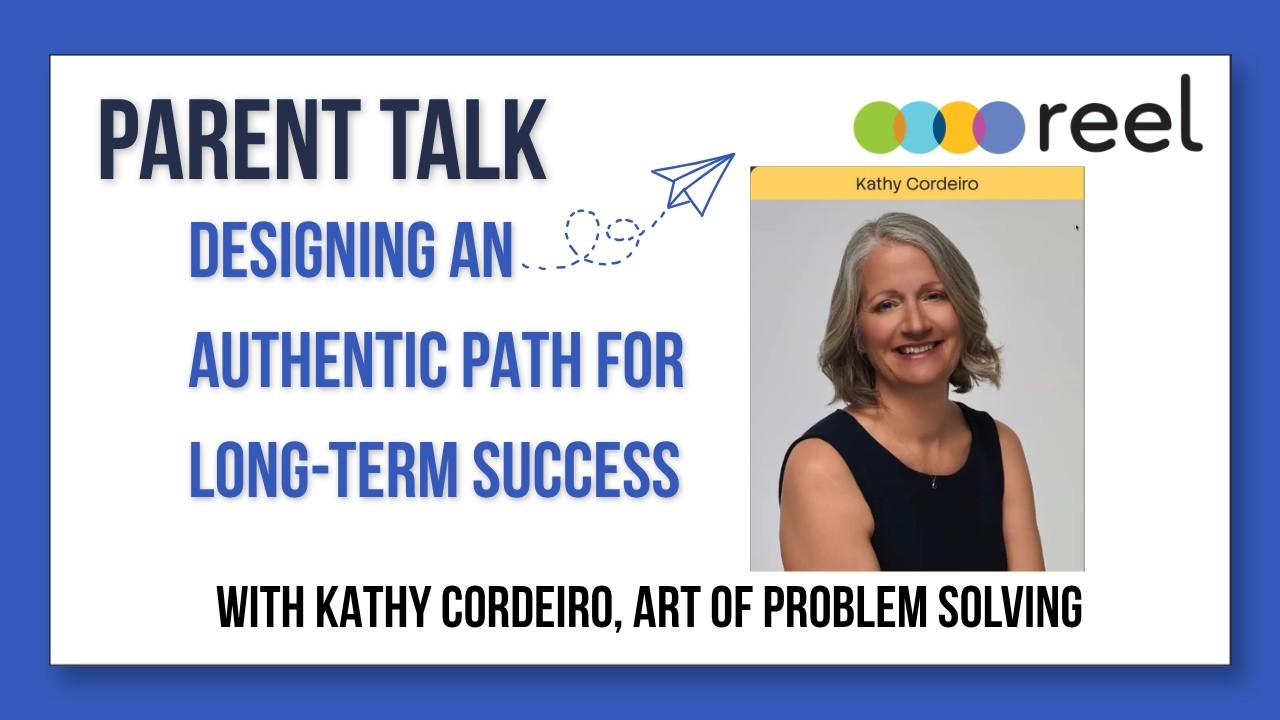
- Video: Parent Talk - Designing an Authentic Path to Long-term Success
At our recent event, Kathy Cordeiro from Art of Problem Solving joined REEL to share a practical framework for helping twice-exceptional and neurodivergent learners find a path that truly fits how they think. From identifying your student's unique learning style to reframing challenges as strengths, this session offers real tools for parents and educators supporting 2e kids, including how to think about problem-solving in the age of AI. Ai Assisted Summary: Parent Talk - Designing an Authentic Path to Long-term Success At our recent event, Kathy Cordeiro from Art of Problem Solving joined REEL to share a practical framework for supporting twice-exceptional and neurodivergent learners. Rather than treating these students as puzzles to fix, Kathy encouraged parents and educators to start by understanding how a student actually processes information, whether they're reflective or a mover, visual spatial or auditory sequential, novelty seeking, or sensory sensitive, and to build from there. A few key takeaways from the session: See your student as a collection of strengths to nurture, not gaps to close. Internal motivation (autonomy, mastery, and purpose) drives lasting engagement far more than external pressure. Struggle plays a real role in building a capable brain, even in an AI world. AI can amplify a child's thinking, but it can't replace the reasoning capacity that comes from doing the hard work. Progress matters more than perfection. Fluency comes through practice, not flawless execution. Kathy also walked through how Art of Problem Solving's various program formats (in-person, online, and self-paced) can support different learners depending on age, subject, and learning style. Watch the full recording above for the complete session. Read the transcript Chapter 1: Welcome and Introduction (0:00) Kathy Cordeiro (0:00): Wonderful. I'm so thrilled to be here with you all this evening. As Teresa mentioned, my name is Kathy Cordeiro. I'm from Art of Problem Solving. I had the pleasure of presenting with Teresa at the Gifted Homeschoolers Forum, and I'm passionate about helping parents on their path. So, who am I? I joined Art of Problem Solving in 2020, but I was actually an early adopter of the curriculum back in the early 2000s. I have two profoundly gifted sons, and, you know, every parent raising kids like this, I saw the message about kind of drowning there. We went into homeschool kind of kicking and screaming, because public school was really transitional for me and it was such a bad fit for my sons. So I had to really learn a lot as I went through that process, and I started coaching math counts teams. I don't know how many of you are part of a math circle. They're usually free, and I love them. I facilitated the math circle at UT Dallas for over 15 years. I ran math competitions, so anyone who has questions about the whole contest track, let me know. But I love helping parents on their path. I've spent my whole career guiding generations of students. In fact, I worked at camps that trained kids to go all the way to the International Mathematics Olympiad, and I think I'm on my eighth wedding now of officiating for kids who were at the camps. Thank you, Laura, for the question about what is a math circle. Math circles are an Eastern European tradition. They're usually held at universities, where they match up kids with people who are really passionate about math, and it exposes them to curriculum that's just outside the standard, which works really well for kids on this twice-exceptional path, because they're exposed to math beyond just arithmetic, which is what they tend to get a lot of in the school system. A lot of times these kids are really kinesthetic, so you can just go to masscircle.org and see if there's one in your area. Thank you for that question. So my first point is: there is no program I trust that says "follow these steps and all will be well," some cookie-cutter formula for every student, because it just doesn't work that way. I learned that homeschooling my own kids. You have to figure out how your student processes information, what puts them into a state of flow, and through that observation you can really find out what kind of learner they are. My own kids' education story was not a straight line. We tried public school. That failed. We tried private school. We did a gifted school, which I thought would be great, and it was actually one of our worst experiences, because they knew "gifted" but they didn't change their approach for individual students and how those students process. As I mentioned, we homeschooled. We did online school. We hired different tutors and life coaches to help with executive function, found different mentors along the way, and were part of math circles, chess programs, music lessons, and summer camps. Once I figured out how my kids processed information, choosing among those different options became so much easier. Chapter 2: Know Your Learner — Processing Styles (5:07) Kathy Cordeiro (5:07): How does your student process information? These aren't either/ors — think of it more as a slider scale. Really figure out what your student is doing when they're trying to learn. If you ask them a question, are they reflective thinkers, meaning they can't really answer until they go up into their mind's eye to think about it? You're never going to get an answer right away. Or are they movers? My younger son was a mover. I ran a math club in an enrichment school out of my house for a number of years, and some kids could only explain things to me if they were running around me in a tight little circle. They process through movement. A lot of times, movers have a harder time with fine motor skills, and when they're in a school setting, they want them boxed in at a desk, writing. I had the privilege of listening to a woman who ran a school for twice-exceptional kids, and she had to train them on the "box" that was around them and what movement was acceptable within it. Luckily, at my school, the kids could just get up and run around and explain things to me while their bodies were in motion. I never had the mover kids relying on fine motor skills — I'd have them using their whole body on a whiteboard, on balance boards. My whole upstairs is covered in whiteboards so they could get their whole body into the process. Visual spatial versus auditory sequential was wonderful information from Dr. Linda Silverman at the Gifted Development Center in Colorado. Visual spatial learners think in three dimensions. A lot of the kids in my math club who had dyslexia were incredible visual spatial thinkers — you could give them a Lego kit, take away the instructions, and they could just build it, because that's just where it goes. So when I was teaching them math, instead of working with formulas and systems, I did visual proofs with them, because those are three-dimensional proofs. If you have a kid with dyslexia, just Google "visual proofs." If you're teaching the Pythagorean theorem, it's way better to show them the visualization. There's also a resource called the National Library of Virtual Manipulatives that's great for kids to get a visual understanding of the math they're using. But visual spatial kids operate in space, not in time — they hate timed tests. I couldn't even play tag as a kid because I can't stand somebody chasing me, let alone being chased by a clock. It might take them longer to learn something, but when they learn it, they really learn it for life, because they've put a pin in this map of truth — but three-dimensional space is a lot of space to get through. Auditory sequential learners are just what it sounds like — that step-by-step kid. If you're an auditory sequential learner, someone could give you a list of ten steps to get to somebody's house and you'll get there the first time and remember every step. My husband is visual spatial — we went to a house together, then had to go back ten years later, and he was able to get there. I asked, "How do you even know where it is?" He said, "Because that's where it is." My brain just doesn't work that way. In our math circle, we had kids who were novelty seeking — they're the ones who say, "Why are you making me learn this? I already know it." They want new material, and any kind of review is painful for them. I joke that the biggest four-letter word in homeschooling is "gaps," but a novelty seeker will actually backfill what they don't know because they want to keep moving forward. A needs-confidence kid is the opposite — they have to get three stars on everything, and they're the ones who'll have tears because they want to get everything right and perfect, tending toward perfectionism. My advice to those parents: celebrate every time they miss something or get it wrong. If you can break them of perfectionism while they're home, it'll carry them much farther in college and beyond, where trying to get everything right is almost impossible and takes a huge hit on mental health. In my math club, when kids couldn't solve a problem — not because they were missing something, but because they just needed another level of math maturity they hadn't reached yet — they'd beat themselves up trying to get it right. So I'd have them use the same technique physicist Richard Feynman used: he always had two or three unsolved problems in his head, and as he solved new problems, he'd apply those techniques back to the ones he couldn't solve. I'd have my kids keep a notebook for problems they couldn't solve — "yes, let's put that in the notebook, that's amazing" — and as their math maturity increased, they could go back and solve them. The confidence that comes from that is huge, especially for a needs-confidence kid. The woman I mentioned who ran the 2e school coined the terms sensory seeking and sensory avoiding — I like them much better than introvert and extrovert. Sensory seeking kids tend to be diagnosed with ADHD more often — they want every sense on fire, they love stimulation, and they do well in environments with a lot of action going on. Sensory avoiding kids — often because of an underlying issue (I have hearing issues, I hear everything and therefore hear nothing) — need quiet. My house is completely quiet; I can't handle additional sound. I'm absolutely sensory avoiding, even though I'll get accused of being an extrovert, but I spend about 95% of my week completely alone working from home, and that's my favorite place. Those kids want to cut out all the extra input so they can actually think clearly. Chapter 3: Defining an Authentic Path for Your Student (11:30) Kathy Cordeiro (11:30): So how do you define the path that's authentic to your student once you have an idea of their style? Again, these aren't either/or — they can be a reflective, visual spatial kid who's sensory avoiding, but in some instances, maybe they're more novelty seeking depending on the topic. You'll go through an observation period as a parent to really figure out what puts them into a state of flow and how they process information. I love a structure I found in a book — I believe it was Seventeen Equations That Changed the World — where the author separated each chapter using a Latin phrase: veni, vidi, vici — "I came, I saw, I conquered." So "I came" is what a person's early life and environment were like, "I saw" and "I conquered" are how those things came together. But lists of three are very linear thinking, so I added a fourth dimension for reflection: vixi, meaning "I lived" — because as parents, especially as our kids grow and develop, they change. So you go back to that observation period and figure out what they know, how they process information, and how that might have changed, so the student and the environment stay matched and the student can be their best version. That means instead of looking at our kids as a collection of weaknesses to be fixed, a collection of gaps, it's best to look at them as a collection of strengths to be nurtured — and then feed those strengths to help in areas where they need more fluency. It's such a subtle shift, looking at kids as a collection of strengths instead of gaps, but it decreases burnout and frustration, because it becomes less about the kid and more about the environment and the subjects they're learning. I love the portmanteau "coopetition" — cooperation plus competition — used by FIRST Lego League. Instead of comparing themselves to other kids around them, they realize everyone around them is helping them learn, because if your student is the smartest kid in the room, they're in the wrong room. They want people to challenge them. I already mentioned the notebook for unsolved problems as a way to help with math phobia especially — instead of a student thinking "I'm good or bad at math," it becomes about the process, not about them. I'm a huge fan of process over outcomes. Our school system has so much of a race to an end result — you have to have a 4.0, and kids put that pressure on themselves too. With twice-exceptional kids especially, you're already trying to figure out how to work with your student's strengths to help them navigate, because a lot of parents just want to follow a formula. The main thing is to try to create an environment where the student can think clearly. I get asked a lot about how to tap internal motivation. Research says motivation requires autonomy, mastery, and purpose — the ability to work on your own, to dive into a topic and reach a certain level of fluency, not an end result of "mastery," but that fluency, seeing it as part of a bigger fabric so you have purpose and curiosity. That means setting the right tone — not focusing on what score you got, but on getting a little bit better every day, and it's not about perfection. I'll share this slide deck at the end — I have a great article linked about the "full potential trap," because there's always that drive as a parent to want your kid to live up to their fullest potential. It sounds noble, but it's a bottomless pit, because there's no measure to being human. We want our kids to know we love them for who they are, and we'll help them be their best versions without worrying about perfection. Chapter 4: The AoPS Mission (16:32) Kathy Cordeiro (16:32): With all of this, I believe problem solving is the key. I love the AoPS mission, which is to discover, inspire, and train the great problem solvers of the next generation. Obviously we've laid our cards on the table — problem solving is the way to go — but it applies to all topics and all areas of life, especially in this world of AI we're entering. How do you train a student to deconstruct a problem to most effectively reach truth? It's not about just racing to answers. So you learn a student's style, then you find their development path. "Discover," in our mission, maps to the elementary school level. I don't know how many of you have heard of the trivium — a system developed 3,000 years ago by the ancient Greeks and Romans to answer the question: how do you prepare a mind to navigate an uncertain future? That question is still the same, regardless of AI or other technology breakthroughs. At elementary school age, kids are discovering how they think and how they process information. The trivium calls that the grammar phase — the foundation, the building blocks they need to get to the next level. Can AI do that grammar phase better? Absolutely — but if they don't have that foundation, they have nothing to build on. In neuroscience, the elementary school brain is at peak pattern absorption, which is why kids can learn languages so much more easily at that age, pulling in so much information from their environment. By middle school age, in our mission, that's when we're ready to inspire them, and in the trivium, that's when they develop reasoning and logic — it makes sense, because neurologically their reasoning networks are actively forming connections. Cross-discipline curriculum is so important at that age, to bridge between the nodes. So much of our education system puts subjects into individualized buckets — you learn algebra, you learn geometry — but what about geometric inequalities? Is that algebra or geometry? We need to help kids reason across disparate topics. By high school age, kids start to really take the reins of their own education, and you can start training them in earnest. In the trivium, that's the rhetoric phase, where they have the wisdom to express themselves clearly, pruning the complex networks they've built and synthesizing information. So how do you develop talent? This is a list that applies to any curriculum, not just ours: know your kid's learning style, know where they are on their developmental path, and find programs that promote critical thinking. We're in a world where answers are a commodity and the real currency is in questions. If you can help your kid ask good questions, that means they need to understand the "why" and the "how" behind what they're learning. Chapter 5: How the AoPS Approach Develops Talent (20:00) Kathy Cordeiro (20:00): I loved the AoPS curriculum when I started, because even just the textbooks are designed so the kid is constantly asking questions. Teresa mentioned starting with Beast Academy — the characters in our elementary school program, presented in a comic book format. It actually works well for kids with dyslexia, partly because of the kerning of the font, which helps with reading, and partly because of the comics themselves. The characters have dialogue about math, because at elementary school age kids may not know what questions to ask, so they see these characters modeling curiosity and questions about a cool problem. What do I mean by a problem-based curriculum? It means multiple steps to reach a solution, as opposed to exercises that are just one step with no creativity. A lot of our program uses puzzles to teach math concepts, which appeals to visual spatial kids and allows for more creativity than "follow these steps and all will be well." We want kids to have that productive struggle, which helps them in every topic. Our CEO once spoke at our math circle about the "tyranny of 100%" — such a horrible metric. At Art of Problem Solving, at every level, even on placement tests, if your student gets 65–70%, they get a green bar — they're doing well. In school, that's a D. But we don't care about the grade; we care that a green bar means you're solid on those topics, and an orange bar means you need more practice there. So instead of "you're good or bad at math," it's "here are your areas of strength, and here's where we can build more fluency." We want kids to not just run an algorithm. So many programs say "when you see this kind of problem, do this" — in language arts, that's the five-paragraph essay. There's zero magic in five paragraphs; it doesn't require literary analysis or understanding your audience, it's just a formula that doesn't really matter. We want kids to apply the strategies they've learned to solve problems they've never seen before. Even in our language arts curriculum, we take a problem-solving approach starting with philosophy, because you can't write if you can't think, and we want that strong foundation. Process over grades, again. Grades are great — who doesn't want to be told they're doing well? But they can be a real demotivator. We want to focus on effort and enjoying a cool problem, so kids can flourish even when executive function may lag, because a lot of these kids are brilliant but don't turn in their homework. I had to let that go completely with my younger son — he struggled with grades when he went back into the school system, even though he loved learning and was doing the mental effort, it just wasn't translating to grades. When his executive function caught up — his senior year of high school, after life coaches and all sorts of support — he went on to graduate summa cum laude in college. I never would have predicted that based on his middle and high school performance. It was really gratifying to see. Chapter 6: Thinking in an AI World (24:23) Kathy Cordeiro (24:23): I bring up AI because it's everywhere now. Neurologically, struggle builds the physical structure of a more capable brain, and we need to make sure our students are doing that. Going back in time — the first time we went into cognitive surrender as a society was with the invention of GPS. I literally don't know where I exist in space anymore; I have no idea how to get anywhere without it. But it's a very human thing to know where you are in the world and how to navigate it. When researchers looked at the brains of London cab drivers — before Uber, when GPS first came out — they had more cortical folds, and when tracked over time, cases of Alzheimer's were almost non-existent among them, because they had to memorize "The Knowledge" — every street and side street in London — without GPS. The more we give in to cognitive surrender, the less capable our brains become. So kids will say, "If AI can do math better, why do I do math? If it can write my essay better, why should I write it?" Because AI amplifies your intent. A child who wants to build reasoning capacity and uses AI to learn will find AI becomes a multiplier. But a child using it to give in to cognitive surrender, as a substitute, will pay a cost for that substitution. [Responding to a chat comment about productive struggle and kids who shut down and only want to play games:] The games on Beast Academy are incredibly learning-rich — those puzzles are pattern recognition and spatial reasoning. They were developed by a puzzle constructor who won a world puzzle championship. It's a certain way of thinking to solve those, and honestly I'd argue those puzzles are more applicable to the problems kids need to solve in tomorrow's world than just following a formula, because it's pattern recognition — seeing things that aren't there. If it were just a frivolous game, I'd agree that's a problem, but I teach a lot through gaming myself, and I love games. [Responding to a question about anxiety and perfectionism:] That's a real challenge, and it's why I like celebrating every time a kid gets something wrong. With math contests, we'd do a diagnostic afterward to see what problems kids got right and why — was it the algebra, the topic, the way it was written? And for problems they got wrong — did they misread it (which is huge for these kids — "I know what it's saying" when they actually don't, because they didn't underline key words and rushed too fast)? Are they missing foundational knowledge? Did they run out of time, because visual spatial kids will over-obsess on one problem and never get to the others? Another exercise I'd use with anxious kids: write out four columns on paper — what do you know about this thing, what don't you know, what can you control, what can't you control? This gives a kid agency in their own life. For something like the SAT: you know you can study, you have resources and books. You don't know that you'll do badly, or that it will ruin your life if you don't do well — you don't actually know that. You can control how much sleep you get, eating well, exercise. You can't control being sick that day. What's interesting is the "know" and "can control" columns end up much longer — that's their agency. The "don't know" and "can't control" columns are the catastrophizing list, and it's usually shorter. It's a phenomenal exercise to help kids see what they can actually do. We want kids to understand how to view problems and curriculum — to look at what's missing, to observe, rather than just optimizing what already exists, because all AI is a statistical summary of the past. Twice-exceptional kids think differently — they're outliers in the data. They may come up with an idea, put it into AI, and AI will say "that's not a great idea, I've never heard of it" — not because it's a bad idea, but because they think differently. We have to help them understand how AI is built so they trust their own thinking. Chapter 7: Program Formats and Modalities (31:33) Kathy Cordeiro (31:33): This is a quick chart of Art of Problem Solving's program offerings. The main point: when you're looking for an environment for your student, find the modality that matches how they learn. Sensory avoiding kids may like an online, no-video program, so they can cut out extraneous noise. Sensory seeking kids may want more in-person instruction or video. Kids who are "burst learners" — way ahead in class, then slower — do well with self-paced courses. Don't be put off by the 30–60 class size number for online, no-video classes — for every 20 kids, we add more instructional staff, so it's still very back-and-forth. We're not raising racehorses. If you've got a kid blowing through math because it's a strength, I really recommend depth and breadth. The US system has this race to calculus, and that's all most high schools offer — so a math-accelerated kid can run out of math with nowhere else to go. That's part of why I like contest classes: contest problems cover four areas — algebra, geometry, number theory, and counting and probability. These are discrete math topics — the math of modern computing, and the world these kids are going into — so contests are a very efficient way to cover that ground. If you've got a visual spatial learner who hates being timed, they won't like most math contests, since almost all are timed. There are exceptions — the Consortium for Mathematics and Its Applications runs middle school and high school math modeling competitions done with a team over a period of days, not under a strict clock. So there are other options, but knowing those discrete math topics matters for the world these kids are heading into. Chapter 8: Closing Thoughts and Q&A (34:22) Kathy Cordeiro (34:22): Finally, embrace what makes us human. Find curriculum where students can connect information, be creative, innovate, and pivot and adapt. We're not raising racehorses — don't just race toward calculus, but take time to explore depth and breadth in the topics they enjoy. I love the idea from Designing Your Life (there's also Designing Your Work Life) — a design approach looks at the strengths of a system and builds on those, as opposed to an engineering approach, which is "here's a laptop hinge, how do we make it open and close 10,000 times without breaking." We don't want to engineer our kids or break them. We want humans who have the ability to wonder why and maintain their curiosity. I appreciate your time. I'll find the link for the math modeling contest and drop it in the chat. Please stay in touch — this is a passion of mine. I'll put my personal email in the chat as well; I'm more than happy to talk with parents about their particular students. Thank you all so much. [Host]: That's fantastic, thank you, Kathy. There's a lot there — I might have some questions myself, but let's open it up if anyone else has questions. End of recorded session. Q&A continued beyond this point.
- A Parent's Guide to IEPs for Twice-Exceptional Students: California - Bay Area Edition
REEL is excited to announce the publication of of A Parent's Guide to IEPs for Twice-Exceptional Students: California - Bay Area Edition The guide was written by Amber Willburn and provides invaluable insights into navigating the IEP process with your 2e student. Click here to get your copy! Disponible en Español: Guía para padres sobre los IEP de Alumnos Doblemente Excepcionales California - Edición del Área de la Bahía Haga clic aquí para obtener su copia!
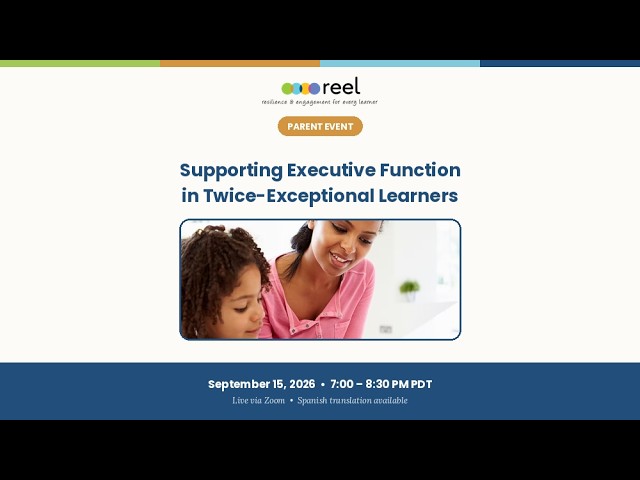
- Video: Supporting Executive Function in Twice-Exceptional Learners
REEL hosted a panel with three executive function experts, Mason Tudor, Maxwell Greenberg, and Presh, covering practical, real-world strategies for supporting 2e kids with executive function challenges, big emotions, and building independence. AI assisted summary: Executive function isn't one thing Mason opened by grounding the conversation in the basics: executive function challenges show up differently for every 2e learner, and they aren't a character flaw or a motivation problem. He walked through practical, physical strategies for building routines, including one parents loved: having a student write their own morning routine in dry-erase marker directly on the bathroom mirror, checking off each step as they went. Defining "done" Maxwell picked up on a theme that came up again and again in the chat: perfectionism and time blindness. For a lot of 2e kids, "done" is a moving target, and estimating how long something will actually take is genuinely hard. His advice: make time visible, define what "done" looks like before starting a task, and treat time estimates as something to calibrate over time rather than get right on the first try. Big emotions, real scripts Presh closed out the presentations with a framework for navigating big emotions: fight, flight, and freeze. She shared concrete scripts parents can use in the moment (and just as importantly, what to say afterward, once everyone's calm) to help kids feel understood rather than judged. What parents asked about most Popular Questions from the Chat Here's a roll-up of the questions parents asked most, with answers pulled straight from our speakers' responses. Q: Can you share a specific example of a "physical reminder" for routines like brushing teeth or washing your face? Mason shared a real example: he had a student write their entire morning routine in dry-erase marker on the bathroom mirror, erasing each step as they completed it. The novelty made it fun (and felt a little rebellious), which built buy-in. The bigger idea: create a simple, visible to-do list in each "station" of the routine (bathroom, breakfast table, backpack area) so the reminder lives where the task happens. Q: How do we build awareness so kids notice (and clean up) the mess they leave after a project? Mason reframed this as an initiation issue rather than an awareness issue: kids often know the mess is there, they just don't feel it's their job to fix it. His approach: tie access to future project supplies to cleanup ("help me get this cleaned up together, or I can't set you up for the next one"). Presh added a "make it fun" angle: clean up together to a favorite song, then hand off the task once they're ready. Maxwell noted that age and differing "tolerance for mess" both matter a lot here. Q: How do we let younger kids choose what works for them when they don't have the experience to know their options? Maxwell suggested giving a limited, curated set of choices (for example, "Google Calendar, a whiteboard, or a paper planner, pick one") so kids get real agency without being overwhelmed. Mason shared a memorable example: his own kids thought there were only three ice cream flavors until they were old enough to order for themselves. As kids show more independence, you can expand the menu of choices. Q: What do you do with a perfectionist who blows past the time you've set aside for an assignment? Cut them off, or let them finish? Maxwell's first move is figuring out why it's taking longer: is the extra time productive work, or are they stuck? If they're genuinely working, he'd let them finish and recalibrate future time estimates rather than force a stop. Presh recommended agreeing on a hard stop as a family in advance (e.g., "by midnight, we're done, because tomorrow gets hard otherwise") and having the deeper conversation about pacing when your child is calm, not in the moment. Mason noted that reduced-workload accommodations through an IEP or 504 plan are also worth exploring if this is a recurring pattern. Q: What if my child won't cooperate with mom and dad on things like hygiene or homework, and what does a typical EF coaching session even look like? Presh's take: resistance to parents is often normal developmentally, and hearing the same message from someone outside the family (a coach, mentor, or tutor) tends to land better. A good session starts by letting the student explain the problem in their own words, not the parent's version of it, before co-creating a plan. Mason summed up the bigger picture well: there's no such thing as a "typical" EF session with 2e learners. Every student needs something different, and progress often looks like quiet, steady change rather than a dramatic before-and-after. Read the Transcript [0:16] Yael Valek Welcome, everybody! So nice to see you, thanks for joining us tonight. We're just gonna give everybody a minute to get in. Should we give them one more minute, Hadas? Thank you all for joining. People are still continuing to join, so I'll give it one more second, and then we'll get started. [1:10] Teresa Nair It's great to see such a big group tonight. Eve. [1:18] Yael Valek This event may have… may be our record for most signups, so we're very excited. Okay, I will get started since we have a lot of, I know, eager learners here tonight, and I want to make sure that everyone is aware that there's Spanish interpretation available. On this channel. And Hadas, you'll put that in the chat as well, at times, yeah. Thank you. So, in case you're not familiar with REEL, we are a non-profit. And we ensure Twice-Exceptional students thrive in school by doing events like this with parents, and raising educator awareness as well to understand practical research-based strategies to address the needs of Twice-Exceptional Learners successfully. And just so we, you are probably familiar with this, but just so we all get on the same page, we use the Bridges definition of 2E, Twice-Exceptional. It's students who have both distinguishing strengths, high ability, and potential in one or more areas. combined with complex challenges, such as dyslexia, ADHD, autism, anxiety, and others, and they combine to make a… the blue and the yellow combine to make a green child, and both the challenges and the strengths have to be addressed simultaneously in this child, not just one or the other, which makes them more challenging to support in a classroom environment. As you know. And just so you know a little bit about REEL, if you're new to us, we have a lot of free services, such as this speaker series, and I will show you the other events we have coming up this fall. We also offer… oh, I didn't update this, it is now a monthly parent support group. We have a private Google group with over 1,000 members that you can ask and answer questions, finding local resources. We have parent toolkits for different times in your life, how to talk to your teachers at school. A lot of online resources, including guides for IEPs. A list of student guidance, all kinds of school lists. And then, two things that we offer for a small fee are our small facilitated paid groups and one-on-one consultations. In addition, we offer educator services. We do custom professional development for schools, offer online resources, recorded talks, and we have an educator newsletter. So please reach out if you'd like us to come to your school. This year, REEL's kicking off a year-long awareness campaign called See the Whole Child, because the way that we see children shapes the way they see themselves, and we hope that, to help people look beyond challenges and focus on their strengths, so we can unlock children's full potential. So, some of the events supporting this theme, this weekend, we will be at the Stanford Neurodiversity Summit, which is accessible online and in person. And, in September 24th, coming right up, we have a private school and educational options panel, where you can learn about different options for schooling for your TUI learner. On October 15th, we're having, a Stealth Dyslexia talk, which is a really interesting topic if your child's having trouble learning and reading and you're not sure why, even if they read at grade level. And then we are going to do our, Intro to 2E, What is a 2E Learner, if you'd like to learn more about that on October 19th. REEL will be speaking at the AI and Education Summit on October 24th, and then we'll round out our, semester with, Beyond Social Skills, How to Help Neurodivergent Kids Build Authentic Friendships. We know that's a topic you guys have requested a lot. We also have, more, two more parent support groups, available, this semester, so please join at reel2e.org. I know Hadas is putting a bunch of links in the chat, trying to keep up with me. And again, you will have, you can follow REEL on Facebook, Instagram, LinkedIn, and see all of our old events on YouTube. And now I'm going to introduce our speakers, with no further ado. So Mason Tudor is an executive function coach, mentor, and experienced educator who specializes in supporting neurodivergent and twice-exceptional students. Precious, or Presh Listana, M-E-D, is the founder of Executive Function Tutors and Executive Function Coach who partners with neurodivergent, Twice-Exceptional students and their families. She works closely with parents to co-create personalized systems, tools, and routines with students, empowering them to become independent and confident in reaching their goals. And Maxwell J. Greenberg is a historian of American education and an independent academic and executive function coach specializing in Twice-Exceptional 2E high school and college learners. So, welcome to the three of you, we're so excited to have your expertise here tonight, and I will kick it off to Mason. [6:10] Mason Tudor Thank you very much. I appreciate that. So… I wanted to talk… before I get started into my practical section, I wanted to talk a little bit about the foundation that I have to understand to begin doing what it is that I do. So, I think this will be helpful to you all as well, as you're trying to understand your own 2D Learners. So A bit of… a bit of an introduction. So, executive functioning and the 2E learner is a complex intersection, right? So, where these two meet, we find that some of the unique pieces of being twice exceptional really come out in this Experience. And when these come out in daily life, academic life, professional, social life, all of the different places where they come out. And some of the concepts that I kind of wrap my head around are listed in the slide. But I wanted to make sure that, like, I'm properly grounding and situating these. So, the first is that when we're talking about executive function and executive dysfunction, The surplus and deficit part of the TUI Learner becomes really prevalent, and we have to respect that as we move into teaching, learning, working with, supporting, accommodating, and that is that we have that exceptionality, but we also have that challenge. If we lose sight of that, and we focus only on the challenge, or only on the exceptionality while we're trying to teach that executive functioning skill and skill set, and help them develop those associated abilities. then it's… we're gonna lose the 2E learner, and this is a really frequent occurrence. The other concept, and I see this come up quite often, often we recognize giftedness in children before we recognize challenge. This isn't always the case, but when this is the case, it has lifelong ramifications for the TUI learner. So that is, start doing all of this amazing stuff, and, you know, you're living your best life, and you're the smartest little boy or little girl ever, and you get compliments, and… Adults gush over you, and you get used to it, and then something happens, and the first challenge comes up, and it is a devastating shift from you can take over the world to, oh, now there's… now there's all these challenges that you have. Okay, well, let's… let's fix you, and let's fix your problems, and that takes a turn that is detrimental, right? So, I think that's one of the patterns that I see pretty frequently. And the last one is uncertainty in the common. And this is probably hard for some people to understand, where Most people are… really comfortable with common things, and making predictions about common things, and learning common things, and being in that world where all of these really common and shared skill sets are just part of daily life. However. with a… I've heard parents say, easy's hard, hard's easy, and that is talking about that exceptionality and how it's expressed in skill sets, right? And so. This leads to a learner who looks at something that is common, that is easy for everyone else in their mind. And defines it as hard, and so there's avoidance, there's resistance, and this, this keeps being a recurring thing of, like, well, I don't want to do those things that are difficult for me. And that… becomes even part of the sort of culture around them is that everyone else is doing this, I can't do it, I don't want to do it, I'm not going to learn it, it's not… it's not going to make any difference, I'm broken. Kind of those kinds of ideas come out of this. Again, these are very personal, and they are very, contextual, but I think they happen often enough that they're worth saying, hey, let's put some basis on this executive function stuff, because oftentimes it comes up with fairly normal things that are coming out of these conversations. And just because it's normal doesn't mean that. We can just treat it like that sort of easy skill that everybody can master in no time, right? So… Executive functioning. is a confusing field. I think when you're getting into it, you do all of this research, and you write pages and pages, and get these informational packets, and you want to find the experts, and you want to just really dive into it, and we end up building a list that just keeps growing. And every time it keeps growing, you find something new to fix, right? I've even known sometimes, going through some of the things that are related to executive functioning, parents will begin self-diagnosing and being like, oh, I have, I have executive functioning problems. Sort of, but not really, right? That's not really how it works. I mean, at the end of the day, though, I really like a simple model that we can build from with some confidence, without having to sort of explode the view. Certainly could explode the view, but I think it's better to kind of think about it in simpler terms. So the, the Harvard… I've got to look at my slide, and it's over there. The Harvard Center for the Developing Child has to find executive functioning based on the parts of the brain that it activates, which is working memory, self-control or inhibition, mental flexibility, also cognitive flexibility. So this simplifies what we're talking about when we talk about an actual biological anatomical feature of these are the parts of the brain that are activating. So, when we have a deficiency, it is, the deficiency is with brain development in those areas, right? So, this isn't, again, something wrong with a person's personality or anything, and two, it can develop. It's a physical feature that can develop, right? So this helps us kind of root all of that sort of optimism in a little bit of neuroscience, right? So, the second part of It's Confusing is that there are some… overlapping words that come into play when we're talking about, I want to change the executive functioning skills of my 2E Learners so that they are more autonomous, or they have more autonomy, they have more independence, right? And that is, we're kind of overlapping or interchanging words like skill, strategy, and ability, right? So, as we're thinking about this, I want you to keep in your mind that some of these are different, right? Even though they can overlap, right? So we have skills, and these are things that you should be able to demonstrate in a physical world. You should be able to demonstrate that you have the skill to do something, right? To a certain degree, right? strategy is usually a teaching device, sometimes it's a… I don't want to call it a crutch, but sometimes it is a mechanism we use to get through tasks, right? Because they're complicated, because we're worried about our own memory failing, or things like that, right? So sometimes they can be a useful tool, but in general, when we're talking about developing EF, we're talking about a teaching device, right? And so the system then is presented to help develop. the… skills of the learner, right? And so, oftentimes, this is, like, put into a system, or it's incorporated into a routine, so that these pieces can… it's not autopilot, but these pieces can get easier and develop a sustainability, right? Then we look at the ability, and this is where we start talking about accommodation. versus scaffold to independence, right? So ability, it can grow, but once you get to, sort of, the ability ceiling, it's going to be diminishing returns. So there's going to be a lot of effort, not much movement when you get to the ability ceiling, right? So once we get there, we're really waiting for the brain to grow, to catch up a bit, and then that goes on, or we're waiting for that sort of flag that this is what we can develop, and now we need to look into accommodations past this point. Right? So, hopefully, that kind of demystifies some of executive functioning. before I really jump into my practical example. So, I want to focus on 3 pieces, and no, these are not executive functioning terms, by and large. This is more about helping embed, sort of, instructional pieces into daily, practical EF application, right? So I want to focus on outcome and result, I want to focus on teaching and scaffolding, and lastly, I want to talk about preparation and revisioning. And this is kind of a specific metacognitive, approach, so I do want to make sure I highlight that, executive functioning, word. So… So there's two routines that come up almost every time I've worked with a student who's 2E and struggling with executive functioning. One is the homework routine. I believe Max and or Precious will be talking more about that at length, and so I'm gonna… I'm gonna keep my… my grubby hands off of that, but the morning routine happens to be one of the ones that I think is really important. It sets the tone for the day, it sets the tone for family tension, and this is a really big deal, and can lead to… it can lead you to a lot of other things that are going on as well. Particularly the things that are happening in day-to-day life that are kind of absent school pressure, even though part of the morning stress is from school, but these are the These are the daily living in the home instead of, you know, the pressures that may be coming from being at the school location or being pulled into school activities, right? So, in the first phase of this piece, we would be looking at doing a sort of planning piece, right? So, when you're looking at your morning routine, you want to sort of break it down into the phases that it is, and you want to try to… and I'm saying you, and I mean you as a team, because if you do not include the 2B learner on this design process, you will probably have zero buy-in. If you just make all the decisions for them. I think you can hire any of the three of us, and we'll pick up where you failed, because without that mutual, collaborative approach. It's almost doomed from the start, because even if they comply, there will be at some point where they do not understand and cannot figure it out, and at this point in the process, it's all your system, so when it doesn't work, it'll be all your fault, and that's a really easy way to make you the scapegoat. So you want to make this a collaborative learning, environment, where we're we're working on the morning routine together, right? Once you have that agreement, now you can work through it and help understand, and you can understand them, and there's a whole lot of learning going on once that arrangement has been made. So we're gonna… like, what are we gonna do once we have that agreement, right? You're gonna tackle known issues, right? So it could be waking up, you might need practical strategies for waking up, like, for instance. Do they need something to physically move them? So, are you shaking them awake, right? We might try to figure out something later on to replace you, like a vibrating, they have those little… it's like a watch. but it vibrates on your wrist. Maybe they need some tactile sensation to wake up. Maybe they need lights or noise, or maybe an automatic blind opener for the windows, right? There's all kinds of different strategies you can integrate. Once you've identified that waking up is an issue. Now we can deal with that, and we can look through How can we teach that to be a more independent task, right? the… oh, that's not even the one I want to talk about! I forgot about my example. I love this example because it's the first thing I try. It doesn't always work, but it's the first thing I try, and I usually get my students to have a little bit of fun with it. So you create a physical reminder of what has to be done in each location, so each location becomes this sort of station, right? So what do you need to do in the bathroom? Things like brush your teeth, put on deodorant, maybe wash your face, right? If I can get people to do that before they step out of the door, it's usually a win, right? So you would have one, you know, in the area where they're eating breakfast. You might have one where they're packing their backpack. It's a really good thing, like, if you're doing… they're packing their own lunch, say, or even if you're packing their own lunch, you know, you're making it, and then they… they start taking over certain tasks, right? They put their drink in the lunch… lunch container, right? And you can build off of that, but if you have that sort of physical list of what happens in each location, we're not losing it, we're not figuring out you know, what I'm supposed to do over here, we're not… depending on our own working memory, all that sort of stuff, right? And I've created some pretty obnoxious ones so that we'll notice them, too. So, sometimes it pays to be obnoxious and in your face, as a hint there. So, as we're implementing strategies, we want to look at scaffolding, and that is being able to take a step back, right? So, once I start this sort of strategy, it's probably going to be with the adult or the parent doing a lot more, right? But we're looking for those steps to remove as the child is capable of more. Sometimes that's a maturity thing, sometimes that's a learning the routine thing, but as we're looking at Pulling back up. pulling back as the parent, and here's where I put the wake-up strategies. Got it all out of order. But we're looking at pulling back so that the child can do more and more as we progress. Sometimes you will pull things back, and it is something that is beyond their capacity, beyond their, capability. make sure you have a conversation about that and see, like… and try to get them to be honest with you. Maybe they were just being lazy, right? I do that, you do that, we all get lazy from some… sometimes, and no need to make a big deal out of it. Okay, do you want to try it again tomorrow, right? Like, and if the answer is no, then maybe we should put a pan in that, come back to it later, now look for somewhere else you can take a step back, right? It's about progress, right? So, the last one… is… and I sort of previewed that with the conversation that I just modeled. But when you do this, you're constantly addressing things that they are struggling in. You're constantly looking for those places of challenge. And you're constantly looking for opportunities for growth, right? For them to step in and do the thing. So we're monitoring, and I'm gonna call them blind spots. We're monitoring for those blind spots, right? We don't want to get hit with blind spot after blind spot after blind spot. While we want to develop some resiliency, we don't want to keep being bombarded with a bunch of unexpected things. So we're going to develop strategies until we get, say, 95% of the blind spots kind of out of the way. We can't account for all of them, just life is surprising sometimes. But we want to get those processed as much as possible, and we want to have a plan, some strategies, and be building skills around those Those things that are challenging. So, and I'm gonna say, find one thing to improve at a time. Many of the parents I've seen get involved with 2E individuals, they are at a level that the child is not capable of. There's a mismatch, and even if the two individuals wasn't struggling with executive functioning, there would still be a struggle because they're… they're immature They're a child, they don't have experience, and so the level of that parent with high scheduling capacity and high networking capacity and high… all of those high skills that the parent has, right? those are mismatched to the child, not only because of TUI, but because it's parent and child, right? So, the child will never take a step into that role and do it at that level. That's not going to happen. So. Monitoring that appropriate expectation for the one thing you're gonna improve. We need to make sure that the bar is where it should be. We don't want the Tubi Learner to trip over it, but we also don't want them to feel like they have to do it exactly like the parent, right? Because oftentimes that's a… that's an unrealistic expectation, right? I've even heard parents say, no, I've lowered my expectations so low, and then they will list out their expectations, and I'm like. blow for who? Like, that's… that's not it, right? So, a lot of times, we get lost in our own sort of plan and all that sort of stuff, and we… we set those expectations a little… little too high. We want to be incremental. We want to find that first step. We're going to be incremental, and we want to celebrate every single inch forward, right? So instead of, say your goal is to be 10 minutes earlier getting everything ready so that Maybe they want to do something in the morning, maybe they want to draw for 10 minutes, or something like that, right? Don't do 10 minutes all at once. Do 3 minutes first. See how that goal goes. Then maybe do 5 minutes, then maybe do 6, and then 7, and then 8, and then 9, and then 10, right? Being incremental is allowing that Sort of to settle in and develop those skills as you move along. But this is the part where conversations become really important, because Them developing awareness in this case, them developing planning strategies, them developing improvement strategies is the point, not the morning routine. Right? Okay. I think I gave some practical things there. I will turn this over to Max, sir. [25:27] Maxwell Greenberg Thank you, Mason. I think that was fantastic. It was really helpful to get a primer for everybody on what exactly we're trying to talk about here. I agree that I think executive function can be quite tricky and challenging, and I think it can come to encompass so many things that parents are hoping to try and address for students that are struggling in school in various ways. So, After I speak, Presh is gonna have a fantastic presentation dealing with, emotional regulation and emotional dysregulation. And Mason was giving us an example of something, at an… as an at-home routine. I tend to work with students who are slightly older, typically high school and college, and so my presentation is going to focus on Practices that deal specifically with school tasks in particular. And the goal, I think a lot of Parents worry sometimes that how do we balance, sort of, natural consequences with scaffolding and with support? And the goal here is to try and work towards independence, but that that is actually built on layers of support first. So… The first thing I want to sort of talk about is what causes what looks like inconsistency? IM. 2E students, you know, and so, I… I start this presentation with the… baseline of understanding the assignment, right? So, if they don't understand it. we're talking about something different. That's another kind of intervention that might be required to help that student. But if you know that they understand it, if you know that they are capable of doing it, if you have seen them do it before, and they're not doing it this time. well then, what gets in the way between this understanding and beginning the assignment or finishing the assignment? And so there are these sort of eight gaps that I've identified, that can be hurdles for students. To get tasks. finished. So one is sequencing. So, what is the order of operations in which I do a particular task? So, sequencing within a task, what is the first step? but also prioritization, sequencing of tasks. Okay, I have multiple assignments that need to get done. How do I sort of figure out which one to start first? The second is… time estimation, and this can work both ways. They think something is going to take much longer than it actually is going to take, and so that leads to avoidance, or they think something is going to take much less time than it is actually going to take them, and then that leads to procrastination, because they think it will be simpler Than it turns out to actually be. Third is task initiation. That relates to sequencing. Okay, I know what I need to do. How do I actually get started? I think there are environmental factors related to that as well, which I don't necessarily touch on in this. presentation, but being in a place where you can be productive is quite important. Or it's resuming. Initiating the task is not super challenging, but if they have to walk away, if they can't finish it in a single setting, coming back to it is challenging. or task transition. So, I finish this one thing, now I need to start this other thing. How do I move between them? The fourth, or the fifth, sorry, this is one I see especially often in 2E Learners, would be, how do I narrow down the unlimited range of things that I can do in a particular assignment. This is especially true on writing tasks, or sort of open-ended projects where they have that creative license, but it's almost so broad, and they have so many deep interests, that it's really hard to even narrow down, okay, what am I even going to do for this assignment? Sixth is… stopping. And this is particularly for students who have a kind of perfectionism. What does done look like on this assignment? For them, it almost feels like it's never done. And that can make getting started hard, and obviously that can make actually turning something in hard. There could be a sort of shame around the quality of it, that it doesn't reflect what they're really capable of. Those things can be really challenging. And then these last two are… A little bit different, so… The seventh is valuing, and this, to me, isn't really an executive function challenge, but I think it is important, is that does this task make sense to the student in terms of why they're being asked to do it? And so, I wrote a blog for REEL a few months ago about, sort of, the historical origins of schools, and Schools really ask us to do these incredibly arbitrary tasks. And, like, most of them don't really make sense, and most of them don't really have real-world application, and this sort of emerges out of historical context about obedience, whatever. But I think that's really important. If, like, if the assignment doesn't make sense to you. why would you do it? I sort of dealt with this as a student myself, in a 10th grade geometry class, I was acing every test, and so I thought, well, why do I have to do the homework? If the homework is meant to be additional help, but I'm acing every test, then why would I have to do this thing that I'm wasting my time doing? And no one can really ever… no one was ever really willing to explain it to me. And so I ended up doing quite poorly in that class because I wasn't doing this thing that was required of me, but had no real explanation, and I didn't value it. And lastly would be asking, and this is about, sort of, self-advocacy. The gap would be you're not willing to articulate what some of the gaps that you're experiencing are, not willing to ask for help, or not able to ask for help. And so, I think I won't spend too much time on this, because it reiterates a lot of what Mason shared, but… I think for many of us as adults, we tend to make these assessments now. Maybe it took us some time to get there, but without taking up much bandwidth. Like, we don't have to think about them nearly as much. As students have to, and with the kind of regularity of deadlines, that students have to in school. And so, because school is so abstract. These things can look like, I think, what often gets articulated as a kind of lack of motivation. But what I want to try and dispel is that, like, that's not really what this is, and a lack of motivation, I think, is often just a way that we obscure actual underlying executive function challenges. So I wanna, walk through 6 different sort of approaches, principles, etc. for executive function with your students. And again, I won't spend too much time on this slide because Mason already primed us on this, but I'll articulate it a little differently. Mason talked about collaborating, Presh is gonna talk about co-planning, the historian in me thinks about structure versus agency. So, to what extent are sort of, like, the structural factors getting in the way of student success, and to what extent do they need agency in that process, or to what extent is their own agency a hurdle that they need to overcome? And so often I hear parents say, like, oh, we have the color-coded folders, we have the 24 by 24 calendar. Like, we tried all that, nothing's working. And my first question always is, like, well, okay, whose eye… whose idea was that? And I think… Mason… said it well, a little bit of the magic of the work that we do in particular is that we're just not mom and dad, and there really is a lot of… a lot of power in that. But there also is a lot of power in student agency. And so, what does that look like? That looks like Giving options, so we have systems that work for us, but we need to sort of maybe be willing to expand the range of possibilities for our students. And allowing them to choose, to try. and to reflect. And that relates to what Mason was talking about with building that metacognition. Okay, this… this paper planner worked really well for you. Why? What about it worked well? And then moving from there. Getting to sort of name, what challenges it resolved for them, or it didn't work, and things are still missing. Okay, what went wrong? What's getting in the way? And trying to reflect and revise our practices. So we need to build their system, not ours. I have my preferred way of doing things. That's not gonna work for every student. Next is a launch pad. This is, like, just the simplest thing that I can possibly think of. But it clears all of these hurdles, between starting and actually starting. So, you sit down and you say that you're starting, but when are you actually getting started? And so, this, depending on, what TUI looks like for your particular student, because we know it looks so different for every student. Sometimes this is a great task to add to, a routine at the start of the evening, or at the end of the evening, when things are calmer, etc. Other times, it is a way for students to get into actually starting the routine, so building the launch pad can be the first step to sitting down and actually starting the work, but there's an expectation that we have that they're just gonna sit down and get things started. That is relatively tricky, so we want to make sure we curate this space for them. That they already… that their computer is charged, that they know what the, expectations are for the assignment that they're starting. They have the Google Doc open, they've already named it, they have everything that they need here, so that starting is just that much easier. They know exactly what they need to do, and they have everything that they need to do it. And this is especially powerful for writing. For writing tasks in particular, if they have everything that they need, it makes getting that first sentence down all that much easier. So, a launch pad, this is really part of that building a productive environment, creating that space where you can be as productive as possible, because the environmental factors really do matter. So, curating that space, building that launch pad for students to Be able to get into the task as quickly as possible. Next is, something that I find extremely helpful, for students is to… Get as far away from abstractions as we can. So if we move away from nouns. and we move towards verbs. And so, whenever I'm working with my students, I always really encourage them to not make a to-do list, but a you-do list, which makes things actionable. Okay, what do you actually need to do? Study for biology is not actionable. What does that actually mean for when you sit down the next time to do that task? And so moving into these more descriptive, actionable ways of of, getting into a particular task. So, I try to get them to be as specific as possible, and the kind of test for this is, can someone who is not you read this and generally understand what is meant to be done? And that just takes away some of that thinking about what do you actually need to do? What do you have on your agenda? So moving away from these sort of passive, static kinds of to-do lists, I have to do math homework, I have to do the… okay, well, how about I have to do problem set. 12, page 134, odd questions only, something like that. So something that is just… moves into a more descriptive Language than this sort of passive, static typical to-do list This one, this one works both ways, so, when I… when I put this slide together, I'm mostly thinking of… of kids who have a perfectionism. But it also… works in the opposite direction as well. So… with a no-stopping rule or without defining done, what does that usually look like, especially for a kid with perfectionism? That looks like they… they work beyond what they have the capacity to actually do, and they're not even producing something worthwhile, or they're not gonna even start it. But a third thing that I can add here is The kid who isn't super interested in the topic, they don't like it, but they've internalized that they do need to get it done, and they… you… you look at this task together, and you think in your head, this is gonna take them 15 minutes. And then they come back, and they're done in 5. And you're like, wow, that was… how did you get that done so fast? And then you read it, and you realize it's because it is the worst thing that they have ever possibly produced. And it's like, okay, you've… I guess, sort of met the basic baseline for what they've asked you to do. But you haven't actually met the expectations at all. And so, being able to define an endpoint, an expectation for a particular assignment is really helpful, and it doesn't always have to be something that you come up with. Oftentimes, it is already articulated by the teacher, but it's reiterating that, or making sure that is reflected throughout the assignment. So, for example, they might have a… in a history class, they have to read, an assigned reading, and they have to respond to these 10 questions, and every single question requires a quote from the reading, but it only says that at the very top of the page, and so by the time they get to question 6, question 7, that has sort of fallen out of their understanding of what the expectations are, and then that's how they finish in 5 minutes in a task that you thought would take them a lot longer. So just reiterating to them, having it written down, either editing the document itself if they're doing this online, a sticky note next to them at their launch pad, like, this is what this expectation actually means. More often, it's maybe this other end of the spectrum, which is a student who really wants to just do something that they really feel reflects what they're capable of. But they need to articulate to you either what that means, or you need to help them set their own expectations. Especially if this is, like, just a homework assignment. This is… this does not need to be your best work. So working through those emotions and those… those self-perceptions, I think, is really helpful. And, Allowing them to have some agency with you to define what does it actually mean to finish this assignment? What does that… look like. Next is making time visible, which connects just exactly to what I was talking about at the outset, and also with defining what done looks like. is that… I think people in general are really bad at estimating how long something is going to take. I know when… when I teach in the classroom, this is something that I struggle with mightily. Something that I think might take students 10 minutes, takes them 20 minutes. Something that I thought was going to be a 20-minute activity is, like, they're actually not that interested in it, it only takes 7 minutes. And so those things are really challenging, and they're challenging for students as well. And so. making that time visible, talking through it in advance, and creating, like, a time log is something that I ask students to do. Not forever, but just to try and calibrate, expectations with reality. Okay, you thought this was gonna take 10 minutes, it actually took you almost double that. That's going to significantly impact your time management and your ability to get other things done that you need to get done. So being able to sort of manage your time and plan ahead really requires that ability to be introspective about how long a task is actually going to take. And a good way to do this is by actually just logging. What is your expectation for how long it's going to take? How long did it actually take? Another option… is to use something like a Pomodoro timer, and say, I'm going to work until the timer sounds, rather than setting a sort of concrete endpoint. I need to finish this assignment, rather than a sort of… endpoint like that, it will just be, let's do focused work for X number of minutes, and that is accomplishing the task as well. So making time visible for students, whether that is them tracking how long something actually takes. Or tethering, tethering an assignment to a prescribed amount of time, especially if they have multiple days. To work on it. This relates to making time visible, Time is… Extremely abstract. It doesn't really mean much of anything to most kids in particular. And also, our lives are really not that neat and nice and tidy. And so one thing that I think is really tricky is if you're asking someone to do something at a particular time. One thing that I have seen time and time again is that if someone commits to doing something, say, at 6pm. something gets in the way, and they didn't get home until 6.15, usually that's, like, a little bit of a license to say, well, I was gonna do it at 6pm, but it's already 6.15, and now I'm not gonna… do it at all. The worst version of that looks like someone who's really flustered about not having met a particular time deadline for themself. And so, rather than trying to tether something to a particular time. I find it much better to tether it to a familiar event. So, when this task ends, when this event ends, then I will do this thing. And then the time sort of becomes irrelevant. So, whether dinner is at 6 o'clock, or if it ended at 6.30, or 6.45, or 7.15, it doesn't really matter, because you are going to do this thing after dinner, regardless of when dinner. happens. So, I do this thing, and then I follow with this. So, tethering new routines to familiar and often recurring events. So, these are sort of my five basic principles of supporting 2E Learners. Agency is the best efficiency. So, maybe you think that your system is actually the most efficient and it works the best. That might be true for you, but it might not be true for your student. We want to shift from verb… we want to shift to verbs rather than nouns. We want to move into the actionable rather than the passive. We want to try and set the table for them, but we don't want to cook the meal, right? Help them build that launch pad, help them set those expectations, help them keep that time log. But… we want to try and help them build that independence. Make sure we define done, and again, that works in both directions for kids who struggle with perfectionism and for kids who just rush through something to get it done as quickly as possible, and also tethering new routines to existing ones. And I think I have a little bit of time flexibility, so I wanted… I wanted to go back, to something like this, just for a minute to say. I know parents are often asking, like, well, how do I get my kid to do this? Or something like that. And something that I found especially effective with Twice-Exceptional students that I've worked with is You don't need to start these things in the context of school. So, like, you can ask them to make a you-do list for a task or an activity that they really already like to do, and that they would be really excited to explain in really actionable steps for someone who isn't them. The same with, defining done. Whatever the task is they're doing, like, what does finished look like to you when you are building this LEGO set, when you're you know, making something on this Minecraft server, when you're building this, when you're making a beat online or something, what does done look like? To you, in this, in this environment, and also making time visible. You can have, like, let's time something that you're already really good at and you're already really familiar with. And that's especially effective if they are already quite good at, Being able to meet that expectation, So, I will hand it over… to… Precious now. [47:55] Presh I was muted. Awesome. Well, thank you, Mason and Maxwell just for… really giving us a good foundation and just giving a lot of practical tools and routines to try with two e-learners. The part that I will focus on is big emotions to self-advocacy, and my goal is for all of you to walk away with a framework and some scripts you can use when your 2E learner has big emotions, and I think there's some questions and scenarios already being put into the chat, so hopefully this will be very useful to you all, so that, a little bit of background With myself? I am the founder of Executive Function Tutors. Before that, I taught high school math and computer science, and I worked with a lot of students with IEPs, 504s, ADHD, autism, dyslexia, and just wonderful students. And this picture to the right is my sister's recent high school graduation. She is a learner that I think has a lot of amazing strengths, and when it comes to co-creating routines and tools that I think could be more efficient with her, I think that there tends to be some, just challenges. And… creating this presentation allowed me to really reflect, like, how did I support her in her, development as an adult, towards independence, and then how do we also support our students towards the independence and confidence that, they want and parents want as well. With that said, I think it's important to take a little bit of time to really understand what's actually going on in the, learner's brain. illustrative representation to the right. I got it from a YouTuber named Emma McAdam. She's a licensed marriage and family therapist, and she shows a representation of a 10-year-old's ADHD brain versus a neurotypical brain. You can see from here that the biggest difference between the two types of brains are that one of them is just more colored, or more activated. So, the neurotypical brain just has a lot more connections happening from the front of the brain to the back of the brain. And when we specifically look at this 10-year-old's ADHD brain. Some of the less activation includes the poor executive function skills. We heard that from Mason, we've also seen a lot of applications around that with Maxwell. And then, really, this is just challenges around planning, prioritization, reasoning, decision making. This part that is really activated is the amygdala. And the amygdala in our brains serve as our own alarm system. So whenever you as an adult experience, like, a fight, flight, or freeze response, that is that small part of your brain alarming you about a stimuli that you're experiencing in the environment. So with this 10-year-old ADHD's brain, that emotional part of the brain is just way more active than the front part. So that means that they just have bigger emotions. Because it's harder for them to regulate it, because developmentally, that part of their brain is just more active. The other parts that are less active, that, again, we learned from Mason, as well as the inconsistent dopamine. We heard from Maxwell that starting tasks, sticking with a task, attention, motivation, all those pieces are hard because, when you look at their brain, that part of… is just less activated. And then lastly, there's, like, the poor, impulse control. So if they want, desserts after you said, you know, 10, like, you said no 10 times, it's just, part of it is just, their impulse control is a work in progress. So I think just understanding that there are actual, like. differences in the brain, I think when I think about supporting my own, like, sister, think about supporting my own, like, 2E students, I think it just helps to recognize that, their brains just are wired differently, and they have their own strengths with their different wirings. With that said. when thinking about big emotions, I think it's important to recognize what exactly do these look like. So, in fight mode. These can be triggered in your student from a simple question like, hey, did you, do your homework? Hey, how are you preparing for that, like, upcoming test? And if they're already dysregulated for XYZ reason, they might yell at you, they might just be defensive and, like, say, stop asking me, or stop nagging me, and they might have a physical response of stomping and maybe even, like, raising fists. Another piece is flight mode. This could be you ask them a question, and they just don't want to deal with it at all, so they try to leave, they try to hide in the room, or maybe even put on their headphones to really shut, the conversation out. And then there's also freeze mode, where they, are just unresponsive, you ask a question, you try to learn a little bit more, and they're just really not, giving you, anything. Physically, they may be putting their heads down. If you also, and you could just see from their body reaction that they're just giving you a lot of, like, heaviness. Just to get a little bit of engagement, because I am the last one presenting, I am curious, like, which of these reactions do you commonly see in your child? One is fight mode, two is flight mode, two is flight mode, and then the other one is freeze mode. Just put in the chat real quick which one you typically see, when you… are working with your learner. Seeing… Right now, looks like Fight tends to be a popular one. Okay, let's give it another moment. Sorry for the REEL team who might have to copy the previous questions at the top, but loving this engagement! Yes, thank you all for sharing and giving me a little bit of energy, here. Okay, from my quick scanning, it's really feeling like, fight mode goes first, and then it's like a mix of retreating or freezing. So thank you all for sharing, and I hope that shows you that you're not alone in this journey. It really is a community to be able to raise students into independent adults. So, knowing a little bit more about these big emotions, I think, something you might be wondering is what Does my student, what does my child really need for them to listen in that moment? And it falls into three steps. And these are the same three steps that we try to support the parents that we partner with. So first is your calm connection, second is your collaboration, and three is your celebration. You're going to hear parts of this as well, kind of reiterating what Mason and Maxwell shared as well, but I'm just going to put it all into a framework, which I try to just share with parents as the 3C process. There's a lot of seeds here, but there's the connect, the co-create, and the celebrate. I think the best way to really understand how this process or framework works is to just think of a scenario. So, I picked one that is, I think, just a very common scenario that I felt with my sister, when whenever I would try to support her with homework, and the scenario goes where Student is sick for 2 days, and they have homework that have piled up. And during dinner time, as a parent, you ask them, hey, how's your missing assignments going? And they just don't say anything, and then they start to put their head down. So, how does this 3C process work in this scenario? The first one is the column connection. The first step to doing that is you gotta keep yourself calm first. When we think about traveling and you get on a plane, the first thing they always tell you is put your own oxygen mask first before you go and put it on other people. It's the same concept when your student is fight, flight, or freezing at you. So, some tips that can help with keeping your calm first is to do box breathing. There's a wonderful GIF that shows you 4 seconds of inhaling, 4 seconds of holding, 4 seconds of exhaling, and 4 seconds of holding that. That just gives oxygen in your brain so that the stressful situation feels less stressful. Another one is just say a mantra. I think for me, my mantra is, my sister is a good… a good child, my student is a good sister. Like, I just need to say that sort of positive thing, just so that I can see them in that lens, because they're having a difficult moment that they're showing me, but I need to ground myself to see them in a positive light to truly be able to support them. And then the third one is just think of a happy memory. For me, with my sister, it's all the times that I'd drop her off, or picked her up from middle school, and her eyes would be super big and just light up and get so excited, because It's been a while since I, you know, picked her up and hung out with her, so I just try to think about these happy memories, just so that I can brace myself for the reaction they might give me. So once you're grounded. Then, the next thing you can try, just to give you a little bit of scripts, is to help them name their emotion. Oftentimes, when students are dysregulated. they… again, it's their… that small part of their brain is super active, that that prefrontal cortex, or all the logical thinking, it's just deactivated. So you cannot fight… you cannot go in logic mode when your child is giving you emotion mode. So you have to just co-regulate with them, and the first step of co-regulating is helping them name their emotion. How that could look like is just saying what you're noticing, and you… and seeing it as calm as possible. Like, it looks like you're feeling down. If you say that in a way where you're dysregulated, and you're already angry, and you say, like, it looks like you're looking down or feeling down, they're gonna give you a different response, because they're gonna match your energy. Once you help them name their emotion. Next thing you want to try to do is to connect with them. Students really just want to feel like whoever they're engaging with gets them, and part of how you can connect with them is to just put that emotion to something that relates to you. It could be, I also feel down when I'm behind at work. In this scenario, they're already down because of the missing assignments, so you can connect that to you feeling down if… when… whenever you also feel behind at work. And then, lastly. If, let's say, that, you help them in their emotion, you connect with them, you tell them, I also feel down when I'm behind at work, and they're just not giving you anything, maybe they're still shutting down, or maybe they're just, like, saying, like, oh, I don't want to talk about this, you could always table the conversation. And, that… if… By doing that, you're just giving them a moment to self-regulate, versus trying to push them in that specific moment, because their emotional brain might still be activated, so you want to give them the time to try to get themselves to also calm down. So tabling the conversation could look like you can say, I don't need your answer right now. can you tell me what you think after dinner instead? So, like what Maxwell said, you're giving them an option on, when they can engage with you, you're giving them the agency versus demanding or, like, wanting it in the moment when, again, they're dysregulated. The takeaway here is that when their emotional brain is the one that's most activated, you're… it's just super hard to really reason with them. I think giving them the time to, just calm down and regulate. That is really the first step to them listening to you. Easier said than done. Nope. let's say that they're at the point where they, are able to engage with you. So this is the second part of the C, which is co-creation. And, let's say after dinner, they, Just feel… they're not shutting down, they're, more engaging with you, maybe instead of giving you one-word answers, they're giving you, like, a sentence or so. and then you still want to, like, get the answer on missing assignments, the next thing you want to do is you want to ask for permission. The way you could do that is you can say, hey, can we look at your missing assignments together now? And then, I think the next line that your learner might be super surprised if you say, hey, I promise I won't judge you. I think if they shut down, there's… probably, like, a really important feeling that they're not communicating with you. It could be shame, it could be fear that you might reprimand them, it could be something else, but if you just tell them, hey, I won't judge you, I think you're giving them the opportunity to really be honest with you. And then once you have their permission, you really want to learn their process non-judgmentally. And the way to do that is, like, the questions that I think Mason and Maxwell shared, just really asking them, like, hey, what have you tried so far? What do you think you need to do before you go to bed? And what can you push for tomorrow? So these questions, these are questions that I ask when I'm working with my students. They know that I'm not judging them in whatever that they've been able to do or not do. To me, those are all data points, and I treat it like data points, not a reaction. And asking these questions help their reflection and their metacognition when it comes to helping them really plan and come up with realistic things. And then, with, I think we've seen the, part of it is really being able to externalize it. A lot of the overwhelm happens because learners live in their heads. If they can start to see it and visualize it, sticky notes, Google Doc, pen and paper, literally a napkin, then I guarantee you their overwhelm will start to go down, because now it's no longer in their head, it's somewhere else that they have, like, delegated those big things. So write it down is really key. And then, lastly, you want to give them specific praise, and then help them start. I think positive reinforcement works really well with students, and the more specific you are, the more that they will remember it as well, and some examples of specific phrase is… saying, thank you for writing a You Do Now list. What is the smallest thing here that you can do while I wash dishes? So this, you're kind of passing it to them to do something while you do something else, to give them, again, agency. And… I think, moving on, after you have to co-create, let's say that at the end of the scenario… oh, this drif, I think. Ultimately, you just want your… your child, like, in this, like, office episode, you just want them to feel like, that you get them, because if you walk away with your conversations, make… with your child feeling like you get them. I guarantee they will share more, they will show up more for you, they just need to feel safe that they could do these things, like, with you, fundamentally. And then lastly, which is my favorite step, is to celebrate. We covered a little bit of, like, giving specific praise, and… I think the key here is just, instead of saying, good job, or nice, or nice job, or amazing, you really want to ground it with that specific thing that they did, because the next time it happens, they have a reference point. So… next time you think about something that they're doing well, try to challenge yourself to be specific in that phrase, and something you can ask yourself is, like, what exactly did they just do that, like, made me feel, like, happy or proud of them? And I think that's how you want to give that specific praise. And then lastly, like, do something fun together, like, Doing this helps you invest in your relationship, but also in what you want out of your relationship with your student, where if they feel like they can trust you and they connect with you, you will have lots of influence in the things that they have in their day-to-day. So doing something fun together is, like, super important. That could look like eating ice cream together. That could look like if they love, watching shorts and YouTube, watch those things with them, and just learn about what they like, or maybe if… If they don't want to share, like, don't ask them questions, just literally watch it with them. And then, whatever both of you enjoy, try to make time for that, too. I think that your learner, I'm sure, wants to hang out with you outside of school, and if they feel that connection with you, they're gonna show up differently. Okay, so, and this is another GIF that, with my sister, whenever I want to hang out with her, we just watch cute otters and, cute, dogs and animals. So, when it comes to self-advocacy, this is the last part of this presentation, is that think of it as, like, a muscle you're building. Like, if you're going to the gym, you're working out your upper body, you're working out your lower body. Self-advocacy is also, like, a skill that you work out, and it also needs repetition for people to become independent in it. So doing the… connecting with your learner, co-creating things with your learner, and celebrating with your learner. You're really giving them reps to be able to build that skill, one big emotion at a time. So the first time you run this, you might, you know, have to ask a few times, hey, what's missing? And then maybe you have to walk them through the routine. And then maybe, like, a month later, two months later, you kind of keep having this sort of framework. Instead of you always leading it, maybe now they reach out to you, and they say, hey, can we look at this thing together? And then, eventually. the skill you're teaching them with co-regulation is they can then name the feeling, they can then find the next step, and they can just tell you the plan. But I think the key takeaway here is that it takes time, it takes… Again, it's easier said than done. We know how hard it is, and we understand that parents have a very difficult role in playing that, because you have full-time jobs as well! So… but I think that if you think about it as a long game, and if these are things that you practice with your learner. eventually it will happen, and this is how you kind of shift from raising a child to raising an independent adult. And then lastly, I know that, things, again, are hard, with doing it and managing things on your own when your child is… goes on fight-flight-freeze mode, so if you, just… we hear from parents time and time again that, doing this makes them feel like a project manager, makes them feel like an enforcer, and they just have a hard time having that sort of relationship, with their child on top of their full-time job. If you… want to connect, you can definitely scan the QR code to, one, get this slide deck, and then, two, more than happy to do, like, a free call to just learn, what you're looking for and what EF coaching, can look like for your family. We do have, like, a Tudor match guarantee and a money-back guarantee just to make it easier for new families, so feel free to, just scan this code, put in your information, and I'm definitely happy to make time to just give you a call and just learn more what you're looking for and how EF Coaching can support your family. That's it from me. I think I need to pass it back to the REEL team, and thank you all for the engagement and the questions. [1:08:30] Yael Valek Thank you so much, Precious. Thank you so much to all three of you. We have gotten some questions in the chat, and everyone, feel free to add more questions to the chat, and we will ask them of our three speakers. So, Hadas, maybe we want to pin all three of them, so they can answer the questions. So, the first one is to Mason. Can you please share a specific example of a physical reminder? I see the list of examples, such as wash face, brush teeth, etc, but I'm not understanding where the support is. [1:09:05] Mason Tudor Sure. I'll give you the obnoxious one that I… that I came up with, with the… with the student and the parents. I had to talk to the students to get by… or the parents to get buy-in. So the bathroom routine was really problematic in the morning, so I encouraged the student to get a dry erase marker and to write their entire routine on the bathroom mirror. This was very present. They wrote it the night before, and then they could erase it off each time they did one of the things. So, it was just fun enough, and felt rebellious, and they really, like, got into it, but then when they got bored with that. they had already built this routine and had kind of taught themselves how to do brushing teeth, washing the face, putting on deodorant, just… just by that kind of knowing that it was, like, a little… little obnoxious for their parents, but it's… really what you're doing is creating this sort of to-do list in each area, right? And so. the one that I… that I picked for that student was based on them, sort of saying, oh, the paper… the paper copy won't work, the sticky note won't work, the whiteboard won't work, and I finally got them interested because they wanted to be a little bit of a jerk to their parents, right? So… We played off of that, and the parents kind of gave a little bit of attention, which gave them some motivation to do it, until they learn the whole process by themselves, and they do it without the listener. [1:10:33] Yael Valek Very cool. I love that. Someone asked for tips for building awareness. Any three of you, all three of you can answer this. My children don't tend to see the mess they make after working on projects that involve a lot of materials strewn about. I can point out to them to clean up, but I want to build their awareness so they can work toward doing it themselves. I know the ADHD gets in the way as the dopamine has worn off, and they would rather move on to something else. Any… who wants to… Ideas for awareness. [1:11:07] Mason Tudor I'll go first, and I'll let Presh Max follow up. So my first question here is, we don't see the mess, or we don't think the mess is our responsibility, or… I have a hard time believing that we did an entire project and then went blind. So I think, like, the living with clutter is a different level, kind of, for everybody. So, I'm not sure that this is an awareness issue, this is an initiation issue. So, how do we get them motivated to clean up the mess that they make? probably not notice the mess that they make, but probably actually do something about it, right? And so, there's a lot of different ways, and it probably depends on how old they are. So, if they're younger. you know, the tactics that you would use would be different than when they're older. So if you have, like, a 17-year-old who's still not cleaning up their own messes. are they supplying the things that they need for these projects? Because if… If they're not, then you control starting the project, right? So if you don't clean up the mess after the project, then I am not going to provide you the the things that you need for the next time you want to do a project, right? So, like, we need to get in this together. How can I help you get started on this task, right? And so, sometimes a little bit of threatening is okay, mild threatening. But I would say it's that initiation piece. I would say they didn't go blind, they just don't think it's their job, right? [1:12:43] Presh I think to, quickly piggyback on that, you could try phase one of just asking questions to help them develop the self-awareness. Like, maybe there's… a time in dinner where things feel orderly. It's like, hey, what are you noticing that makes things feel, like, like, efficient? Or efficient is probably a bigger word, like, just feels, like, orderly, or feels organized? Or, you could also ask them in that specific moment, like, what, like… These glue and these construction paper. who is gonna clean this up? Like, you could bring it back to them, basically, so that they could have that sort of awareness, but sometimes students would just either resist, or they want to chase the next dopamine, like, event, and I think with Mason, the part of making it into, like, a routine that I think can make it feel fun is beat the song. Like, play their favorite song, or play your favorite song, and just clean up with them together, just so that they can see that, expectation. And maybe in the beginning, you know, you do it with them, and then the next time, when it's done, you could say. wow, like, I can't believe we finished cleaning this up before the song ended. Next time, do you think you can put the song on by yourself? Like, name it, and then give them, like, the next thing to try on their own, if you think they're ready to be independent, but… I think the more ways you can think of how it's fun for them and just try that with them first, I think you'll see a lot of success if you try to make it fun for them. [1:14:27] Maxwell Greenberg Yeah, I don't have too much to add to that. I think those are great suggestions. I think one thing could be… I do think the age is really important, and that matters a lot, and also, are they not cleaning up at all, or is this just, like, your… your version of cleaned up is different than their version of cleaned up, like, different levels of tolerance for mess, as well. But also, yeah, just getting back to, you know, defining done, or what is the endpoint, part of the expectation, like, the project isn't done until it's cleaned up. Like, that's part of doing the project as well. But I just think, the age is a bit big piece of it, so I thought that, Presh and Mason, your suggestions were fantastic, and your questions. [1:15:13] Yael Valek Thank you guys so much. Okay, super helpful. Next question. How do we let our younger kids choose what works for them when they have no clue or experience to know different options? [1:15:31] Maxwell Greenberg I'll jump in on this one. So for me, there is… Actually having agency in the process. And having the feeling that you have agency in the process. And so, the younger you are, obviously, the more that the parent needs to sort of control the bounds of what, what works for them. And so it still looks like, you know, maybe a more limited selection of options. So my example was, like. Google Calendar, a whiteboard, or a physical planner. The younger you are, maybe it's like, you get… you get two options. But I still think… talking through it, that reflective piece is really, really important. So if something's going well, like, trying to get them comfortable with the metacognitive piece of saying, or being able to recognize, clearly articulate why something works for them, why something doesn't work for them. And also that Like, just a reminder to everyone that Habitual change is a long-term project. This stuff takes time. I'm sure Presh and Mason can attest to this, like, there are students that I work with for… four years, like, every year of high school. And, like, they get better every year, but they're all… they're still working on something. And for other students, that's not true. And so, yeah, I think limiting, constraining the choices, but still giving, you know, a sort of illusion of choice, but really making sure that you're, talking through them, talking with them through what's working and what's not working, and also sort of modeling that for them. What are you noticing about what's working and not working for them, especially if they don't have the Capacity to sort of articulate what's working and what's not. [1:17:20] Mason Tudor I'm gonna jump in here with, like, applied, limited choice situations. My kids thought there were only 3 variations of ice cream when they were younger. Chocolate, vanilla, and strawberry. And one day, they found out there was all these other varieties, and I said, when you order it yourself, you can order whatever you want. But as long as I'm ordering it, you have 3 choices, right? So, it's… you can also use more choices as they get more mature as an incentive, right? These are the choices, because you're depending on me right now, but as soon as you are doing more on your own, you get more options, right? And this is… this is probably limited not just by you wanting your kids to order ice cream, but this is probably limited by how much time you actually have. Maybe you have other kids and that sort of stuff, so you don't have as much time to give them all of the options, right? So, yeah, I definitely think controlling the options is a really good approach to that. I just wanted to, like, buzz in with something… something funny. I'll let you say what you wanted to say, Presh. [1:18:26] Presh So I, I think you both covered it. I know there's a lot of other great questions. Yeah, I'll bring it back to you. [1:18:37] Yael Valek Awesome, thank you. Sorry, between muting and looking at the questions and going back and forth. We have a perfectionistic 7th grader. What do you do when you define an endpoint, i.e. finish 3 paragraphs of writing, and help estimate how long it should take? An hour, but when the hour is up, they're only halfway done? Do you cut them off, results in a meltdown? Let them keep working for another hour to finish? We do use a visual timer, but they seem not to be able to adjust their pace in accordance with how much time is left. [1:19:10] Maxwell Greenberg I will also start at this one, since this seems, like a question based off of my presentation. I think this is a great question and a challenging one. I think the EF coach in me is always about, like, taking this Socratic approach, so I have questions about the question, which is, okay, they've worked for this set of time, but how much of that was productive work? Are they really working that entire time? And these tasks just take them longer than the allotted time? Or is the task taking them longer than the allotted time, because they aren't actually being productive within that time that's been allotted? I think that really changes how you might go about trying to address this. I'm… you know, at all cases, especially with someone in seventh grade, I'm trying to avoid a meltdown. And I think a little bit for me, it's that the visualization of the time is not a tool to adjust pace, at least not for me. It's just a tool to try and either delimit how much time you're going to spend on something, because you might spend too much time on it. or a way to calibrate what you think something is going… how long you think something is going to take, and how long it actually takes. And so… I think to answer your question directly, I would let them keep working in this scenario, but I think it's really about uncovering what is taking so long, what's getting in the way, and if it just takes them that much time to do the assignment. then that's okay, right? That's about calibrating your expectations with the reality. But if that's not what's happening, if there's something getting in the way, if they're losing focus halfway through, if they're not being productive, then that's really sort of like a different question with different Solutions that relate to, you know, environment, task initiation, those sorts of things. But that's my… those are my initial thoughts. I'll throw it over to Presh or Mason. [1:21:29] Mason Tudor we're playing a game of chicken there, who unmutes first, right? So my idea here would be, I agree with everything Max said, and those questions would be important before I would get into this, but if I've exhausted all of those things, and simply to speed them up, the timer was my first try. I'm going to come up with another try. The one that I immediately am thinking of, and again, I think collaboration is important here because stress tolerance is a deal. It's a thing. And what I'm going to suggest could be stressful, and it could cause an internal amount of stress that is not what we want. So again. Negotiation, collaboration, all that sort of stuff is important. But what I would do is probably create a music list where the tempo, changes slightly, but by the end, we have something that's fast-paced, and this is sort of that timer, remember in old game shows, they would have that countdown timer, and it would get faster at the end. You can change your internal pacing Based on the beat and rhythm of music. Because you… you start to move faster when the music is faster and things like that. Not every… it doesn't work for everybody, but, that gives you a different internal sense of time, which adjusts that sort of expectation and how fast you're moving. And if you can do that slowly enough, I think you might actually change their… cognitive speed to some extent. And again, this is an issue where if we're at our cognitive speed cap, you're going to get diminishing returns everything after that. So if it just takes on that, it just takes on that. So you might impression… I think I… whatever you want to talk about, but if you could add the reduced homework accommodation, you might know a little bit more about that than I do. I think that's a really powerful tool here, so… I'll just… I'll feed you that, and then turn myself off. [1:23:15] Presh Yeah, well, I think, with the question directly, definitely agree with, Max's and Mason's, like, approach, and I think… in that moment, the learner is probably already, like, stressed and overwhelmed. They… stopping might just be, like, greater stress and greater overwhelm. They, if they choose to, like, push and continue, I think the best thing you could do as a parent is decide a hard stop. like, if they are continuing and choosing at 10pm, but you know that by midnight they really need to go to bed, because if they don't, then the rest of the day is just super hard for them. I think having a hard stop, like, they… I think learning that concept and talking creating that as a family, I think, is going to be really important, especially if a student just wants to keep pushing through. And then the only… I think the best way as a parent to have those conversations is when your learner is like, calm and regulated. It's probably gonna happen, like, the next day, or maybe on the weekend, and that's where, like, maybe just write down the questions you want to bring up. Write down the specific things that you noticed, because I guarantee you that when they are more calm, they're not thinking about that moment, they're not in that, like, deep, deep focus mode. You're gonna actually get more out of them in terms of, like, what to try differently next time. So yeah, hard stop, and then bring that topic In a different moment. I think homework, modifications, this tend to come up in, like, IEPs 504s, and when I was a teacher, we definitely had a lot of… a classroom teacher, we definitely had a lot of, learners with IEPs, where when I would read it, I had to, instead of giving them, like, 10 math problems, I probably had to do 5 because the stress tolerance for math problems were just a little hard, so… or, like, not… not there in, like, that sort of, like, level yet. So… I think, that's definitely, something to, like, consider if your learner, has a diagnosis and you want to have specific modifications, like the number of problems they get in an assignment. That can definitely be explored with, like, IEPs or 504s. And public schools, like, teachers are liable by law to, like, read that, apply it in the classroom. Private schools have a different way of doing it. They're technically not liable by law to do anything about that, but most of the private school partners that we work with, they tend to have their own, like, systems in place. So, yeah, I'll end there and go to the next question for you, Yael. [1:26:10] Yael Valek Thanks. I also wanted to share, I just put in the chat, I know perfectionism is really hard for a lot of TUE Learners, and we had a great talk about writing and perfectionism by, a neurodivergent young adult named Lucy who, does writing tutoring, and she shares how some kids write and erase, write and erase, write and erase, and never complete the assignment. Because no sentence is good enough, so she shares some tips for overcoming that that I thought… Might be interesting. So there's a lot more questions than we have time for, but I thought this one was interesting, also related to the IP504. We only learned last week my 5-year-old son has a 2E profile, and we're still trying to understand the right educational philosophy. I think this is for a lot of parents grapple with. Should we adapt the educational environment and resources to his strengths and learning profile? While providing support for his challenges, should we focus on helping him adapt to a typical classroom and typical expectations? How do you find the right balance between accommodating his differences and teaching him to function successfully in school and society? Just a small question. Does anyone want to take on a little chunk of that? I know we struggle with this with my kid, as you were saying, like, if it's not valuable to them, how much do you push them to do the thing the teacher said, right? Or when you hit a wall and they just keep not being able to do it, is it time to change learning environments? [1:27:31] Mason Tudor I'll knock into it a little bit. I think… the first thing to do is to, in your mind, realize that what you picked today may not be the right answer, and it may not be the right answer because things change, right? So, the answer today would be different for you than the answer when they're 13, and when they're 15, and when they go to college, the answer is going to change based on the profile, right? So. probably what you're going to start out with is the one that we all sort of would default to, and that is, how can I help them adapt as much as possible to traditional learning? If that isn't working, or if that looks like it's not bringing them to their full potential, then we start looking at what are other modifications? What are adaptations we can make? And then, at some point, we might need to change that philosophy of adapting to the traditional classroom into something else. So we may be looking for, I'm sorry if I'm not supposed to advertise this, but Bridges Academy, to me, has looked great, and I've talked to… or I've listened to their founder talk several times, and I would recommend taking a look at that when things aren't going well, or if you have a feeling that things aren't going well, it is a great model for 2E education, and it kind of has the things that are important to think about there, so… I will cut off now. Somebody else can pick… [1:29:08] Maxwell Greenberg I don't think I have much to add. It's, I mean, certainly not my area of expertise, because I tend to just work with students who are a little bit older, so the decision-making process transitioning into high school looks slightly different. The process of transitioning into college looks a little bit different. But, I would just plug all the REEL resources here, and especially just, like, the community. The Google group is such a great place to ask a question like this and get so many varied perspectives, from parents who are dealing with it, and also, professionals who navigate this kind of landscape. So yeah, I just… I would just plug REEL again to say, like, there's so… there's so much great community, and people that can answer these kinds of questions with more, specificity than I can. [1:29:59] Presh Yeah, and I think to wrap that up, like, the, it is, like, for sure true that your decision now is going to be different from, like, when they're in middle school and, like, high school, and I… I think… when I was in the classroom, I think the biggest feedback I've gotten from my students was that they just felt like they were never a part of these accommodations and these modifications. It's just like these adults were the ones creating it, and… I think that's, something that I want to encourage all of you to, especially if your learner has, like, accommodations and modifications, is, like. how much were they a part of that conversation and that co-creation? I mean, ultimately, they're the ones that are benefiting from that, so they should have a really big seat in the table. And if they don't yet have the skill to advocate for that, like. then how do you meet them where they're at to be able to, have that agency and, like, those ideas as well? Because, yeah, I do think ultimately that the learner is going to be a big part as they grow up and see what's working for them and what's not working for them, teaching them to advocate for what's… what their strengths are and what's hard, it's something that I think is going to be really fundamental in their learning, and just centering them in that decision is going to be really key. [1:31:22] Yael Valek What's the typical age you guys start working with kids at? Would you say the youngest is 4th or 5th grade, usually more like middle school and up? [1:31:33] Maxwell Greenberg I'll just jump in up. For me personally, I just decided that I would only work with students with whom I had first-hand classroom experience, and so I taught 8th grade through 12th grade, and now I teach at a university, so I've just sort of constrained the work that I do to students in those… grades or that… that age range. That's how I landed on that for me. [1:31:57] Mason Tudor Depends heavily on the student. If you can't get them to sit in front of the screen, it doesn't work remotely, right? There may be some in-person options, and some of those can use something that looks a little like gaming to and gamification of tasks to, increase executive functioning skills. But even then, I would say you're looking at third grade as an early point, and online I think that middle school range is usually more typical. Sometimes that fifth grade, 4th, 5th grade range can work out, but yeah, it highly depends on the student. [1:32:36] Yael Valek Yeah, we… [1:32:38] Presh We primarily serve 4th grade to, college for those same reasons. [1:32:44] Yael Valek Okay, we are, 2 minutes over, but I want to be respectful of your time, but there's one last kind of thing to wrap this up that I thought would be nice, kind of combining a few questions. What about getting cooperation with parental, societal, and school expectations when they don't want to work with mom and dad? For example. Hygiene or homework, as you were saying, like, the test scores are high, but the homework is poor. Slash, what does the typical EF coaching session look like for a reluctant teen? So, I thought we could maybe How do you get… what do you… what do you do if they won't work with mom and dad, and what does the coaching session look like? And then we'll wrap it up. [1:33:28] Presh I can share on, this for a quick moment. we're in, like, calls constantly with a lot of families, and, this… I, like, love this question, because, Ultimately, what it tells me is, like, the parent-child dynamic, means that the child didn't have buy-in for the session in the first place, that if they hear it from someone else. it tends to land better. So, whenever I talk with, parents where that is, like, the main resistance, I just, like, say, hey, like, can I… can I talk with, like, Jimmy, right after this, or can, I find time to connect with Jimmy? Like, Jimmy just needs to be able to share their own, I think, preference, and… and talk, I think, directly with, with, with Somewhere else other than mom and dad, so that tends to help a lot with getting buy-in, because as they age, they just want to kind of, show more independence, and part of it is just Sadly, the parent-child development is… child just resists parent suggestions, sadly. And I think the typical session around, like, life routines, like hygiene, eating, sometimes even taking their medication. It's, like, just truthfully, being able to learn from the child, like, what is the challenge in their lens? Not, like, what mom and dad said, but have the student try to verbalize it, and then try to, Figure out with them, like, how is that a… Problem in their day-to-day, and then once the problem is really clear, then, like, co-create the next level to try to make their life a little easier. But that process feels more like an art than a science, because it's ultimately getting buy-in, and you can try so many things in your toolkit, but every student's different, and it's just a matter of, like, truly having a good connection with them, truly understanding their problem, and then having their trust that you can guide them to that next, like, thing that can help them. Yeah, I'll pass it to Mason or Max. [1:35:34] Mason Tudor I would say it's not art, it's actually magic. And it does look like a magic trick, because I want to do something Or I want to tell you something. If you're expecting typical EF sessions with two e-learners, prepare to be disappointed. There is no such thing as a typical session. I have had students show up week one, and they are tight-laced and ready to go week two. It is a totally different student, and they need totally different things, and I have to put I put on different hats. For some of my clients, I use different accents, I keep them engaged. I also engage them in their interest at a deep level, which a lot of adults cannot do. And all the while, there's this sort of distraction going on. I'm working on EF so… Under and underhanded and sleight of hand. That… the parent's like, what are you even doing with my kid? And then all of a sudden, things start to fall in place, the magic trick comes together, and they're brushing their teeth without a reminder, right? So, I will tell you that the typical EF session doesn't exist with 2E students, and that we can't even really bank on a routine one, and it is really more like a magic show than something that you can standardize and put metrics to, and that you can have a packet that the student works through, and a workbook, and, you know, all of these branded templates can get burdensome with many of my students. So, yeah. I think it's a magic trick, half entertainment, and half, sort of, doing… doing the strange things, and I think that's part of the reason that it doesn't work with your own kids, because you can't do magic with your own kids anyway. [1:37:25] Maxwell Greenberg Yeah, to wrap us up, I think… to go even… I think there's no typical EF session, with a… with a 2E learner. There's no typical EF session just at all. Like, everyone does it very differently. All three of us probably approach the work very differently. We focus on different things, we have different things in mind, we have different tricks up our sleeves. But I think the one thing that we would certainly all agree on is that buy-in is super important, and the way that we get buy-in is by developing that relationship with, our students. And just like Mason, really getting into the nitty-gritty of their, sort of, who they are as a person, not just who they are, like, as a student, that's really important. It also, like. like everyone said, it helped… it just helps that we're not mom and dad, and that, you know, for me in particular, like, I could speak… I could speak the language of Gen Z, like, we can… sure, we can lock in, like, whatever, whatever you need to do. Or you… you wanna play some Roblox? You wanna… you wanna play some Clash Royale? Like, cool, I'm down. I'll do whatever you want, as long as you know that you can trust me that we can sort of build these things together. So, I think that really is the magic of it, is that we're just not mom and dad, and we're getting to know them and trying to build that trust to be able to. Get to the things that they really need to work on. [1:38:53] Yael Valek Thank you both so much. I'm so sorry. Mason actually has a student right now, even though it's 10.30 PM his time. So we can see how hard these EF coaches are. Lots of great positive feedback in the chat. Thank you so much to you both for coming and staying even later, and thanks so much for everyone who attended, and we put your emails in the chat so people can reach out to you, and we will be sending the recording out, as soon as we can get it up. So, there are lots of nice thank yous in the chat. Thank you so very much for sharing your expertise. East with us.
- Video: Parent Talk - Back to School
REEL's Back to School parent session headed by Teresa Nair covers practical tools to set your twice-exceptional (2e) or neurodivergent child up for a strong school year. Teresa walks through the "Whole Child Snapshot," a strength-based language cheat sheet, self-advocacy scripts, and easy ways to introduce your child's needs to a new teacher, plus resources on executive function, field trips, and getting evaluated for 2e. Free resources, events, and community support available at reel2e.org. REEL recently hosted a free parent session focused on getting twice-exceptional (2e) and neurodivergent kids ready for a strong school year. Teresa Nair, REEL's Parent Community & Services Program Manager and a former middle school teacher, walked parents through practical, research-backed tools they can use before the first day of school, including how to introduce their child to a new teacher in a way that actually gets results. The session centered on a few key ideas: building a "Whole Child Snapshot" that captures your child's strengths, what helps them thrive, and what to do when things get hard; reframing how you talk about your child's challenges using strength-based language; and teaching kids simple self-advocacy scripts they can use starting young. Teresa also shared a plug-and-play template parents can send directly to teachers, along with resources on executive function, field trip prep, and getting a child evaluated for 2e. Below is the full transcript from the session, including a live Q&A where parents asked about neuropsych evaluations and finding the right evaluator. Read the transcript here Teresa: All right, cool. Excellent. Thank you. Um, so real ensures neurody diverent twice exceptional students thrive by raising parent and educator awareness. So we I say we have two pillars. One is we educate the educators and the learning environments and those that support children in learning envi environments. We really try to make sure we put support there too. Researchbased and backed strategies. And then we do the parent side which is hopefully how you guys found us. And this is an opportunity for us to do um tools and strategies all researchbased and strengthbased affirming neuroirming. So a little bit more about what is twice exceptionality. So we use Dr. Suism Balm's ex um definition and explanation. So what we talk about is that this is a child or a person who has distinguishing strengths. So these are high abilities or high potential in one or more areas. I say think about the kid who can memorize the periodic table or can negotiate you under the table by the age of four and those kind of kids. Maybe it's kinesthetic. You know we've got a really great athlete who knows how to move their body and um go through the world that way. So these high potentials, high abilities and then we also have these complex challenges that you find in traditional learning environments or traditional even parenting ways. So um oftent times autism, ADHD, dyslexia, general anxiety disorder, those kind of diagnoses can create challenging um situations in traditional learning environments or even those parenting strategies that should work for everybody. But then we have this beautiful mix of both sides. So you've got these high potentials and these complex challenges and traditional environments come together to create one child. And that means that we are looking for strategies and an understanding of this amazing child as a whole. So one of the things we like to do is kind of use this graphic. We probably hear it all the time. age- based expectations. Whether it is swimming lessons and it's age-based expectations, whether it's the classroom and it's age-based expectations, we've got this idea of age-based expectations. Well, our kids, our twice exceptional kiddos are what we call asynchronous in their development oftent times. And so, we've got these, like I said, these high highs, these high potential. So, it might be vocabulary or reading fluency or math reasoning. But then we've also got these other areas of either um lagging skills or different development expectations. And I say this oftentimes um with executive function, it is not unusual for the gifted brain to stay in the quote unquote spongelike phase um for 2 to three years longer than their neurotypical peers. So even just when we have that opportunity to say it is age-based expectations, but it's also cognitive development for our unique um asynchronous brains. And so what does that mean for us as parents as we're trying to work this out and negotiate all the way through this um whether it is emotional regulation, social development, um all of those skills while still maintaining a strength base. So that's what we do at Real. Um, we spend a lot of time, like I said, working with both parents and educators, reaching out to clinicians and talking as much as we can about what it means to be neurodeivergent and twice exceptional from a strength-based neuroirming approach. We have lots of resources. Welcome to check out real.org, which is where you will find us. We also have services in the parent side, which is what we do. So, um, I'm the program manager for the parent services in communities at Rio. You'll see that many of our services and the programs that we offer for parents are free. This includes a private Google group. So, I'm going to ask Diana to start dropping some links in there for you. So, if you want to check out um some of our links such as the private Google group, this is literally um you know a private group of probably several hundred parents who are compassionate and thoughtful and really are there to support each other and share resources. We also have tonight's free parent work um support group that we meet monthly now. Expert series, we're starting our new fall series. I'll tell you more about that and a lot more. So, here is um a lineup of our free speaker events this fall. So, just this fall, you'll get a chance to learn about supporting executive function and twice exceptional learners. This will be a really great panel. Um I'm excited to introduce you to some of the speakers. Also, we do a private school and education discussion around twice exceptionality and talk about that. That one is not recorded. So, if you want some insights into private school education, what you can be looking for when you're looking for an education for your twice exceptional kid, I have a feeling we'll probably include some non-traditional schooling options, probably like online schools or homeschooling um too, but I'm not sure. Please do check it out though and come join us. Um, capable readers. So, when you have a capable reader um but what's the hidden pack impact of stealth dyslexia? It's another great one that we're going to talk about. So, you can find us also on several different um social media opportunities. So, Facebook, Instagram, and YouTube. And I'll give you some of those addresses as we get going on this one. So, the way we're going to run tonight is tonight is about um I'm going to kind of go and show you guys a couple of the tools that we use for back to school and how to kind of set you and your child up for a strong year and um communicating that way. So, I'll go through resources and share some links with you guys and then I'll open it up to questions. So, if you guys have questions about going back to school, how can I prepare my child? What things does will be helpful for the teacher to know? Hopefully, we can talk about those things. Even if I don't have the right answers, I have a feeling we've got a great group of parents who've been there, done that, and can um share some support ideas, too. So, it's not just about me today, folks. Please know that. Um I'm just hopefully getting the conversation started. So once we do a little bit of resource sharing, we're going to go into breakout rooms and that will be I'll talk for maybe 20 minutes and then we'll go into breakout rooms where we get a chance to um get in a group together around diagnosis and talk about what's going on with our kids, ask the questions, see if anybody has resources and share stories. So, um, to start our back to school conversation, I was lucky enough that I just finished up a small group facilitated discussion group and it was about six parents, um, six to eight parents. And one of the things I encouraged my parents to start out with as we're thinking about back to school is um I want to look at one of the articles. I'm going to go ahead and stop sharing real quick so I can show you this article. This article is about now if you don't mind sharing in the chat if you had one word just one word that by the end of the school year you hoped that your child felt this particular way. What would be that one word that you hope your child felt by the end of the school year? Oh, I love that. Happy. Supported for sure. Confident. Joyful. Yes, joy, proud, those are all awesome, excellent words. And that's kind of what I want to um talk about tonight. It's like how do we get there? So, what I do is I call that I'm going to share my screen again. That that's what I call my north star, right? So, tonight as I share some um resources and some ideas about how to get your kid um back into school and how do we communicate with a teacher, kind of keep that word in mind and I really saw some beautiful words. So, I'm very very excited. Um but you know, I'm very excited to see that you guys are thinking so happy, connected, understood, empowered. As we start to communicate to the teachers, as we start to communicate even to our child in back and forth conversations, keeping in mind that north star, are these conversations going to get us closer to my child being understood? Are these conversations leaning towards helping my child feel more confident? So, how can we do that? So as we go in with that word in mind, I like to suggest um what we call the whole child snapshot. So as I'm running through these, you know, this is something that you will have all the links. If you want the links, please go ahead and, you know, put your email in the um chat or send it to Diana directly in the chat and she'll get the she'll make sure you guys get all these links. Um, but one of the links that I like to send out or one of the things I like for parents to do as they're starting the school year is to kind of begin on this um what I call like the the one pager um you know what is what are the what are the things that we just want them to start to understand. So this is something that I would recommend that either you start yourself I I go go through it for yourself first. So, it says as you're introducing your child, this is one page you can send to your your child's um teacher and it says, "What would I love you to know about my child?" Um, brainstorm and just kind of think about this. Write a lot of things down so that you get kind of the the juices flowing. If you wanted to put something down in here, what would you want your your child's teacher to know about your child? And so this is something maybe that they love. Um this is something that is natural they're naturally curious about. Uh these are strengths that they bring to the classroom. Things like that. What lights them up? So think about this as a way for your child's teacher to be like, I heard you really like cats. And your kid will just like light up and be like, yes, I do like cats. Can I tell you all about the cats? you know, and so what is something here that we can put in there that the teacher has? And so I forgot to mention some of my background. So, um, I have been a teacher in the past. I spent probably seven or eight years in a middle school classroom. So, trust me, as a teacher of, you know, middle schoolers, it's fun to have that little cheat sheet of what can I mention that your kid might light up about or what do they what are their strengths? So, um, you know, for my son, it might be that, you know, anything strategy. He loves something strategy. Can you give him some kind of brain puzzle that he can try and figure out? Those kind of things. So start right there with that one. And then the next one is my child thrives when and so these are environments, relationships. So my child thrives when they have the opportunity for choice. Um some people's children really do um thrive with autonomy. like as a teacher just to know that okay if I say to your child okay you can do your this first or this one first which one would you choose it's amazing just by knowing that this child gets to choose um that will help them engage in the classroom or maybe they like to be the expert like or they like to know what to expect um can move while they're learning that's a good one too um and then we like to connect it with learning or feels safe asking questions. So, as a teacher, I'd say, "Okay, um they'd like to feel safe asking questions." Is that like maybe as a parent, um you can say, "My child would feel more comfortable if they can write questions down or something along those lines." So, we're we're kind of creating this this cheat sheet for your kid. Okay. Next one is when learning becomes challenging. Um so, for comic. Yeah. Parent: Sorry. Do you mind just zooming in for those of us who are sure if I can Teresa: um 100%. Maybe if you can zoom in a little bit. Thank you. Hey, look at that. Look at me. That's my tech background. Um that's the extent of it right now. Attendee: Just a quick head up for uh folks who really need it close. Sorry to jump in. Uh you can actually zoom in on your own screen as well and it will literally it will engage. I as someone who is blind I definitely do that because whatever is zoomed in is like usually not enough. Teresa: Okay. So it is it like the pinch and kind of pull kind if you pinch and pull on like a tablet or anything it will also it will further magnify if you need it even bigger. All right. Yay team. Hey we're getting a tech lesson as well. Thank you. Okay. So hopefully that's helpful. And like I said um Diana is going to send you these links anyways too. So, um, real quick, when learning becomes challenging, these are some of the typical that I listed here. Like, two kids often have a challenging time getting their ideas down on paper. So, that kind of thing. Um, my child struggles getting ideas down on paper. Um, you know, let's brainstorm ways to help that, you know, happen. Can they put them on note cards instead? Can they make it fun on sticky notes? Like, how can we get past this challenge, maybe? what are the challenges? Um, she notices many things in her environment and benefits from reduced distractions. I had one parent tell me, um, I've asked that my daughter sits at the front of the classroom because she often gets distracted by what everybody else is doing and so that way if she's at the front, she has a little less distractions, right? Not completely distraction free, but but less. And I thought that was a great idea. Um, so what helps? These are some of the most common ones, but it's because they work. They're they're good. Um, visual examples, extra time for processing. I recommend you, you know, let the teacher know my kiddo would love to answer a question. So, give the question and say, you know, I'm curious what you think about chapter X, Y, and Z. And then know that you can say, um, Sanjay, I'll come back to you in about 3 minutes. Let me know what you're thinking. When you're ready, put your hand up. Does anybody else have some thoughts now? So then Sanjay can get there through his processing time and say, "Okay, I have time. Let me think about this." Quiet workspaces are great too. Opportunities to move, talking before writing, predictable routines. So once again, what helps your child? What's going to help them get towards the confidence that you're hoping for? What's going to help find them joy? So I love that one because in these we can put those those hints. What what's going to help the teacher know is that my child gets joy when they get to spend time doing creative artwork, right? Okay, that's good to know. Maybe, you know, I now as a teacher can say, I want to make sure that Sanjay gets an opportunity to do some of his own creative artwork so that it brings him a little bit of joy throughout the day. How can we fit that in? uh my child may be telling you. This is one where often times when executive function skills get challenged. It is behavior that teachers see when they might be needing to understand scaffolding instead. So avoidance might mean they're just overwhelmed like they've just shut down. They're avoiding because they don't know where to start. So um shutting down might also be your child needs a little more help understanding where to begin. So, um, clarifying the steps, starting again at one. So, what are some things that your child often does? Maybe at home you realize if I give my kid a list of five things they need to get done, they stop listening at three and then they don't even remember what one was, right? And so, you know that lists can be complicated for my kid. Um, please make sure that he has a visual reminder of what the steps are, those kind of things. And then one one thing that I hope you see I hope you see in my child and then I had one parent say I hope you see in my child that she is working very very hard to be um almost perfect and it takes a lot out on her. So help her find ease in other places. Right? So knowing that this kid is putting 150% into every day, I hope you can see that so that you can help find times for them to relax and maybe have find some more joy, might find some other things. So this is where I start. And the second thing I would say is next do this with your child. Sit down and say what do you want your teacher teacher to know? Like if you could tell your teacher like your favorite things, what would you want to what would you tell her? or what are you curious about? Those kind of things. Um, when do you thrive? Like last year when you were in school, when did you feel like you were really able to do well? Like when you were able to wear your headset or was it when you were able to, you know, choose which project you worked on, those kind of things. So have these conversations and go through these then with your with your child. And I had a lot of parents say, "My kid doesn't know the answers." And that's okay. They don't need to know the answers, right? This is how they begin that metacognition of thinking about what does help them, right? And that's a skill, too. So, we're just going to begin it together and start working on that together with them. So, that is where we can start with that. So, like I said, um starting with this whole child snapshot that is on our website goes into a literature review that is one of my favorite. It's from 2025 and it talks about how um we need more research but the little little research that we have around neurode divergent autistic youth and self- advocacy skills shows that there is a correlation in growth and happiness in education, job performance, relationships, all of those things when a child learns to self- advocate. case. So, teaching those self self- advocacy skills early. I'll probably do a whole another support group session on self- advocacy. And then the strength-based language cheat sheet is another one that I love to give parents. So, um this one I go into the the formula which is strength, goal, support, but you may know this as she gets easily distracted. So one of the things I often say is the way we talk about our children is the way the world is going to see them. So when we change the way we talk about our children, the world changes the way they see our children and ultimately the way our children see themselves. So instead of saying she's easily distracted, let's start with leading with her strengths. She notices and has such a curiosity about the details in her environment with tools to help her focus and redirect. She'll be very productive and creative. Right? So, we're going to lead with a strength. And I recommend, you know, when you're working on that um sheet, write down as many strengths that you can think of or put them here in the chat, too. What are some of your child's strengths? So, you know, for another thing, we might look at this and say she's perfectionist. She's a perfectionist. She's over she's overly perfectionistic, right? Instead, we can talk about she's she's got really high standards and she cares very deeply about her work. So, with gentle reminders and strategies on flexibility, it helps her takes risks and see learning as more of a joy instead of a right or wrong. We want to reframe the way we're talking so that it becomes a strength. The way she sees um the details in in the classroom, the way she feels so deeply about and cares about her work is actually a strength and it can get her very far in the world as long as we talk about it with those strengths in mind and how we support her to use them in a healthy way. So he avoids challenging tasks. Well, he prefers to feel confident in his abilities. That's really what it comes down to because most kids are not looking to avoid everything as much as they're afraid and they they've got some fear around something. So, he wants to find something that he feels confident confident in um and that he may hesitate when he's unsure. With encouragement and scaffolding, he will persist. We believe that he'll persist and he'll grow. So, these are ways for us to kind of take the language um and I call it the strength-based language cheat sheet. Literally just change the language about how we talk about our children so that our children start to see how they talk about, you know, how they feel about themselves a little bit differently too. Um I have advocacy scripts in here too with advocacy. Once again, could do a whole another talk on that one, but it's that idea of just start with one sentence. Sometimes I encourage parents to have their child write that one sentence in the front of their notebook. So, when they're anxious or feeling overwhelmed, um they open up their notebook and it says, "Can I have written directions for this assignment?" And they can just show that to the teacher. They don't even have to say it. they can show this one line that they've written and they like directions. And so, however your child begins to self- advocate is going to be a great step. This right here will give you some ideas and some scripts on how to help them. It starts with just one or two words. Um, and then I have scripts all the way up into uh high school and how, you know, as the old kids get older, how they can begin to say, "You know what, boss? I really I hear that you have a couple things you'd like me to get done. I do really well with lists. Could you slow down just for a moment while I write down what it is that you need me to do?" Self- advocating right there. And that is a goal, right? That's a win. And so helping the kids learn this early that it's not a bad thing to say I do well with lists or um you know I need a moment to process that. Let me think on that and I'll get right back to you. Those kind of things are really going to help our kids. So starting young, starting early, starting often with self- advocacy. Okay. So where are we going to go from there? We talked about those. I also have a link to a short video. So that'll give you kind of the rundown of that. And then next, this is a template that um you might do a screen grab. Otherwise, like I said, we will get you the slides if you do want them. This is a template that truly is one of the easiest things. It's kind of plugandplay, and that's what I wanted for you guys. It says, "Hi, my name is Teresa. I'm the parent of Ava who will be joining your third grade classroom this year. We're really looking forward to it." Ava is um very good at nurturing and being a part of a group. She's a deep thinker and very curious. Um she thrives when she's able to lead activities or help other people. Um and then it says at times Ava fill in the blank um may find everything in the classroom distracting. So, we recommend that low distraction environments and her headphones will help her through focusing with gentle reminders. So, truly, this is just a template that I give all my families and say, "Fill it in with a whole child snapsh, you know, snapshot that I gave you and send it off. Here's my kiddo. It's nice to meet you. I'm looking forward to collaborating with you this year." Boom. You're ready. Teresa. Diana: Yeah. Um before you move on, we have a question I wanted to Sorry to interrupt. Um a parent has asked if this template can be used for high school students as well or what do you suggest for college students? Teresa: Great great one. I would I would suggest giving this to them and talking about how they would adapt it for themselves. So it then becomes hi my name is Ava um and I am in your X Y and Z class. And so you can use this kind of framework for all age groups and as they get older. And I encourage high school students to work with their parents to start to write their own and then as college students hopefully they're ready to send off their own. But definitely work with them in the beginning because it's going to be something very similar in the framework. Now it's their name and they're saying which class they're in. Um and now they're looking forward. So they just kind of turn this all into their voice and help them figure it out. Um, so I enjoy and then put in your own strengths. So does that help if I, you know, kind of put it that way to to hand this over to them and say now how do we make this from you about what you need and who you are. So hopefully that would guide them. Um, and I'm happy to, you know, adjust it and write it, too, um, for high school students if you guys would like one of those. But I do recommend that parents work with high schoolers. I have sat with my, um, 16-year-old, and last year we did this for a couple of the teachers that she was concerned about the classroom. She's like, I'm not sure how I'm going to do an XYZ class. And I'm like, let's just introduce yourself and, you know, say what you might need. Um, and so it worked out well. And I think forming those relationships and helping them know that those relationships are really valuable is a good way to start. So hopefully that's helpful. Um, so moving on, let's say you're not sure if your teacher even knows what 2E is. Don't worry, Real's got something for that also. So, one of the back tochool things that I like to point parents in into the to the direction of is on our front page, um, which is the real 2E.org. There's this wonderful video right here called what is 2e the dear real model. This is like what maybe three three minutes and 46 seconds. And it is a wonderful thing just to send to teachers who are open to it. Be like, "Hey, we just got this new diagnosis last year. Um, I just wanted to stick this video in here so you have some idea of what I'm talking about when I say 2." Um, you know, and and truly just play it off casual. You don't have to be like, "You really need to know something about this. Do you do you have any clue what you're doing? Don't do that. So, just kind of put it in there nice and casual. We've got this diagnosis that we're still kind of navigating. Um, and here's a great little short video on it. Love to talk to you more. Uh, and so that would be the what is E. We also um have our YouTube channel which this can kind of take you to um and it will give you more than just that. That'll give you a whole bunch of stuff. I won't go too far into that one. So, what is 2E? our short video, our scripts, and now some of my fun tips about executive function. So, don't get too hung up on these because these are, like I said, articles that I want you guys to read um when you have time. This is me letting you know that there are resources out there. There are things out there. So, what is 2E or what is executive function for twice exceptionals? So, here we've got a great article written by Lucy, who is one of our um she writes for us all the time. She's an executive function coach. We're lucky to have her um share her knowledge with us. I think she graduated from college maybe a couple years ago. So, what is executive function and how does it work in the writing process? This is one of Lucy's articles. Um here is high school 2e tips. So you're looking to do um an executive functioning reboot. So keep in mind executive function has everything from organization to cognitive flexibility. So there's a lot that you know EF skills can come up with. Once again um Lucy recommends these nice easy simple tips and why she recommends them. So um organizational habits. I think, you know, I think that this is also a time that you guys can start to practice these early. So, just be like, "Hey, bud. What's what outfit are you gonna wear tomorrow?" I know it's, you know, before school. We got a couple weeks before school starts, but maybe we can start getting in the idea of at least thinking about what outfit we're going to wear tomorrow. Did you have it clean? Those kind of things. Um, so organizational. Get a planner. These are high school things. And then um shared family calendar. This is a big one that kind of changed our lives and that I highly recommend. Um Google calendar and it just means everybody needs to have a Google email account. Um and you could use it for nothing else but you know getting a shared family calendar going. And I'm happy to walk through that a little bit more. good study habits, set up the environment, 30 minute breaks, uh kind of the Pomodoro method, take breaks, map out daily visuals, some people are really good with visuals, and then these other resources. So, once again, we're going to get you guys this article so that you can deep dive into this however you choose. Lucy's done a great job there for us. Beyond the process. This is one of our speakers that we're going to have at our um event coming up, which is great. I really like this um gentleman. Let me see if I can find his article. Maybe not. Um it's called Beyond the Process. And um as a speaker um you'll get a chance to meet him. His name is Maxwell Greenberg and this is him talking about how to develop um not just the skills but also the ones that will work for your child. So um that I'll make sure that link works for us. More practical strategies. This is task initiation. As I was saying, executive function covers task init initiation, cognitive flexibility, emotional regulation, a lot of things. So, task initiation ideas, time management ideas, self- advocacy ideas, um building skills that last last a lifetime. So, those are a couple more. And let's see, I'm just rounding out the end of my little chat here. We've got parent tool to toolkits that will deliver all of this to you and there is a wonderful one called field trips um tips on how to make field trips more neurode divergent friendly. I myself love this article because my kids go on a field trip like the second week of school. And so in here we've gathered ideas for teachers and for parents on how to prepare their neurode divergent child for a field trip because preparation helps. So previewing the trip, ask the student about their concerns, normalize anxiety, um give them a go-to adult. All of these things are in here and they're full of a lot of great tips. So, this is for field trips and how to help your kid get ready for field trips. Um, and all of our events coming up. So, just finishing up there. Those are some of the back to school um articles and res resources that we have just to share for tonight. All right. So, that's me. Are there any questions before we move on? Can I help with anybody's ideas? Anybody have anything on their mind they're concerned about or wondering what they can do? Got it. All right. Parent: No, this is great. It's been very helpful. Thank you. Teresa: Excellent. Okay. And like I said, we're gonna move into support um like the smaller breakout rooms now. So, um, make sure that Diana gets your email if you do want these slides that will have all the links into them. So, hopefully if that's helpful. Um, and then we're going to go into our breakout rooms. Hopefully you guys can share ideas. Diana: Teresa, sorry, one question just came in. I wanted to get this person. Um, so they have a a gifted son, but how to get tested for 2e, but have they have not? Teresa: Okay. So, yeah. Okay. So, there's a couple ways that you can go about and um so one of the things that you're going to see on this parent page is on the right hand side there um there's a a parents guide to IEPs and um that'll give you some information on how to get those too. So, you can talk to the school um or look for talk to your pediatrician or look for neuropsychologists. There are a couple different ways to go about this. And so if you have a helpful pediatrician, let them know your concerns and they might be able to recommend um some next steps for you or people that they've collaborated with. Otherwise on REEL's page, we have um resources and lists of neurossychologists, um educational therapists, and then if you talk to your child's school, they might be able to help you too if you're looking for more of an educational assessment, which means they'll look for reading and those kind of things. So, a full neurossych, you know, neurosych evaluation is everything. That's the psychological evaluation. That is the neurological evaluation. That's going to look for everything from, you know, autism A all the way down to Z, anxiety. Um, no, I'm just kidding. That's not the Z in it. But, you know, A to Z, the full neurosych is going to get you everything. That is often most out of the pocket, but sometimes you can get um super bills to try and submit to your insurance. From there, work with um like I said, the school or another psychologist um and your pediatrician to find other options. Also, reach out to PHP and see what they recommend. So, hopefully that's helpful. That's where I would go. Anything else? Diana: Thank you, Teresa. Teresa: My pleasure. My pleasure. Okay. And I'm still here for questions, too, if you guys jump out. Diana: Psychology Today. Teresa: Yep. Yep. And like I said, um if you want, so our resources. So, Psychology Today does have a um a list in our parent up on our parents right here. Um you'll see where it says experts and resources. All of the school options, psychologists, pediatricians, um homeschooling, writing tutors, all of these things have been um brought in from our Google group. So these are parents who have said, "Oh, I used so and so or I recommend so and so or we did this." So, um if you go to our resources and directory page, this resource experts and resources under parents, um you'll this is kind of a nice list because then you know that at least somebody with a twice exceptional kid has gone to these people and they're probably some you know once again every experience is different for every child and every family but this has come from our twice exceptional group. So hopefully there's um some somewhere to guide you through here. So, psychologist. Diana: Yeah. Go ahead. Teresa: Yeah. Go. I'm going to finish your thought because I I'm going to jump back to the neurosych guide that I want that for people to who are going down this journey to be able to use. Sorry. Diana: Sure. Yeah. Do you want me to show it real quick? Teresa: Yeah, sure. Diana: Okay. So, that was the that was the resource resources and experts that we were just chitchatting about. Um, and now the toolkits, which was the top one, parent toolkits and guides. This is the one I think that Diana you're talking about. Like we've got the Teresa: Yep. Diana: Go ahead and chitchat about this if you want to or you want me. Teresa: Oh, go ahead. Go ahead. Diana: Um, this is once again, this is a beautiful robust guide along with this other one down here about the IEPs. um about you know um what do you do when you have a diagnosis or you're looking for a diagnosis um and brings you clarity and confusion. Let's see. Can we get to it? No. Okay. You'll just need to fill in your name and um download it. But what neurosycle evaluations are, how to choose the right evaluator, not just the right title, questions to ask um before you even complete the evaluation. definitions are in there too. What is masking? What is twice exceptionality profiles? How do you um as an evaluator approach twice exceptionality um and twice exceptional children that you are evaluating? It's different just so you know perspectives uh in schools, private districts, testings, those kind of things. So, um, this is, as I mentioned, under parents, parent toolkits and guides, and this one right here. And when you're ready, if you're looking for IEP information, this is a great one, too. Teresa: Thanks, my pleasure. Okay, now I'm going to get you guys in the breakout room so that you can chitchat with each
- Working Memory and the 2e Learner
Working memory affects every part of a child's life; however, most people know little about it beyond perhaps a score on the WISC test. REEL hosted Thea Slingland, Director of Educational Services for Learnfully, to talk about where working memory is used in daily life and how it affects routines, academics, socializing, and emotions for 2e learners. Transcript below [0:00 — Welcome, REEL's mission, and website resources] Host (likely a REEL co-founder/staff member — unclear from transcript): right well good evening everyone thanks for coming um so we are REEL and we are a Bay Area non-profit that works to raise awareness of twice exceptionality and really help students Thrive both at school and at home and so we do that by putting on many parent uh events and we also go to schools and we do work with Educators and truly trying to bridge that gap between home and school everything in service of the 2E students in our lives so just really briefly in case you may not know the term twice exceptional or you've just heard it and um kind of new to the concept twice exceptional students are students who have both like a distinguishing strength a high ability or potential in one or more areas and then simultaneously they've got some complex challenges so we often talk about students who have dyslexia or dlex or ADHD or Autism but other twice exceptionalities could include uh Oppositional Defiant Disorder anxiety Etc and these students are kind of experiencing both ends of the spectrum at the same time and so it's kind of a helpful metaphor to consider them uh green they've got a mix of their yellow strings their blue challenges and they're their own unique uh child with their own unique needs they can't be kind of addressed separately I also just want to quickly draw your attention to our website uh REEL2e.org we've got a lot of information there there's a new feature that we've just launched a few months ago called the 2E topics tool where you can find a whole bunch of resources we've got a fact sheet that you can print out and hand to Educators we have some informational sheets about like is your child child twice exceptional we've got some great blog posts and then all of our events that are recorded are then available on our website as well so if you're not able to attend or you've found out about a past event you can find those recordings and get that information as well [2:29 — Upcoming events, fundraising, and speaker introduction] and so we are just you are the first to see our calendar for the next um winter and spring of 2023 um and one last event of this year so we have a really interesting talk by a REEL member whose child is going to attend college around video game design as a major so if you think your child's wasting all their time playing video games maybe not um and we have three different support groups we have a bi-monthly support group hosted in conjunction with PHP where we break out into rooms and you can meet other parents of Tui Learners um we have an amazing uh person named Gil gershoni joining us in February to talk about dyslexic design thinking and how neurodivergent brains have hyper abilities that should be looked at as strength and not deficits and then in March we have autism level up coming to speak about how we can best support neurodivergent children and how to change our thinking in terms of trying to fix children that are broken in April we have Andrea wachter who is pretty famous on insight timer coming to speak to us about how to be mindful and how to manage our anxiety which a lot of parents of Tui kids have in Spades and and then we will round out the year with Dr Tasha Oswald from open doors therapy talking about how to celebrate the child you have and how to take it easy on yourself and take care of yourself and you can find all of these in RSVP for all of these on our website REEL2e.org and we also host a Google group for parents where you can ask and share resources and ask questions of other parents we are also available on Facebook and Twitter and all of our past recordings are available on YouTube we wanted to make sure to mention that we also offer educator workshops you can read the very long list here but we have about 13 workshops that we can provide either ourselves or in partnership with others and we actually have seen more parents making these connections with their children's schools and introducing us to their schools so that we can really help expand educator understanding and awareness of choice exceptionality and how to work with these awesome and interesting kids so please introduce us if you would would like to bring us to your school and I think I think so um this is a new new thing and it's uh something I just want to be kind of upfront and honest and real I guess about like real uh it makes me a little nervous to bring this up but I think it's important um to announce that we do have a fundraising campaign going on right now I feel a little bit like the person on NPR who's like call in please help us beat our match but we are um just launching as a non-profit this last summer we just love bringing all the programming to our community we are so bolstered by the comments of appreciation that we get for the work we do and we really want to be able to continue it and build it and grow it we know there are at least nine thousand twice exceptional children in Silicon Valley and we currently are probably reaching about a thousand families so it's a lot of people we still aren't supporting that really are feeling lonely and lost and need our community support we know there are about 35 000 Educators in Silicon Valley and we've probably had contact with maybe a thousand if we're lucky uh we're doing a lot of great work right now with schools we're partnering with San Jose State University to help in the teacher prep program but we really have a long way to go and we can get there a lot faster with support from our community um you know even if it's just considering what would you pay to come to an event like this and donating that each time you do something if you're able we really would love to keep our events free we know that having a neurodivergent child puts a financial strain on families so we don't want anyone to not be able to participate in our programs because they can't afford to pay to do so but if it is something that you are able to do to support all the work we're doing we would really appreciate it and we do have a generous matching donation of twenty thousand dollars that we would like to reach as soon as possible so if you can donate to us we'd greatly appreciate it and that is the end of my NPR speech on donating to REEL so our speaker tonight is Taya slingland and she's the director of ed services at learnfully um Tay has had 20 plus years of diverse teaching experience including k-6 gen ed teacher and being a K-8 special ed teacher and being the director of learning support at a private school and also doing case management and she takes great care to create highly engaging lesson plans and is an expert in motivating Learners her areas of expertise include dyslexia scl autism online education and executive functioning and she joined learnfully to take an active role in finding a better solution for Education our children have big dreams and it's up to us adults to help them build a staircase to their Dreams by tapping into what interests and motivate them so without further Ado I will give it over to Taya Taya: thank you okay I'm gonna go ahead and switch over to my share hold on and see hold on of course you can see my screen all right uh so I first of all I I really appreciate the uh fact that we are we are reaching out to your program reaching out to all of the families and understand the matching campaign so that that excites me so you'll be hearing from me shortly on that one um working memory and the 2E learner [8:41 — Taya: What working memory is and how it powers executive function] um if you don't have a pen or pencil and a piece of paper I I encourage you to get one because we will be doing a little simulation to kind of get you in the shoes of your learner for this so our agenda for this evening will we're going to start with understanding working memory um I I know uh we come from a broad spectrum of where you're coming into this you know some parents may be brand new just receive that diagnosis and needs to kind of go I I know working memories in here what does that mean for my child um in the classroom at home you know what what steps should I be taking but and then some of us are further afield with that so hopefully in this next hour so we'll we'll kind of touch base on all levels of understanding of the working memory system so we also will be doing like I mentioned a caregiver simulation we put two in the shoes of your your learner some possible indicators if you're going I have a feeling or one of my kids has it I might see this over here in one of my other kids um so let's look at some of those some strategies that work we do you know working memory is one of those things that we can always grow upon um so we want to make sure we have some strategies with that and then the last component building self-advocacy and self-awareness and that's something you know obviously it changes with how we introduce it to different ages and stages but we do want to grow on that every year because the goal is for them to develop some strategies that make them independent so without further Ado so let's look at working memory so working memory just a quick definition of working memory working memory falls under the umbrella of the executive functioning so some of you may have see executive dysfunction or executive function issues on your IEP or on your neuropsych eval it falls under that umbrella executive function or we commonly refer to it as EF is described as a conductor or a supervisor of our brain self-management system um the EF is not in itself a diagnosis but a dysfunction often considered as a comorbidity or a similarly present issue of several disorders um is often considered with our Learners with ADHD and autism um growth for executive function is most rapid in the preschool ages but it does continue to shape um on through adolescence now adolescence it has kind of grown in scope as are the way we uh have you know grown Through The Years in in need you know I always have heard you know as we develop it's it's based on um need that is how fast we go so 26 is where adolescence is now considered to kind of be fully developed but they do have some that go on into their early 30s so I know that's a wide range but that kind of gives you an idea that you know when our kiddos go off to college that executive function's not necessarily fully fully ready so looking at working memories specifically as it falls into this it's the ability to not only retain information or keep things in our head it's the ability to manipulate the information and apply it as we actively incorporate new information so it is considered a key element in our academic success um it allows us to do a minority of things one of them is to persist through challenges so when something gets really difficult and they get bogged down it allows them to kind of flexibly think and persist through um it allows you to follow directions especially multiple step directions so have you ever had you you give directions to your child and there's no chance that they didn't understand you they understood you but then they go off and they get caught in something else or only one of the three things gets finished that could be a working possible working memory issue um it it can focus on the ability to maintain Focus so it helps us to remember what is important so when you're in a classroom uh and you're saying okay Johnny I need you to stay focused well what are you focusing on instead of saying Johnny I need you to stay focused Johnny I need you to stay focused on me until I'm done talking or Johnny I need you to stay focused on me until I'm done writing on the board or I need you to stay focused on this assignment until you have finished one through five see how we've changed instruction from this vague I need you to stay focused to focusing on that importance and providing some structure for that um another thing with executive function can be seeing a task to completion so for the same reason that multiple step issue may be difficult for them if you have a very large project being able to break it down into small chunks or knowing how to attack each section while you're keeping in mind what the teacher asked you to do can be very difficult so that's where the strategies come in I did notice in some of the questions is you know why is my child getting frustrated I don't understand you know we're doing this why is my child getting [15:02 — Why working memory challenges cause frustration (the "changing the rules" analogy)] frustrated well think about when you have a memory system you're trying to play a game you're a board game or a game and sports game outside you have all this other stuff you're filtering out as far as you know people are interacting with you and you have a set of rules that you know you practice them you're confident in them and then people come in and they change those rules that's gonna be you can see where that could get frustrating and it's not that they're hyper focused on the rules as much as wait a minute I just learned these this is the rules and you changed them and so it it sends that kind of that brain into a tail spin and that another example of that is to learn a new skill like reading English language has a lot of rules and just when you memorize them they change them so that when it comes into decoding or writing actively you have to recall those rules as you're actively trying when you're writing you're active trying to think of okay this is what I wanted to say this is what the teacher wanted me to write oh how did I spell that word oh how do I decode that word that's all working memory you have to keep all of that going at the same time um so the other thing is group activity projects in the classroom you you have that student in the back going well how can they're very vocal outside they have a lot to say how come they're not participating in the project or how come they're off task goes back to those rules we have them all situated in but it's changing is that you know people are piling on different pieces to the puzzle and you're trying to actively remember what the teacher wanted you to do while you're you're shifting with perspectives with your team that can be very overwhelming um in going to have you ever had a child who you worked really hard to finish that homework assignment they get to the classroom and they don't turn it in and you're like wait a minute I know they finished it you have it in the folder you went through the process and the teacher's like I even asked for it well actively your that child is thinking of what am I supposed to be focusing on what am I supposed to have on my desk oh what's my friend doing over there what's my teacher saying you see how all those different inputs they're having to focus those out in which one is is going to be held in and which one is going to fall by the wayside you know I know I'm supposed to behave in my desk right now so that was a focus that was given to me that's going to take take precedence maybe overturning in that homework assignment so that that can be your working memory in action especially when you have that comorbidity of that ADHD where you know where that filtering out external stimuli is difficult um another thing is applying math and you know I have parents why do you have why do we have to learn math facts math facts are so difficult and for some of our Learners especially with some of the the um disabilities with them so we have to think of okay yes math facts allow us to build that that piece that you hold in your hand as you're learning along division but some children really have difficulty acquiring math access where your strategy comes in what can we do so that we're still staying up with a class and learning long division If the child doesn't have math facts and that's where why you see the accommodation of the charts the number of charts or the different things it's not to say that the child is not going to learn all the steps it's just that we don't want to slow them down these are bright kids that are going to be able to get a division but we can't hold them lab for something that we can create an accommodation for as so we're meeting those two sides you know that especially when you have the the 2E presentation you have a child that's exceptional you know they're very adapt to looking at oh why is this kid able to do it why is this kid able to do it so we want to be mindful of the strategies and giving them the tools that they need to succeed um hold on I gotta give my next thing here okay so [19:57 — How working memory differs from sensory, short-term, and long-term memory] looking at hold on I'm looking at the memory systems is like one of the questions someone had sent us is you know how is working memory different than the other memory systems so when the sensory memories you know it we heard it we we saw it we you know you know what sent you know if we're doing multi-sensory instruction it could even be we touched it what sensory system comes in it brings it into our memory that could be a couple seconds long well then we it goes to our short-term memory how long if I gave you a phone number how long are you going to hold that phone number without doing something before you're going to forget that phone number we have to be able to do something with it well that's where the working memory comes in so that's where you you actively are using that information am I going to write in my phone am I going to use my strategy to say it over myself several times my husband does the whole if every time he shakes a hand he says the name five times is how he remembers or it makes some kind of word play on it and he has this ability remember everyone's name based on that so that's where your your working memory is and that's where it goes from that holding it in short-term memory and tossing it into long-term retrieval it's like that car that takes you between the two it's that placeholder so going from oops going from that we look at [21:31 — Executive function components: cognitive flexibility and inhibitory control] you know how is this we talked about that umbrella system how is executive function the precursor to learning so you can see how it's really pulls them together working memory cognitive flexibility inhibitory control so cognitive flexibility is that like I said when we first started is okay you know how do we persist through challenges right well that means if you're going okay I have this problem-solving technique it's not working what do I do do I just keep plowing through and hope for that to change or do I switch gears in that and I think flexibly and try to think of a new new way of solution but that working memory ability to hold it and flexibly think kind of go together and then we go into our inhibitory control so our inhibitory control is can be how long do you hold it before you blurt out a question you're in a classroom okay I'm writing down I I'm you know all this I'm doing fine until I'm not all this stuff is coming in and then you're like wait a minute yeah and then you ask that question and the teacher's like can you raise your hand it's like but but but but yeah I need to process this is a lot of children will do that and when that happens it means that hey I need a moment for me to process before you continue I'm doing this to stop you but they're they're not always able to articulate so it's that that's one of those strategies where you're going okay I need I need you to slow down all right this is what I need from you and um that's the inhibitory control another inhibitory control is okay I can't interrupt I've been told I can't interrupt so I just fade off I zone out you know you have the child that's like I I have no idea how to put together all the things you just told me and I'm just gonna I'm just gonna come over here or I'm gonna I'm gonna you know do some way to get this out of my mind so I can have that moment to process another thing a child will do is they will do this all day manage manage [23:56 — Emotional dysregulation and the caregiver simulation exercise] manage they get in the car and they blow up how many have had where you got in the car and they completely disregulate and I mean some we had they could be held together all day and then they get in the car and you can hear them driving off the lot it's just it's because you're their safety you are one I I've had more parents call me at you know seven eight nine o'clock at night and go you know in tears why you know they they I've been in your classroom they're fine all day and is it because you're safe is the pot sitting in the slow boil in the back of the classroom and then they they boil over so that's where the strategies come in because you know it that emotional regulation is how someone emotionally responds in differing situations so it's not to say that they're being difficult for you or they're being they're being easy for them it's just to say that they know socially they can't hear and they know you're going to love them no matter what so that is you know how how long can you use hold it together until you can't um so that brings us to what's it going to be like for them well the best way for you to understand your kiddo is to put your feet in their shoes and I the simulation I still remember I didn't um autism certification we had to do in the state of California you have to be an Autism specialist if an education specialist so part of that training with Orange County Department of Ed is you had to do simulations and the simulations I still remember I've done it twice I did two different programs I did through a university and I did the Orange County Department of it I still remember my simulations of what it was like to be an autistic child in the classroom and because it was that profound so hopefully you get some feeling of what it was like for me because you know it's been 10 plus years now and I still can tell you that feeling so this is simulation will create the level of anxiety your child has when all of this is coming through so this is the part where you we need you to have your paper and pencil ready and we're gonna go so I am going to show you a slide so let's go ahead you will be shown cards for five seconds oops hold on yeah and you will try to remember all the symbols as best you can because you will be asked to answer some questions about them so this is going to simulate what your child is facing in the classroom for six hours a day get when stuff is all new given to them and they're asked to repeat and to do something with them actively are we ready all right let's do this okay so what I'm going to have you do is I'm going to have you write the symbols you saw in sequence okay did it do you use ask yourself did I use a strategy to help me so that's one of the things that as adults we have learned whether we're aware of it or not to compensate through the use of strategy and that's what we are seeking to do with students is to get their brains it's not that you can't it's that we maybe you can't yet we just need to find a strategy that works for you but we're not done look at how did you do foreign we all have strengths and weaknesses in our cognitive abilities we're going to do another one so when when I will tell you when we start the school year because of the long in the states we have a long period of absence over the summer correct we have what's called kind of a a period of review to kind of slowly ups and I'm sure you've all seen it where that oh you know what they're doing okay they they do you know it's that that calm before the storms August September they're kind of getting a little bit more difficult it's it's we're doing okay it goes up continually through December oh things are getting a little hard January February March it's the design of our school system in the classroom the child may be struggling a little bit with this amount of material given the right amount of time to process it they may be okay they may feel like you know what I'm gonna do okay I answered that okay then what happens is we have to we have to increase it so let's try another one okay knowing and using those strategies again are a great way for us to use our strengths to bolster our weaknesses [30:29 — Building compensatory strategies through self-discovery] families of are some of the questions that came through is how do I know you know if my cat is really exceptional how do I know if working memories really an issue but your child is starting to build is compensatory strategies and that's what we want we want them to feel like you know that full power of that ability they have and we guide them toward that in that compensatory strategy is I find my guess is if I lined you all up would be different for all of you so can you still write all of those those symbols down the other question is would you be able to do it backwards that's working memory what if I asked you to only do every third symbol I'm applying new rules you weren't expecting would you be able to take them and then categorize them this is what we asked students to do when they are learning their alphabet for the first time when we are asking them to decode information that they have just acquired we ask them to sing it forward we ask them to put all of the valves together all the consonants together all the spelling patterns together we're changing the rules and if you have the right supports in the classroom and we don't try to do it to I think sometimes we have gotten so much information that even the teachers I can hear they're they're talking really fast and it's like that's what we mean by chunking information we're all in a hurry our society is in a hurry we need to slow it down and give them a small piece of information at a time and that's when that beautiful brain takes over and processes it so if you have a child that's dysregulating some type I always say Behavior tells it serves a purpose sometimes that purpose is just to avoid why are we supporting them in the way that their brain works and it may be a brain totally different than our own so that is one of the things that we look at for working memory keep in mind is to eat learners there will be many things that they can do well and they're going to have many Curiosities and there's going to be many passions I know this because I have I it runs in my family um but learning will be about finding the right strategies for them so it's important to understand it's not that they can't learn if they can we just need to make sure it's like okay you're gonna go to to work you got to make sure you have all the right Tools in your tool chest to do the job same for them so one of the questions also that parents had asked was what how can a parent identify a possible working memory issues anxiety and self-doubt are high when a smart child pinned themselves against their peers so when we're guiding them towards strategies and we're looking at possibly what's going on we need to make sure that we're guiding them toward empowering them by sharing how their brain works um it I think sometimes it becomes very easy for us to kind of go oh wait a minute you know this is how I this is how it works for me but you know share that with them but it's it's about self-discovery and that's that individualization where we want so it empowering them is not just a series of cants more roadmapped to success so the one of the biggest complaints I've had from kids over the years I'm sure you've heard this why why do I need to do this kids want to know why am I working more than everyone else why am I doing tutoring why I'm smart if I'm so smart why is this happening these are questions and sometimes instead of trying to avoid it sometimes going through that that process of self-discovery and showing them you know how and not and why that how works for them is you know is going through that I notice you learn best when you do this what do you think helped when you did this you know getting them into that mind of you were successful here what do you what do you think you did differently getting that feedback making it a series of questions of going instead of the well we didn't do your homework why didn't you do your homework just how it's it becomes that why why do you find it's difficult right now what's what's challenging okay I see that's challenging what could we do so getting him into that problem-solving mode okay I I hear that I see you're frustrated I see that what do you think we should do what would be a good step it brings them into it makes them start articulating because that's the self-talk we want them to do um so that self reflection breeds Independence is a show don't tell and for instance that one of the questions was uh presenting in front of a group yeah ask what they're most concerned about if you're concerned they have working memories what what are you concerned about students will say I'm afraid I'm going to forget I'm I have them strategize okay what do you think we could do you know you you have cue cards cue cards I'm afraid I'm gonna drop them or I'm afraid I'm gonna do okay what can we do to not do that um we could practice we could do one card at a time we could have trigger words or trigger phrases and or even for our tickets some of my kids they had trigger images they drew a picture of what it what they wanted to say next for them that's how their brain worked um they avoid but what you're seeking to do is avoiding overloading the system so when we're looking at possibly identifying working memory issues you're you kind of go through this process of self-discovery with them so we look at okay what are some of the things that we notice they have trouble following through like we talked about trouble throwing through with directions even if they're understood conversations are difficult and can be forgotten have you ever had that point when you had that conversation with your son it's very clear in your memory and they're like yeah I don't remember that they're not they're they're not being obtuse they may have forgotten it or at least the importance of it um they often are believed to have focusing issues children with working memory issues often look like they have an intentional issue sometimes it's a comorbidity sometimes it's that zoning out and it's not truly an attention issue it's just that they're trying to say I need processing time you've given you've loaded up my my screen and I got the wheel of death going on in my brain you know how many times I I drives everyone crazy in my family because I keep so many tabs open that I freeze my computer regularly and you know and that's basically what we're doing to our kids we're giving them too much information and they're freezing so if you really want to be heard give them small Snippets at a time and as you're doing that you're building stamina that building of that stamina is what's going to get them to be able to do more and more and more and if they have high levels anxiety which kind of often comes with it that building of that stuff every time they have an a comfortable experience they're gonna they're gonna trust and reach a little bit more and that's what our goal is as Educators and as parents and caregivers is to build that stamina in a in a comforting environment and that's going to help you right now if they're getting easily frustrated or tired with mental tasks that's because they're telling you I don't know how to organize this in my brain so that all comes together and that's what working memories it's all coming together but if they're not organizing it that's where you have okay working memory is tipped what else an executive function is tipped is that organization and planning and self-monitoring are all of those tipped that's where you have to give them you have to see that link is yes it's showing up and really bogging down the working memory system but what are we doing over here to make sure that this is is is as fluid as possible so if you're looking at you know okay my child has a very limited working memory system make sure everything else in the executive function is working in in cohesion as well [41:15 — Supporting writing, reading, and organizational challenges] um and when we look at the writing is arduous and often avoided despite great ideas give them the supports they are having trouble what in every you know that's why we say graphic organizers that's why we say give them a the vocabulary wall give them you know there's certain vocabulary words or academic words that are supposed to be in that give them that section give them you know help them go through these processes to to create some some success some of our children use templates the templates are I always say it's kind of like an educational Mad Libs but it isn't you know education that fluidity of writing sometimes starts by you can looking at Mentor texts here is what it looks like successfully here we're going to take out a see this is crafted under a structure some kids just intuitively understand that structure some actually physically need to see that structure build it out has however you need it to allow that fluidity give them the academic language okay which of these these terms if we're doing a transition word that's an addition word you know furthermore in addition you want to it's okay to give them those okay which one works best and what you're trying to say it gives them agency and freedom and Independence so that they can become and do it on their own versus US constantly going have you done this have you done this and how many has ever gotten into that Loop of but have you done this I that's you know Mom 101 right um remembering what is red that's remember you're decoding your reading was fluency you have all these different ex expectancies you have words wind wind oh my gosh they look the same but you have to look at it in context to know which one it means is being said so there has to be stop gaps when you're reading that's why we came up with annotation how do we annotate in a way that is useful for this type of learner you know for some of my kids it was creating a template where they put in certain things for some of my kids it was drawing a picture at the end of every paragraph could I draw a good picture yep okay then I'm ready to go could I not no okay get to the end of the chapter could I write a summary could I hit all the W's in there you know so those stop gaps foreign okay so and some of the other questions that um we had looked at was um for school inability to remember to write down homework assignments for each class was one of the what what do I what do I do with that these kids for Our Generation it was write down your assignment notebook and some kids that still works well but these kids were born and spiritually where you're at they look at us they're like I you know what I already have trouble writing I don't want to write one more thing we live in a digital age there are a lot of apps on the phones to have or on their laptops or on the things to help them remember especially if they're in middle school and high school a lot of these schools have one-to-one iPads or one-to-one laptops and once we moved into some of those those helped too for especially when if they're writing all this stuff or getting their homework assignments out and if they forget to turn things in if they have a an Apple watch that has a reminder okay to start a class when that thing buzzes that means it's time for me to turn in homework and you you have it set to the reminders at the start of each class um digital reminders if you don't if uh if you're not allowed an Apple watch some schools don't allow it visual triggers sticky notes I you know at this start of every notebook they open it up there's a sticky note to remind them when they saw the stick you know it was a visual trigger so you would think the homework is but sometimes it's not so if they open up to certain things create a visual trigger and that's one of those things that you want the child to come up with what their visual trigger is be it the Apple watch be it the Post-it note be it whatever it is that you want is when they're Middle School and High School it becomes you're kind of a guider but you're not a teller um directions are given at home immediately does something different does that happen you're you're giving a direction it neatly kind of veers off um Clear Directions with steps I had one student that we literally had to get a dry erase marker and write them one two three onto their mirror in the morning every morning that that kid had to mentally go through the steps and if there was anything changing in the day that had to okay did you put it on your mirror yes okay that was that was how it worked for him some kids do visual schedules some kids have something on their their you know iPhone it changes um but just keep in mind too many tasks will create a decision paralysis so that's the the takeaway if you have too much they'll zone out and they'll they'll freeze [47:42 — Practical strategies: lists, chunking, teaching-back, and memorization] okay so let's look at strategies my child can incorporate in accessing the strengths and now we always say making lists the thing about coaching them with anything to do with executive function I keep going back to is you have to train them these are kids that this is struggled for them you have to practice making lists so okay mom's going going to go to the store we're gonna make a list get a piece of paper and pencil okay what is something you see that we need let's open the fridge what do you like to have in the morning I like to have cereal what do you need for your cereal well I need cereal okay let's go to our look for cereal oh it looks like we need that where should we put that should put that on our list you see how we're practicing making lists in small form and then slowly building that stamina up to to generate more instead of when they go okay I have to do this you're going to go back and you're going to practice all kinds of different lists and anything that requires behavior modification you need to do it for for at least two weeks straight you don't want to just do one list okay we're ready to go go right make a list you're going to practice list making in a million different ways and that goes with anything you incorporate um making connections to new things I have um one student that I had he was brilliant and it's like the kid was a walking map in second grade I mean it was amazing but he had a very poor working memory so what he did is he taught the teacher your greatest thing the process of discussing something is is going to be a powerful tool so okay I'm going to give you I need you to do this for me can you tell me what I need you to do I need you to do that you need me to do this okay what does that look like or okay you here is the math problem can you tell me what how did your teacher show you and if they're having struggling in you or they're struggling with it and you have to pull up a YouTube break it down into small steps okay what did he do there why do you think he did that do you see how we're we're breaking it into steps and he's having to teach you why everything's happening and that process is going to be stronger there's no stronger process than you teaching someone else um breaking things down into small steps you're going to teach them how to do that and you're like what you know I mean how many times have you go okay you're gonna do this we're the managers parents are managers of everything but we're going to teach them how to break something down so you get the project it comes home all right let's get the calendar out let's get out the the list what are we going to do okay we need to it looks like you have these different tasks okay let's look at the first one just the first one we need to create a cover page okay what do you think that means what does that look like what do we need for a cover page say this is a little person so you need to draw something or what okay how long do you think that's going to take you see how we're breaking things down because that's going to be a strategy that that child is going to use all the way through University is breaking large tasks down into usable trunks we take it from building strategy from Little People to Middle School okay we got to study for this test how are we going to break it down you know you have to study for it for you know this whole semester here's a unit test or here's a chapter test or here's what are we going to need to see everything is a breakdown process and they're not intuitively going to do that um another thing is memorization working memory right how are we gonna what are some of the things that we can do as far as acronyms we have one of our Specialists it's all about the acronyms mnemonics how are we going to like my husband with this say that the name five times and then make a word play on it that helps and remember those names he goes through a room full of of people who met 15 people within the span of 30 minutes and he can tell you everyone's name those are playing that's the strategy that works for him he's the king of bliss um mental math build stamina it seems counterintuitive they're already struggling with it it doesn't have to be up here start small and build it up um word associations draw a visual representation of the task or word there is a reason why we have that that personally doesn't work with me but that for some students it works so that's why we look at word associations in different ways what works for that child you know some of my kids visual representations they didn't write anything down they just threw a picture and you asked him what it meant and how it connected they understood they knew how to build that bridge um practice doing two to three steps for on a sticky note I had one child that had to have sticky notes in the center in the corner of his desk he'd take a sticky note out and every time we gave steps he created his little little list how to make steps in the end across them off and we practiced that it's not like it just happened we practiced it and practiced it and practiced it um and after reading look at the notes that you wrote and then summarize based on the notes I'm sure it sounds very familiar Cornell notes right that's what we do um another one is for children with working memory have trouble with sequencing so they're reading a story and they can tell you bits and pieces of the story but it might not be in sequence and where that comes up is just reading comprehension it can be come up in history it can come up in different different aspects but build a story with them so you're you you say a story every night okay and you build on it and I remember my husband did this with one of my little ones and he had built it was every time there was a cat that crashed through the wall for whatever reason made him giggle but it made him come back for more and he was waiting for the cat to crash through the wind and he they would tell the story and it was it was the same story built over and he basically taught him through stamina to build up a longer longer retail um so looking at the oops I went crazy um building up that stamina is going to be important for for them okay [55:45 — Talking with teachers and building self-advocacy] now talking with the teacher talking with a teacher for our middle school and high school when they start looking they come in they got a class behind them and it's difficult for them I I'm not gonna lie so it's not that they don't want the services or the accommodations they do want those that help they just need some help on in making that happen so one of the things that we encourage is showing the child how to send an email to the teacher if they if you instead of like they missed a series of assignments what should we do help them problem solve okay I noticed I can see that you're missing um this assignments you know instead of going into the okay you didn't do this why didn't you do it's going to solve how are you going to solve that let them know that um it's okay to let the the teachers know ahead of time send them a note at the beginning of semester we're working on our child's self-advocacy when this happens I'm gonna send them to you just so you know this is how this is going to play out and usually the teachers are really well welcome that um review the accommodations with the child and what that means for them not just that they have them but what it can do for them it goes back to that strategy um and as they get more Adept at it I know children are invited to IEPs prepare them for it see we're going to go over your strategies here what do you find here's the ones you've had before which ones did you find most helpful what do you feel let's what do you feel still is an issue okay let's problem solve what do you think we could do to make that more attainable for you see it becomes more about independence and bringing them into the conversation they're more Adept to do something when they're part of that conversation as an active participant not just physically there does that make sense um now with guidance you know that practice is but even with the email is going to can take time it's not like it's honest and can you're gonna sit there okay we're gonna we're gonna it's time to write our teacher okay let's go through the process of an email what goes in the subject line what are we asking them for okay did you this is this is the subject did we respectfully ask a question what do you want to happen here you know and if your child has been given extra time and they have a zero that extra time is something that's allotted to them so it you can say I've you know we have finished this we respectfully ask for you to grade it or we've re-looked at this you know those are some of the things that is going to to follow them is to go through high school and into University we want to establish those patterns um and then going back to just like we did with the homework brainstorm reminders how you're going to remember to do this you know make them part of that discussion um [59:22 — Core advice for caregivers: guide, don't fix] oops so someone had asked me this what was one piece of advice for caregivers whose children's face these challenges and I actually took this back to my team because it was one of those things that I wanted to see what everyone you know stand with and the basic was kind of the Nuance of what we just discussed is don't jump in and try to fix it and that's going to be so hard because if we jump in and try to fix it you take away the independence and they will take back seat to their education instead find the help them find strategies through self-discovery you know go through and be willing to practice with them be willing to okay this is the this is the problem I'm having okay let's discuss what are possible ways obviously you're going to have in the back your brain some of the things that you're going to guide them toward but you still want them to be part of that discussion you don't want to just go okay no I need you to do this now I need you to do this because that's when you're especially when they hit high school they're going to resist um they will and know that they will make mistakes we all make mistakes they're gonna make these mistakes often and in fact this came up in our team meeting we're in the middle of Colorado right now in a team meeting and it went around our table fail is the first attempt in learning it is if we look at the scientific process you create a hypothesis and you you have to test it we test and test and test so we if we want them to get into the thing the just into that mode of you know what yes I feel but I'm gonna persevere yes I may have failed but I'm going to use that as a catalyst to learn and next time I study I'm going to study better that in fact one of our training mods we do boot camps for executive function and one of the things is it's we do case studies with the kids and it was like okay this we had two kids both of them had very fixed mindsets one thought I am the best gosh darn math student there is and one thought I am never gonna pass math no matter what I did what was different they both did did um equitably on the first test once and then the second one they both kind of bombed and what happened how did they change that pattern well one had learned through coaching that okay you know what I did not do well in this but I know that I did I this maybe this studying wasn't work what can I do I can see my teacher okay I can study with this person who's who seems to understand it well okay I can practice with my mom you know went through all the things whereas the other one said you know what I am so good at math I'm just I'm glued to the next chapter I don't need to redo everyone did bad if I did bad everyone did bad you know then you and then you could see the two results the the kid that had originally been you know not real good at math had taken off and the one that had gotten fixed and said you know what it so it's about building that stamina for them um but it's going to take lots of practice to get it right offer more suggestions that but questions then Immediate Solutions you don't want to be the solution for them you want to be the Comfort way to to guide but not to so to make that solution um and then ask them what could help what you could do to help and offer two to three strategies if they really get stuck so you see it still they still have to make a choice and they still have to create the independence so that's what I had I understand we have [1:03:44 — Q&A: age-related changes, educator conversations, and building independence] some questions so we will stop this share and I'll look at a lot of faces Host: thanks Taya we actually got a lot of questions in the chat um so one of the ones that several people said was that their child had a good working memory score in their IQ test but they're still noticing all these challenges that you're um that you're mentioning Taya: okay um then I go back to um the comorbidity of the executive function and the reason being is that because of the intertwining what happens is if there's dysfunction in some of the other areas is they rely on that strength of the the working memory and it bogs down like the windows the too many windows opened up so for instance I've had children that have robust working memories but they were really had poor strategy as far as organization and planning and self-monitoring and because that they had to hold more in the working memory system to compensate for those those weaknesses so by by going back and strengthening and bolstering some of those then they were freeing up that that working memory system Host: that makes a lot of sense I wanted to ask actually a question that came in I think through several of the folks um questions is really could you just like give kind of like a a snapshot of like you know you had that great slide that had different ways that if you have a working memory challenge it might Express itself but how do you see it change through time like if you walk like from having a six-year-old with working memory issues then to a middle school or then to a high schooler like does it does it change does it look different or really are you seeing the same things Taya: that is a great question keep in mind that it's like with anything you know our cognitive profiles we are learning there's a lot more cognitive flexibility there's a lot more neuroplasticity than we we once believed um so that's why we say by making the kids from from the young age obviously making it age appropriate we want to we want to build that stamina we want to make them aware of the different strategies so that like for instance the um over compensating with the using the working memory for the other ones that were just um dysfunctional but by using and creating strategies that work for them it will look different because they will be able to persevere it won't be as apparent now it's not going to go away because we all have innate strengths and weaknesses in all of our cognitive profiles we are just basically using Arch profiles for our our advantage if that makes sense um and that's you you have that beautiful blessing of the 2E and that means you have a lot to pull on as far as is bolstering that weakness of the working memory system so I what I would suggest is just going in and and make them part of that process and truthfully when you have a very highly intelligent child making them by that part of that process I have two at home and um you know whenever I try to to Mommy them it's it doesn't work they they they want to have some agency so the the sooner you bring that up it will start showing looking a little bit different absolutely Host: foreign too like how then do you how then do you or your child talk about working memory challenges with educators um and also understand like Educators feel a lot of pressure to cover a lot of content standards they they you know how how do you both help Educators come on board with what the challenges are but also you know the understanding of the challenges the educator also faces in in terms of what you know there's that is a Taya: great and I and I as an educator myself I highly respect that comment because um they do have a lot on their plate they have a lot in the plate before the pandemic now it's just wow um sometimes it can be as simple as I had one parent and this is I'm going to tell you some of the things that I remember wrote a note to me and it was it was just it it was the loveliest little note of let me introduce you to my beautiful child and this is how um my child learns best this is if you haven't you know this is this is this is a little article I'd love for you if you had a moment to read I if you haven't I'm gonna give you a week and if you don't mind I'm going to contact you in case you have any questions and you know what I really appreciated that I really did and well not just because you put a little chocolate cookie on it although I did remember that quite well too um but you know keep in mind that we do go into education because we do want these children to succeed and we are human beings and the and it sometimes it's just it's not that we don't want to it's just if you come into it with the like the respect you just mentioned I think it's going to be well received um that was one way I knew um as far as when they get to middle school high school I am a big proponent of the child writing that letter um it could be in an email it could be in however that child wants to do let me introduce you to me and how I learn best and you know this in writing that letter I would make it a whole project if you know what do you want them to know how do you because it can be a real catharsis for them and maybe as far as lowering the anxiety or lowering um you know expectations of you know they're not going to know it just it it gives them that that agency um so that's one thing I do as far as conveying that um another thing is going back to the littles is I always brought my littles to the conference and we would practice and I would say Okay um we had this but I'm gonna bring my child in here for three minutes and I he has something he would like to say to you and we would practice this like I'd bring him in cold and they would say you know this is this is what I want to know about me or this is you know you know something in any time we build that as part of them as they go up they do pick it up Host: that's awesome so one person said that her daughter has has a very good ability to memorize but she has working memory and um EF challenges is there any way you can think of to use her strength and memorization to be used as an accommodation she can't seem to get through two to three step directions and she's 12. Taya: um that would be a a in in that does happen so that would be where we would strategize the process if and I I can say this for myself I have to write it down I don't necessarily have to read it again I have to write it down and you know I it was one of those things as I went through my own journey and I've you know gone through a few years of school um and I I is and that's what I would create with that child is okay you have a beautiful memory system but if something's coming in you have to combine that with new information and that's the working memory so they have that long-term retrieval but their short-term memory might not be as strong so that's where they would need to write it down so that they have something okay the memories in here what I need is right here on the paper and then I can combine them without over overworking my working memory Host: I learned a new thing tonight about how the different memories work together I love it um any tips for getting teens to be willing to use their accommodations um it seems like you need accommodations to address working memory challenges um have you seen anything work to help kids embrace the purpose of the accommodations Taya: I really go back to kind of what we had um discussed in this is that children especially when they get into teens developmentally they're they're tuned fine-tuned to separate from us so um as far as is getting them to to self-advocate they have to be part of that decision making process they have to be part of the creation of those accommodations the part of the execution of those companies the more agency they have over it the better chance you're going to get them to do them but if you go okay we were in this team over here while you were at school one day here's your list of accommodations they say you really need you're not going to get a team to listen so that's the part where you know I you would sit down and go and if it's already happened I mean obviously it's already happened you can go okay you know we're going to sit down here and I want you let's look at what we got here why do you think we have this where do you think you could use this let's focus on the ones I want you to highlight the ones you think you might need okay it's so if they're having trouble turning stuff in it be there with okay let's look at the list here which one of these might have helped you in that situation Host: I like the self involving them in everything I think that's a great strategy well we want like keep in mind this is they're with us for how many years and then they go off into life that working memory is always going to be there we don't want to inhibit these are brilliant children we don't want to inhibit them from meeting their goals for meeting they're going to have their own hopes and dreams and wishes and you know we don't want anything that's going to limit that so our goal is to help them figure out okay how are you going to get to that dream let's figure that out and a question just popped into the chat what they think is very apropos which is for children in elementary school who are just starting to learn about their needs so they're not quite able to self-advocate yet what are some strategies to help them see that this is a challenge they're having in the moment and then realize they need to put a strategy into action Taya: that's a great question it's keeping mine as they're little we we do start executive function and with little ones and sometimes executive function games are about building stamina and it's just about it can be we have cognitive motor exercises I don't know if you ever remember doing Rhythm you know how you you tapped on the table and you snapped and stuff that was actually a game to build higher level cognitive focus and and other things so um teaching them what those mean answering them why even if they don't necessarily fully conceptualize starting to answer those why questions really help them start filling in the gaps I remember my kid up until about 10. now I kind of he's 17 now so I kind of miss it it was it was always why does that happen well why is this I mean they are just magpies of the world looking at how the world fits into place your job is to slowly fill that in under help them understand the whys um and it might it might be I noticed you're having a little trouble with decoding this is going to help you with the coding let's let's practice this and see how this helps you and then have that what do you think that did do you notice any difference you know giving them that you know giving them feedback and then also listening that feedback pulls them in and then you become a cohort in their education and one thing I've done is I've told my kids teachers in elementary school please if they ask you for something give them something even if you they can't you can't give them exactly they said I need a 20 minute break right now give them a two minute break give them something because then you're rewarding that they self-advocated they'll do it again Host: oh gosh yes thank you I love that thank you Taya: they might not be able to they might not be able to to fully articulate it goes back to behavior gives it serves a purpose and you're starting to slowly reward the behavior the positive feedback Host: well I think what we find too is there's a lot of emphasis in schools about self-advocacy but there's no structure for teaching it there's not a scaffolding system right like and there's not a curriculum that teaches self-advocacy and our education we're working on it our Educators that don't get trained in how to support self-advocacy or what it might look like at different ages and stages or how that might be different for our neurodivergent child right or someone with social communication um challenges or all these different things you know and so that's why I always love yael's advice because it it really says to the teacher like you can be part of helping this child learn self-advocacy it doesn't mean you have to give them everything they want you know but you be part of the process of helping them along the way to know that this is a positive experience that talking to your teacher is not scary Taya: no no and they said they want to yeah how you respond to them at home even if you even if they're they look like they're busy doing something else they they want to see how your response is to the teacher Host: and um I have to pull on that with some one of the things that you had said is um you know how we talk about the feedback you had mentioned kind of feedback for the teacher looping back your earlier question Taya: that is is a beautiful way to to feed give the teacher feedback as far as is the you know self-advocacy because you're right it's but we're not trained we you know there's one of those things that I had to go and get supplemental training my team had to go and get supplemental training um so it's one of those things we're seeking through this and through our own our own program here to push out to the schools and to push out to to Educators in a way that is is viable that we can we can pull all these groups together because I think parents you no one knows their child more than you do and by creating that Circle of of understanding we can't it's there's nothing more powerful for that child Host: what I would definitely like to um to acknowledge because one if I think one of my kids teachers is on on here tonight that the high school she goes to actually does a really good job with us it's the only School I've seen that really does like they have a whole plan 9th through 12th grade what it's what will self-advocacy look like at each grade how will we support it how will we get them to be independent in that by the time they're in 11th late 11th 12th grader and it's just beautiful Taya: that is beautiful Host: it is we did have um another question that came in about um we've had a couple specific questions which I think are really pertinent I don't want to lose them and we're going to run out of time but in high school if you can't remember steps which you also can't take notes fast enough so when working so like there are a couple of specific scenarios that I think I'd like to pose before we wrap up for tonight so like one of these is like note-taking that is a really hard thing for someone with working memory and other executive function challenges to do am I looking at the board am I listening am I writing and then am I remembering what right like so I don't know what strategies you might have around that and then I have two other topics after you've answered that so it's kind of like speed strategies maybe strategy Taya: um well that goes into the accommodation of the note taking where they have the note outline from the teachers um so it would go into okay where you would strategize with the student I notice you're happy you're you're not taking notes why do you why are you well I feel like I should listen because I can't I can't write down fast enough um so that could be where the teacher uh gives to the outline or gives keywords or anchor words on the board um for the child to to start an outline for themselves and then they can you know they they know what q words to start grabbing Host: I think that that's actually been really helpful for my daughter who doesn't have for other other things too she doesn't have working memory issues but but she um has uh um processing uh auditory processing challenges which make it very difficult so these these Solutions are great for for a number of things not just for some memory and I think yeah one of the other questions then the next speed round topic was around social settings so maybe there's a child who really does well on these working memory tests in terms of cognitive skills but they really have the challenge and social situations and interactions do you see that like what's that all about and what are some strategies for that Taya: well there's a couple different reasons why um you know even if the if the working memory isn't a significant area of weakness where if we look at the whole cognitive profile for instance someone that has auditory processing um you put them in a social situation where you get multiple people talking at once and let's face it the classroom is a big social situation you know you you've got people switching outside the hallways you got the gardener outside you get you got deaths and stuff move their filter your brain is filtering all of that out and so there is you know what is the focus so a main thing is um is what is the agenda in it I had a student that I we had taught him to to come in what is my what is my agenda per day or what is my essential question for today or what is you know it's basically what is the the cue um it allows them to put down now going into the social situation as far as like a group with the kids is um it when they're trying to take in everyone's conversation that will be more difficult than if they focus in on one so that's that's the cueing um any time where they have to filter multiple things is going to bring drain that that ability to attend Host: I think I'm thinking about this and this might be more of a long-term memory thing um which is the Memory Palace strategy because I know like one of the things that can be hard for these kids could be right remembering people's names like you you could like how do I keep these names in my in my memory and draw upon them and use them and that is very challenging for a lot of a lot of kids and so there's that concept of the Memory Palace where like you might like think of that name and attach a color to it or attach um you know an animal to it or something beyond the monomic device or Beyond right like it's just another strategy that I don't know but but is that more long-term memory or does that work Taya: yeah that is a beautiful term it's a beautiful like it's the same thing like I said with my husband does he struggles with it so he has to say it five times and then he Rhymes it with something or Rhymes it with something that he or puts it with some memory system that he he knows so you're right it goes beyond um just a simple device it's just basically he knows he has to say it at least five times and he has to to attach it to something and that's basically using you know putting it on a memory hook Host: well if you're talking about your husband too that makes me think a lot about how sharing our own strategies like for these things with our kids like making that visible right making our own strategies verbal and visible to our children because um you can have working memory challenges or not and you still will have some things that hang you up so I think just being able to share this is why I make a list this is what I like your husband sharing these are the five ways I remember someone's name like then that normalizes it and also um makes it less mysterious Taya: so exactly I love that that is a beautiful way of putting it is is basically showing your own vulnerabilities in any time we want children to be vulnerable with us but we first have to be vulnerable to them in some capacity Host: yeah yeah so the last question I think we're going to get in is another topical one like this was around weak verbal working memory so we talked about social you know we talked about some of these other weaknesses but what if it's verbal working memory does that mean it's hard for them to follow along when a teacher is teaching only new material orally like is that then like something you would see orally and especially especially challenging maybe if it's a child who's dyslexic because verbal memory can also be difficult Taya: yeah verbal memory can be is is you're basically you're you know we have the the visual and the verbal memory of the think of your words versus your images so you know yes it could absolutely be under the guise it dyslexic but it's not in all-encompassing thing so when we look at um verbal memory you that's remember I mentioned okay we might have to look at creating a visual cue to assist us with that so basically it goes down to using those strengths to bolster those weaknesses so um it used to be okay we're just going to keep tacking those weaknesses but it isn't because the child does have strengths we just need to make sure and that also is going to empower them because they like no I'm good here I'm going to use this to push this up it's kind of like me with writing stuff down Host: but what might that look like for a middle or high school student right like when it's it's things have gotten more complicated the work is more complicated the concepts are are trickier Taya: um so I had for for one of my kids we had to it for instance we had a story and again that's sequential was difficult so he took a piece of um register tape and he drew images out in sequence you know basically in then they were out of order so we had to clip them and then okay let's look at putting them in to order so it you know in that registered tape could be as he's going you know that annotated notes could be through um with Post-it notes and you have to it goes back to teaching them to break it down and then build it back up so if they're have struggling with something that is is that larger scale especially with the depth and complexity we have to teach them to break it down and um by us breaking it down that's great but then they go to the next class and maybe that teacher doesn't do it so we want we want them to carry things through as we go Host: yeah that's awesome and I would say like that's a key thing I'm taking away from what you've talked about tonight a couple key things are really like helping them learn how to break things down helping them learn to do that and then helping them like really really focusing on the why of things and really helping them see the why of things and talking to their teachers and letting them be part of the solution and I love how you said um bringing in your stories your whys because that connects you to the child Taya: yeah it sounds like also for me I took away that although working memory may not improve you learn these strategies and so ultimately you'll be in a situation where it appears to be improved because you've found compensatory strategies Host: thank you so much Taya: no problem I learned a lot um I'm sure audience did as well and we really appreciate you joining us tonight Host: thank you everyone who joined um and don't forget that you can go to um REEL uh we can put taya's information and REEL's information we're getting a lot of thank yous it was very thought-provoking and things like that in the chat um and so you can visit um learnfully to get um services like the things that Taya has discovered you know talking about she can help teach your child or her staff can help teach your child these kind of strategies and you can come to REEL for more events more information more um things uh handouts you can give your teachers about what it means to have a two-week child and we even have a um a pre-recorded session about how to create one of those intro to my child letters at the beginning of the year so thank you everyone so much Taya: thank you
- VIDEO: Slow Processing Speed and the 2e Child
Slow processing speed affects every part of a child's life; however, most people know little about it beyond perhaps a score on the WISC test. REEL hosts educational therapist Marcy Dann to learn where processing speed is used in daily life and how it affects routines, academics, socializing, and emotions for 2e learners. (transcript below) Dr Marcy Dann gave a talk for REEL about Slow Processing Speed and the 2e Child. Here is a writeup of the event. Unraveling the Challenges and Triumphs of Slow Processing Speed in Education In the realm of education, the concept of processing speed is often misunderstood, yet its impact can be profound, particularly for twice-exceptional learners. Marcy Dann, Ed.D., a seasoned educational therapist with over three decades of clinical practice, recently shared her insights on this topic in a compelling talk hosted by REEL. Dr. Dann's expertise shed light on the complexities of slow processing speed, offering valuable perspectives on how it affects learners and how educators and parents can support them. Understanding Slow Processing Speed Dr. Dann commenced her talk by defining slow processing speed as the delayed ability to take in information, process it, and respond effectively. Contrary to common misconceptions, slow processing speed does not correlate with lower intelligence. Instead, it reflects the unique cognitive profile of individuals who may perceive and interpret information at different rates. Understanding this is crucial, especially in educational settings where the pressure to perform quickly can overshadow the depth of a student's intelligence. Quick processing speed often leads to tasks feeling automatic, while slower speed may necessitate more effort. However, this disparity does not diminish the intellectual capabilities of individuals with slower processing speeds. The Impact of Slow Processing Speed The impact of slow processing speed extends beyond academic spaces. Parents and educators are familiar with its demands, particularly regarding writing tasks. Completing assignments within time constraints can pose significant challenges for students with slower processing speeds, often leading to emotional and behavioral issues. Moreover, slow processing speed permeates daily routines at home, influencing activities such as morning and nighttime routines, as well as mealtimes. For example, a child may find it challenging to transition from one task to another, such as moving from getting dressed to brushing teeth, within the allotted time. As a result, the morning routine becomes stressful for both the child and the parents, leading to frustration and tension. The effects ripple into social interactions and emotional regulation capacity, highlighting the interconnectedness between cognitive abilities and emotional well-being. Dr. Dann emphasized that by recognizing and understanding these challenges, parents and educators can implement strategies to support the child, such as providing extended time allowances, breaking down tasks into manageable steps, and offering verbal or visual prompts to facilitate transitions. Recognizing Strengths and Talents Dr. Dann underscored the importance of recognizing students' strengths and talents beyond their processing speed. She urged educators and parents to focus on nurturing these strengths and accommodating processing speed challenges to foster a positive learning environment by prioritizing understanding and confidence-building over the end-product. Strengths-Based Approach: Dr. Dann shared examples of students who struggled with slow processing speed but excelled in creative arts. Despite facing challenges in tasks requiring rapid information processing, these students demonstrated remarkable creativity and originality in art-related projects. By acknowledging and nurturing these talents, educators were able to boost students' confidence and self-esteem, providing a counterbalance to the frustrations caused by processing speed challenges. Accommodating Processing Speed Challenges: Another strategy involves implementing accommodations such as extended time allowances and alternative assessment formats for students who struggle with processing speed during timed tests and assignments. By tailoring assessments to accommodate students' processing speed while still assessing their understanding and knowledge, educators help mitigate the negative impact of processing speed challenges on academic performance. Emphasis on Understanding and Growth: Dr. Dann emphasized the importance of prioritizing understanding and growth over the outcome of tasks. By celebrating students' growth and emphasizing the journey of learning rather than just the finished product, educators foster a positive learning environment where students feel valued and supported despite their processing speed challenges. Confidence-Building Strategies: Lastly, Dr. Dann discussed various strategies for building confidence in students with slow processing speed. These include providing specific, affirming feedback that acknowledges students' efforts and progress rather than solely focusing on areas of difficulty. By praising students for their resilience, perseverance, and problem-solving skills, educators can instill confidence and self-belief in their ability to overcome challenges related to processing speed and succeed academically and emotionally. Dr. Dann stressed that learning should not solely revolve around the end-product but should emphasize understanding and confidence-building. By prioritizing process over product, educators can empower students to embrace their unique cognitive profiles and thrive academically and emotionally. Non-Negotiables for 2e Learners Dr. Dann outlined several non-negotiable factors for all twice-exceptional (2e) learners, in particular those with slower processing speed, across different environments, emphasizing the importance of recognizing students' strengths and accommodating their unique cognitive profiles. Here's a breakdown of the non-negotiables for 2e learners discussed by Dr. Dann: Intellectual Environment: Authentic and Meaningful Tasks Dr. Dann stressed the significance of providing authentic and meaningful tasks with real-world applications for 2e learners. Engaging tasks that connect to students' interests and passions can increase their motivation and willingness to participate in learning activities. Creative choice and options for accessing the curriculum are essential components of the intellectual environment. Students should have the opportunity to choose between different materials, formats, or approaches to learning, allowing them to engage with the content in ways that suit their learning preferences. Social Environment: Sense of Belonging and Role Clarity In social learning environments, such as classrooms or group settings, 2e learners need to feel a sense of belonging and understand their roles as social contributors. Assigning specific roles within group activities, such as researcher, practical manager, or note-taker, can help students with diverse abilities contribute meaningfully to collaborative tasks. Establishing rapport between teachers and students fosters a supportive atmosphere where students feel respected and valued. Emotional Environment: Psychological Safety and Acceptance of Mistakes Creating a psychologically safe environment where students feel comfortable expressing joy in learning and making mistakes is crucial for emotional well-being. Students with slow processing speed may feel sensitive about their learning pace and may compare themselves unfavorably to their peers. Cultivating a culture of acceptance and celebrating cognitive strengths while acknowledging challenge areas helps build students' self-confidence and resilience. Physical Environment: Movement and Sensory Considerations Allowing movement and considering sensory factors in the physical learning environment are non-negotiables for supporting 2e learners. Students should have the freedom to move around and choose seating arrangements that best suit their needs. Paying attention to factors like posture, lighting, and potential distractions helps create an optimal learning environment for students with diverse processing speeds and sensory sensitivities. Process-Oriented Approach: Prioritizing Process Over Product Dr. Dann emphasized the importance of prioritizing process over product in educational settings. Instead of focusing solely on the result or grades, educators should value the learning process and provide opportunities for students to explore, experiment, and engage deeply with the content. Task analysis should consider factors beyond speed and accuracy, considering students' individual strengths, interests, and learning styles. By nurturing and bolstering students' cognitive skills across various environments, educators can support their holistic development and academic success. These non-negotiables underscore the importance of creating inclusive and supportive learning environments that cater to the diverse needs and abilities of 2e learners, allowing them to thrive academically, socially, and emotionally. Strategies for Support Dr. Dann offered a wealth of strategies for supporting students with slow processing speed. These strategies include: Establishing Routines Routines provide structure and predictability, which can help students with slow processing speed navigate daily tasks more efficiently. By establishing consistent routines, students know what to expect and can anticipate transitions, reducing anxiety and overwhelm. Tailoring routines to accommodate individual capabilities, whether through verbal or visual methods, can help students navigate daily tasks with greater ease. Scaffolding Transitions Students with slow processing speed may need more time to shift between activities. Soft transitions with verbal or visual prompts give students advance notice of upcoming changes, allowing them to mentally prepare and transition more smoothly. Providing clues and laying out materials in advance minimizes disruptions and helps maintain focus. Checking in for Accurate Perceptions Ensuring students understand instructions and expectations is crucial for success. Breaking down tasks into manageable steps helps students process information more effectively and prevents feelings of confusion or frustration. By reframing expectations within feasible timeframes, educators can set students up for success and build confidence. Prompting for Task Initiation and Providing Feedback Verbal prompts help students initiate tasks and stay on track, especially when processing speed challenges may cause delays in starting activities. Providing specific feedback acknowledges students' efforts and progress, reinforcing positive behaviors and boosting confidence. Encouraging self-advocacy empowers students to seek support when needed, fostering independence and self-awareness. Language Use Using clear and affirming language reinforces desired behaviors and builds students' self-esteem. By fostering trust and rapport with students, educators create a supportive environment where students feel comfortable expressing their needs and preferences. Promoting self-advocacy empowers students to communicate effectively and advocate for themselves in various situations. Checking in with Students Regularly engaging students in discussions about their learning experiences allows educators to understand their perspectives and challenges. By validating students' experiences and helping them recognize their strengths, educators can build positive relationships and tailor support to individual needs. This collaborative approach promotes self-awareness and resilience, empowering students to overcome obstacles and succeed. Subject Area Accommodations Accommodations such as alternative formats for assignments and extended time allowances ensure equitable access to learning opportunities for students with slow processing speed. Allowing students to demonstrate understanding in ways that suit their strengths promotes engagement and confidence. Providing choices in demonstrating learning outcomes fosters autonomy and encourages active participation in the learning process. Bulleted answers instead of full sentences, permitting dictation of answers, and providing fewer items or more whitespace for written responses are among the accommodations that can support students in demonstrating their learning outcomes effectively. School Recommendations Implementing transitions with extended time allowances and providing support for tasks in middle and high school ensures that students with slow processing speed have the necessary resources to succeed. Accommodations like extended time for standardized testing level the playing field, allowing students to demonstrate their knowledge and skills without time constraints. These recommendations promote inclusivity and support academic achievement for all students. Can Slow Processing Speed Skills Improve? One burning question addressed by Dr. Dann was whether slow processing speed skills can improve. With optimism, she affirmed that improvement is indeed possible through practice and support. By engaging students in activities that challenge their processing speed and offering targeted interventions, educators can help students develop strategies to navigate challenges more effectively over time. Q&A How do you differentiate between slow processing and dysgraphia? Dr. Dann explained that both involve difficulties with output tasks, with dysgraphia specifically concerning forming letters and numbers, while slow processing speed can affect various tasks. She highlighted the overlap between dysgraphia and slow processing speed, emphasizing the need for a thorough evaluation by a specialist to discern the specific issues. Are there specific assessments families should ask for to sort out ADHD and its impact on processing speed? Dr. Dann suggested leaving the choice of assessments to the evaluator, advising families to share their observations with the evaluator to help determine which measures to use. Can untreated ADHD affect processing speed, and can pharmacological treatment help improve it? Dr. Dann shared her observation that students with ADHD who received treatment, including medication, showed improvements in processing speed and oral fluency. However, she emphasized that improvement wasn't solely due to medication and recommended working with medical professionals to find the best approach. How does having superior working memory but low processing speed impact a child, and what kind of support can be provided? Dr. Dann explained that having superior working memory but low processing speed can make it difficult for students to translate ideas into production. She discussed strategies to support such learners, emphasizing understanding their strengths and challenges and providing appropriate support. Dr. Dann's talk offered a comprehensive exploration of slow processing speed in education. By shedding light on its complexities, providing practical strategies for support, and fostering a deeper understanding of its impact, she empowered educators, parents, and advocates to create inclusive environments where all students can thrive, regardless of their processing speed. Read the transcript here [0:00 — Intro — the "poppies" analogy & what processing speed is] Callie (likely): are you seeing anything now we see your screen that has slow processing speed in the two can you go to the poppy slide and see if we see it yay just do that just go through that okay okay Marcy: these are my gorgeous slides I'm gonna start at the beginning just to show you how gorgeous these are as a reward for that kind of chaos um I was explaining that you know we all have a a different um different brain brains and we're just experiencing life differently and that we don't need to grow in the same height with the same level of straightness so to say so it's my analogy of how we're all these different kinds of poppies I was talking with you about what processing speed is it's a cognitive ability and these um processing speed skills allow us to do things at a certain rate some of us do things more slowly others do things with a longer period of time and what I really wanted to e emphasize is that slow processing speed isn't related to intelligence and you may know of others who are just so impressive but they don't do things quickly and that's okay so then I was talking with you um about this kind of simulation where I'm showing you a picture of the night sky and you can see stars now some of you may have already identified a constellation has anyone in this group already identified a constellation no it's not not coming to you yet so when we talk about processing speed we are aware that some of us see things we perceive things more quickly than others and I thought some of you might have already automatically known what some of these planets are and what the stars were and what some of the star constellations were or whether you could see part of the Big Dipper so some of us can see these things quickly I just wanted to give us a chance to understand that sometimes when we see things it takes us time to make sense of what we see and that also is part of processing speed so for those of us who have are quick who have quick processing speed we experience a great deal of ease things feel automatic to us we can do things quickly without thinking about them for those of us who have a slower processing speed things feel like they take a greater amount of time more effort and because we've had experience doing the behaviors before and I'll get more specific about what those behaviors might be but because we anticipate that things are going to take us longer than others and we might compare ourselves to others and we might think that things will be effortful for us to do them a whole bunch of other kinds of thinking show up regarding the expectation for that kind of task so many of you here are parents and you know what processing speed demands of students at school so you know that there are issues relating to writing in particular I would say that's probably um a very common kind of beh learning behavior that parents are concerned about when we talk about processing speed skills and so here I've got a picture of both someone holding a pencil so a paper and pencil task and also typing on a keyboard which what with what looks like a one-finger approach to the keyboard so I purposefully chose both of these images because we're going to be talking about different kinds of motor responses and then also because your parents you know that slower processing speed skills impact daily routines at home so I have a picture of the morning routine which of course is impacted by a slower processing speed as well as remembering how many things to do at night but we could also talk about meal times I know that some of the kids processing speeds are an issue at meal times as well so my jumping off point um [3:47 — Reading a sample WISC score profile] given that kind of um introduction is by pulling up a sample of a profile and these are whisk scores and the Whisk if you're not familiar with this it's a um cognitive measure that is given in a battery of tests or assessments that might be included in a psychoeducational evaluation or a neuros pychological evaluation so many of you may have had your children uh assessed previously and you may have scores that look somewhat like this so I just want to quickly go through and spend time talking about processing speed so in terms of this um whisk profile you may notice that I only have subtest scores that's purposeful I really use the subtest scores more than any other scores because the other scores are averages for that index or average for the section and I'm looking at the score that's most closely tied to the subtest so I can see what we're actually measuring so knowing what these subtests ask students to do is really helpful because then we know what the the scores will will mean so the first index you may notice that there are a lot of scores in the teens so the scores range from 14 15 15 and 17 I'm not going to go into a lot of details but I'll say that the subtest scores are all in the superior range so we can say that verbal ability for this student is quite Superior so that means that verbal skills come very easily to this child in the next section there's visual spatial ability and you'll notice two very solid scores 14 and 14 so this means that the students ability to visually look at the changes in non-verbal designs and being able to pick from array of what might come next is as strong as the verbal section but it doesn't have the same high scores like 15s and 17s so it may be a comparatively weaker section then you look at fluid reasoning again I'm just going to go over this really quickly so that's a combination of of language ability as well as visual spatial ability and you see that this student is able to get back um the higher scores 15 and 16 get back out in that higher Superior range because the student probably can talk his or her way through the tasks that are being presented um while they're looking working memory just average the twelves are on the cusp of the average range it's high average but not quite in the superior range so you may be getting a sense of this child's profile and now we're going to look at processing speed and you'll see these two numbers one and a five maybe numbers like this are familiar to you so this might look like this student doesn't really have processing speed skills so let's just talk about what these two subtests um ask so these are two coding and symbol search are what give um assessors an idea of a student's processing speed ability so these are both timed tests they're both paper and pencil tests and they ask students to do some visual scanning where they have to look quickly at small figures and then cross them out or not cross them out so they're given a certain menu and the kids have to cross them off and um it's really tied to kids moving quickly so they're looking at a motor response to what's seen which is visual spatial so what's what kinds of tasks are like that in school you know none except for maybe mad minute which is like a a quick Max fluency type test so most learning isn't like this but it gives us a very nice sense of a student's processing speed where we can kind of separate it out from verbal visual spatial fluid reasoning and working memory now some students might have low scores in more than just one index but I was proving a point in this presentation by really kind of making this child 's sample profile very clean so we can just talk about processing speed but in real life processing speed [7:36 — What slow processing speed looks like for students at school] is related to so many other things which we'll talk about in a moment so let's extrapolate what this might mean for a student so this might mean for a student that worksheets at school are going to be a problem and for twoe students who have Superior verbal comprehension ability they have so many ideas in their minds and when they get a worksheet or they get a project they really have to decipher which of those ideas they want to um identify in their on their worksheet so that means they kind of have to sift through all the ideas that they're thinking of and that process of sifting takes time and many children enjoy thinking about their thinking because they've got Superior fluid reasoning ability but in the meantime the rest of the class is just simply filling out the worksheet or simply following the steps of the project and a student with this kind of a profile might really struggle and then when the time is up up and the classroom is ready to move on to another activity or the teacher collecting the pages or they could be online Pages as well but when the time period is over for that assignment this student then has to beat the clock and just finish it up so what do we typically see we typically see the minimum of a written answer or a blank space or we see um writing that isn't very legible or we hear from the student a lot of reasons why the task isn't important or why it's boring or um why they don't want to do it so it becomes more of an emotional and kind of behavioral issue than just the straight processing speed but I wanted to just show you what this looks like because when I see low scores like this I think when I speak with parents I think that their child has really spent a lot of time building up the confidence to handle written uh expression and yet also having to really handle their feelings about written expression given the timeline that asked to complete things so guess what my understanding is that most students think of themselves as a learner not based on their cognitive scores that are superior in verbal ability not on their uh visual spatial abilities not on fluid reasoning certainly not on working memory but on processing speed so unfortunately some children think of themselves as Learners based on how quickly and and how well they write the responses to the things that they're learning in school whether it's a worksheet or an essay Etc so we'll be talking more about um writing tasks but I just want to talk I just wanted to kind of bring up the idea that we really need to look at where students are connected to their strengths and where they are interested in showing what they've learned or what they know and not make all of learning about the product that we really need to assist students who have Superior skills to know how to handle um an assignment where the processing speed skills might be an issue and I think that's why most of you were curious enough to show up for tonight so um I'm going to be leaving the sample profile but the takeaway from this slide is that I think that many kids think of themselves as Learners based on their processing speed ability which couldn't be farther from the truth and I'd like for all of the parents and Educators who are here tonight to really think about students and their profiles and really focus on what it is that they love to do gifts strengths and talents and emphasize that and different ways to show what was learned as opposed to only uh expecting written responses certainly not necessarily worksheets that have small spaces to write answers to but having a better understanding about the process and how this process relates to a child's self-confidence and uh we may talk more about this in some future slides but I'm ready to leave this slide now having [11:26 — Processing speed's impact on daily life, and overlap with ADHD, autism, dyslexia] talked about it so so you know here we have you know processing speed skills impacting everything so daily routines both at home and at school academic tasks we talked about written expression while all content areas expect written expression as a product social interactions we haven't really talked about that yet and then emotional regulation which I kind of alluded to because a lot of students who don't have strong processing speed skills can feel frustration can feel anxiety can feel anger can feel less than good enough can feel perfectionism so there are a lot of emotional things and most of us then handle the emotional issues without recognizing what it is that is the processing speed in that picture it's really hard to kind of just look at processing speed that's why there aren't a lot of studies on it it's really hard to just like the closest we could get were the the subtest scores where we can ask students to hold a pencil and be timed with paper but you know real life you're living it already you know you know slow processing speed and also you know quick processing speed and I I'm here to say that sometimes having a quick processing speed isn't good for some students yet let's go back to this profile for a moment and just talk about for a student who might have Superior processing skills but then weaker skills in other cognitive areas then they may work too quickly for their own good and then we're looking at maybe issues relating to attention which have to do with impulsivity so we really have to be mindful of what does the task require what kinds of processing skills are needed for the child and how can we assist in the process of learning so that learning remains joyful rather than frustrating or joyful rather than um anxiety producing and then joyful instead of frustration with the adults who are around so when I was saying that we don't often see processing skills you know on their own we often see them related to other cognitive abilities so that could be a student who's on the autism spectrum it could be a student with ADHD I think that there are many questions parent have parents have about well is it ADHD or is it SL processing speed is it s processing speed or is it active working memory so the the next few slides we're going to be talking about how to determine what that is I'd like to leave you with that information um slow processing speed can be related to a specific learning disability so um in terms of Dyslexia you may have heard the the term fluency well fluency is processing speed and related to reading it's how smoothly a child can read the words on the page so there fluency has a very specific meaning related to reading skills but in life we all have fluency remember when you first began to drive a car you probably weren't quite that Adept at driving the car and rolling down the window now I'm old enough to say that when I learned how to drive the windows were cranks none of the windows were automatic quite yet so that was a really big deal um and then cooking you know when we made our first batch of baked goods maybe brownies you know we really had to look at the recipe we weren't fluent at all but after we've made brownies enough times we barely have to look at what ingredients to pull out of uh the pantry so processing speed skills are related to other kinds of motoric uh responses and um they're related to um specific learning disabilities I mentioned dyslexia but it could be disg graphia it could be um disc calcula it could be auditory processing it could be visual processing so there really is um quite a bit of comorbidity or co-occurring difficulties that students are dealing with and processing speed may not be the priority but it's in the mix and I already mentioned that students who are diagnosed with anxiety may have difficulty starting tasks and so again it looks like so processing speed and so that's definitely part of the mix so you know I [15:38 — Can processing speed improve? An input/output framework for task analysis] know it's on everyone's Minds this is the big question everyone always wants the answer to which is can processing speed skills improve over time and I just love this image because part of it is really in focus and another part is very out of focus and it kind of shows how much support this race car driver has to do this race and so I want you to think if you're parents or Educators you know we are supporting the race car and some race cars have an engine that can enable the race car to propel itself across the Finish Line whereas other cars may not have the same kind of engine remember I talked about the poppies we're all growing at different rates and in different forms and we all have these brain differences it doesn't mean we're not smart we will get to the finish line but not in this kind of a speedy way so I don't often see that processing speed skills improve over time when I'm working with clients but when I work on processing speed along with other academic skills I do see them improve through practice so I'm going to give you some tools tonight so that you have an awareness about that and these are the tools so when we talk about processing speed skills I'm always asking Educators and parents well on what tasks are you talking about where are you concerned about about processing speed skills and so I'll often ask um parents and Educators to talk about what is their child being asked to perceive so are they looking at a screen like you are now where there are letters which is verbal input or where there are pictures and that's non-verbal input so first of all knowing what is it that the child is is seeing is it visual verbal is it visual nonverbal and then I don't have it listed here but um what is the student hearing um is the student hearing auditory verbal or auditory non-verbal information so auditory verbal might be the words or sounds and then non-verbal might be tone of voice or a passing um fire engine siren and so um the other kind of input that I can talk about is just sensory input how do you feel um you know with your senses and the best example I can think of that I use in lectures is on Halloween sometimes there's a fun game that the kids play and that is that they stick their hands into a paper bag and they feel what's inside without looking and based on the feel what is it so is you know if it's brains is it spaghetti you know um if it's eyeballs is it a peeled grape kind of thing so that's kind of a sensory input so even though you don't see these different types of inputs there are visual inputs there are auditory inputs and there are sensory inputs that are more tactile then the next question I ask parents and Educators is okay what's the output what is the child being expected to do and you'll notice that each of these outputs has the word motor there so there's oral motor which is speaking that's an oral response where the mouth moves in a way that we can create sounds and then fine motor which is using our fingers that could be holding a pencil or a paintbrush or a toothbrush or typing on a keypad graphomotor is specifically related to letter formation grapo is letter motor is motor as you know so grapo motor is really about you know planning where does a pencil go on the page what needs to be written with any Clarity and legibility does the student start at the top of the page or the bottom and of course that includes issues relating to pencil grip Etc and then gross motor has to do with moving the entire body so that could be movement that includes you know getting up from one seat and putting something in the trash bin or it could be um walking up the stairs you know it could be OT occupational therapy related so when we're looking at processing speed skills we have to ask what is the most important aspect of this task is the most important aspect to read is it to listen um based on reading or listening what does the student need to do to show what was learned is it something that's going to be written or spoken or acted out or built or painted so this is really important to look at in what way are processing spill skills impacting the task now in some cases doing something quickly doesn't matter but we don't have forever and I think that's where our parents get the most frustrated especially with transitions in and out of the car for daily routines like going to school and it's also frustrating for teachers because teachers believe that once they've given the instruction that the students should internalize the instruction but students with with weak or slow processing speed skills are always proving that they're weak or slow so every time a student is being asked to write that's an isue for them that's what they're proving now what does oral motor um as a response seem like for with relation to processing speed skills that's noticeable when a student is asked a question in class and they need time to formulate their oral response so we're not just talking about only writing activities we're also talking about oral activities so for a student who um often knows the answer but can't get it out the words are like on the tip of their tongue it's helpful of course to ask the questions in advance have the student prepare possibly rehearse if that's allowed and then be able to answer the question without it being a surprise and allowing a student to restate what they want to say taking the second thing that the child has said or the third thing not necessarily the first and moving on to the next student so for processing speed in terms of written expression there are a lot of accommodations that many of you are familiar with but they probably aren't enough to kind of alleviate the issues so maybe we can do some brainstorming tonight you may be putting items in the chat but because of the way my computers configured I can't see it so I'll look at that when I get the chance but I'm Callie (likely): with the way we started tonight and I are tracking the chat so okay good Marcy: yeah because the way we started I'm really leery to do anything you know that won't be able to get me back to the start we can read the chat too Callie (likely): okay good Marcy: so I just want to say as we leave the slide that when we talk about processing speed we can't isolate it we have to look at it in terms of what the student is perceiving and considering whether it's visual or auditory or or tactile and looking at what it is that the student being asked to do whether it's oral motor fine motor grapha motor or gross motor so that we can determine what's the most Salient aspect of that task is the most Salient aspect of that task to know something or to write it you know and so we kind of enter the conversation in terms of what's ACR but that's premature but we will talk about that so um you know parents will ask me during homework time you know you know how do we keep homework from taking three hours and so I go through this process well what's the input what's the output what are the expectations are the expectations relevant for the child's um age and grade level and then what are the issues because then we can decide the best way to support the child especially and I'm coming back to this slide especially the child who has these Superior cognitive abilities where written expression may not be the best way for them to show what they know so I'm going to move on now that I've given you these tools to really Analyze This is called task analysis educational therapists use this to look at what accommodations or what modifications or what differentiation we need to provide by looking at what's intact and then supporting or scaffolding instruction for what students have or need support with so task analysis is great for you at home with these daily routines as well as for help during homework what's okay to help your child do so we may come back to that and I'm ready to talk about it now I loved this picture too because I was talking about the type of engine in a car and then here's this great picture of all the different uh cars lined up as if they're going to be racing and we have to be very mindful of the students who have you know different kinds of parts and um really keep their self-esteem intact moving forward with what students can do and what they'll need support with in order to get to the same destination but I also want you to think about the process again it's not just all about the product and that motor outcome it's also about how does the student go about showing what was learned and my hope is that learning is as joyful as possible and I think that's where the bulk of our conversation will be for the rest of this presentation I focused a lot on what are [24:35 — The five non-negotiable learning environments for 2e learners] uh slow processing speed skill concerns and so now I want to quickly go through the element of who we're working with who are our 2E children so what I want to talk about are what are the non-negotiables for two e-learners in different environments and you may see that there are five environments in this poster I'm just going to start with anyone because they're all equally important in terms of the intellectual piece what needs to be in the learning environment for twoe Learners is that the tasks are authentic and meaningful and have real world application when tasks are engaging students kind of forget um to resist or avoid because they love what they're learning and um it's helpful for students to really show what they know and dive in deep Dives so they have to have options and that leads us to to the creative section they have to have options about ways to access the curriculum maybe having two books to read or two op an option between the two books to read or it could be uh listening to a video or an audio of an interview before diving into what's learned so they see a real life application so students who have Choice are much more engaged and when the intellectual or cognitive level is challenging and they have creative choice then students are more willing to take the support that they need for their executive functioning skills and for their slower processing speed skills which again are sometimes confusing for for individuals because they both impact each other the next area that I'll talk about I'm going to skip over to Social in the classroom whether um the well whether it's of whole class or a small group or paired learning students need to feel a sense of belonging and they need to know what their role is as social contributors to a group so it might be that um one student is coming to a group and has the role of a of a researcher and they're coming in with information that they found in another source another student might be someone who is a practical manager and is going to remember the due dates another student might be the notetaker not likely the one with slow processing speed skills but this is why it's good to know who's who because then we know what to rely on and we want to be able to rely on skills that are intact and abilities that are intact so teachers establish Rapport teachers and students in social learning environments because everything is social in a classroom that kind of environment the teacher setting the tone and the teacher shows respect for the student and two we students need to feel that respect and that connection and that Rapport if that's missing and can't be repaired or it never was established then it's even harder for a student with slow processing speed to be able to write a response because of all of the uh issues related to relationship with the teacher the next environment we'll talk about is emotional um students need to know that there's a safe we call it psychologically safe environment where they can express their joy in learning and a lot of kids hide that depending on the environment that they're in but also that it's safe to make mistakes that mistakes are welcome and for students with slow processing speed they really feel um well many feel that that it's just known it's so obvious you know that their rate of learning isn't like others and so they can be very sensitive and compare themselves to others and that kind of comparison isn't helpful and it isn't healthy because we'll all do things different ways and still get to the end so having a culture of acceptance and being being able to talk about skills in a very um Clean and Clear way enable students to uh gain self-confidence despite weak areas because there's also a focus on these areas of cognitive Superior skills and then the fifth environment I'm really whipping through these but the fifth environment has to do with um what needs to be in place what's non-negotiable for some Learners and that would include allowing movement movement is allowed for twoe students to engage in learning and so that might mean where they sit and where they sit might impact their processing speed so note the child's um posture note if there are two elbows on the table note if they're crouched over their keyboard note if the lighting is good enough note if it the student is distractable um so you know these are all really important aspects and if we look at processing speed skills you know I think if a student had slow processing speed skills it's going to show up in almost every one of these environments isn't [29:32 — Accommodations by grade level: elementary through high school] it so that's really pretty important to remember so what is the priority when you're doing a task analysis is it that the student works independently and quickly and has all the right answers and it's all product oriented or is is it possible to look at other areas that can be nurtured and bolstered and thinking about processing speed skills in these five environments it becomes very clear how sensitive we need to be with students who have slow processing speed skills and also for those who have very quick processing speed skills where they need to slow down and be more aware of their process so I'm talking a lot about process and really deemphasizing product even though that's scary for many of us because the product is what the grade is based on so I've prepared this this section now where what do we do what are the accommodations what are the modifications what can be done and I've broken this up into elementary middle high school and then adult and you've got these great boxes so let's just go through these so what would we recommend for students at school so the red box has to do with establishing routines so until students can do this on their own until they can be autonomous with their with with themselves the adults in the learning environments have to provide this for students so that's parents at home home and teachers at school and sometimes with when students are being homeschooled it's one and the same and during the pandemic it was one and the same so many of you know more about your children's processing speed skills because of the pandemic than you might have otherwise but anyway it's really important to establish routines now think about input output think about the students capabilities is it best to establish routines and structure time and space with words because the student's highly verbal or with a visual calendar and visual reminders because the student is highly V uh visual spatial so there isn't one right way for every student we really have to think about what are those students capabilities what will be meaningful for that student so structuring time can be emphasizing the passage of time so that means having a clock face as opposed to a digital clock so an analog clock can be very helpful for many students because then they see how long they've been thinking about an answer and how much time is left to produce it now that's not great for all students I'm sure many of you parents know this but it could make your child more anxious to see a clock and so that might not be the best way for them so there isn't one right way to go about this but there are many questions to ask about whether or not it'll work and then of course it can be tried so how do we uh how do we structure space well we look at the area where the student is sitting and we look at how many brakes are needed and we look at whether a motor break is helpful between a task that has been U man well structured into smaller more manageable parts so I'm sure many of you have at home established routines where your child comes in the door and puts their backpack in the same location every day now this might sound like we're talking about a student with attentional issues but students with processing speed may also have attentional issues so clarifying the expectations for establishing routines is really helpful even though it sounds like it might be something that we might do for a student with attentional issues so structuring time and space to make a routine is great because the more often we do routines the the stronger students get remember we were talking about fluency now again some kids don't respond to routines you're still doing the same thing that you've done for a long period of time and you may be feeling frustrated with child and so what's important is just to keep scaffolding those executive functioning skills and enabling routines to one day get better because I'm sure you all know and I would love to see the chat to when I pose this but maybe I'll just do that I'll pose it and then Callie and you can tell me but you know justes saying hurry up or rush or go quicker does that help you know thumbs up thumbs down no it just doesn't work so are losing our frustra are getting frustrated and losing our parental cool doesn't help so we really want our students to or our children to establish routines and kind of be independent but we're really in this for the Long Haul like I said about the car the car engine and the car makeup you know we're all going to go let's just go back to that car analogy for a second we're let's say we're all going on a road trip okay and we're all in our cars let's just go back to this little image here right here um we're all in our cars and I'm in Los Angeles so let's say I'm going to go up to the Northern California coast and we're all going to get into these cars right so those of us with fast processing speed are going to want to gun the pedal to the metal and want to get there maybe fast right or fastest or first and other of us might want to stop along the road side and get a snack maybe that's just or you maybe taking a little detour and looking at this little area or going to the coast along the way so it's like things catch our interest and we're all motivated in different ways some of us might be motivated to take more breaks some of us might be motivated to get there fast some of us might you know want to just as I said gun it so there are so many issues related to motivation and interest but we can't drive through stop signs we have to recognize when it's time to stop and when it's time to pause right we don't want a speeding ticket on the way we're getting and we might need to take a break and someone else might need to drive the car so you kind of get where I'm going with this kind of analogy I just kind of wanted to come back there and reiterate that we when we're in a family on a family trip in a car we have all the different needs in the family and that trip is going to be fun so parents know that they're going to plan for that and I'm thinking maybe we could do that for students who have slow processing speed during homework time so keep that in mind for a moment students with slow processing speed I'm going to go to this kind of yellow box they need more time to transition now at home that's about getting in the car I think many of you as parents say okay we're going to leave in 10 minutes we're going to leave in five minutes we're going to leave in 2 minutes we're going to leave now um that's very common another way to kind of help that transition is to say look around and tell me what you need to pick up or pack and what that requires parents is that you have all the time in the world so I know that's not always realistic but to whatever extent you can allow yourself to create that time these kinds of transitions will be lovely and I I'm going to give another example because I'm hoping that the examples are helpful at Bridges Academy where I uh consult there is a lovely time of day between classes where there isn't a bell system so the students are attuned to the teachers giving directions that it's time to go outside and the teachers determine that based on the students Readiness and then they go outside and they play or they have a snack and then when it's time to come back into class they look at the visual field because either the teacher or the teacher's assistant has come out and the kids gravitate around the teacher or the teacher's assistant and then they go enter class but they don't enter class until they've had a conversation the teacher greets the students so it's a lovely what I call a soft transition if a student were in a traditional classroom there would be a lot of difficulties during this time period don't you think so what happens at home is that we as parents are juggling a lot and we want to rush and we want to get there or we want to do whatever and we have to be able to remember what it's like to have this kind of a soft transition now sometimes it's not possible we just have to get there but other times it is possible so consider how might you make a transition at home possible um and then you know being able to give the clues is the student going to listen to verbal prompts or visual prompts and um kind of lay things out whether it's clothes or materials having a drop spot making things as easy as possible I'll go to the next box which is green so this uh checking in for accurate perceptions so this is a big one and this is more related to Executive functioning skills the way I I teach it so in executive functioning skills I'll just say that most parents are most concerned with being their children being organized and meeting deadlines but there are a lot of skills that are required before that can occur one of the very first executive functioning skills is making sure that the student has an accurate perception of what's expected and so accurate perceptions could be knowing the oral directions or it could be um knowing what the product might look like but again there's such a focus on product that we also want to make sure that we are guiding the student with the learning process so how is the student thinking about the directions how is the student thinking about next steps if we ask the student how they're thinking and what they're perceiving then we have a better sense of where that student is on the right track and we can say great I like how you're thinking or whether the student is is misperceiving or has missed a Quee and we have to provide that or reframe it so I'm not going to talk about this for much longer although I could but that's a different topic uh on Executive functioning but if a student um is expecting uh a very complicated written response and the time frame isn't um possible for such a complicated project then we then the teacher or the the parent has to reframe what's possible within that time frame looking to the Box on the right prompting for initiation of tasks providing feedback for ongoing process progress again this is very much attuned to what students who have attentional issues need um and also students with anxiety sometimes students don't get started the longer that they've talked about the instructions or the rationale for not having to do it they could have finished the task already right so these are highly verbal students again it's the highly verbal skills that are being shown off in this kind of negotiating it goes back to the important intellectual environment here where students who are really interested and engaged and motivated they're more likely to take the prompts for processing speed and executive functioning because they're loving what they're doing and it's meaningful so keep that in mind when you're thinking about what students need to initiate a task and what kind of feedback is provided for their ongoing progress when students hear that they're on track or that someone likes how they're thinking it can make a huge difference and most of the time as parents we just want our kids to do it and we want them to do it without our asking first and then when they finally do it we're we're silent so we have to give as many prompts for when the students are doing what we're asking versus when they're not so keep that in mind too the blue box talks about the language that we can use when we're working with children so I like to be very specific I'm sure you've all heard this before but we can say something like I notice how well you're doing X and make sure that X is very specific to the task don't just say you're doing a good job just say I really like how you gathered your backpack before I asked you to or I really like how you're thinking about this answer or I really like that you're looking online for this that's exactly the right place to be looking for it so when you give give specific feedback the child gets the message that they're on the right track but it also gives the child a sense of where support might be needed next and that has to do with self- advocacy now some students can ask about their learning needs and other times it's the teacher or the parent that has to solve the mystery of what's really going on and so a self- advocacy can take place when a student has self-confidence and rapport with the adults and feels that it's safe to do so self- advocacy is based on a student knowing what they can do well as well as knowing what they need support with and an example I can give you as adults is think of something in your adult life you can put it in the chat what's something in your adult life that you could do but it would take you forever and you'd rather pay someone else to do it or you'd rather someone else helped you out right you as an adult you can choose to do that if you have the funds you can pay for someone to do it right mow the lawn fixing appliances taxes laundry folding laundry right okay so oil right exactly that's exactly those are the perfect kinds of answers so this is real life so what I'm saying here is that we know we could do it we could do it well if we had two weeks but we really need to do it now for whatever reasons so how do we get over that hump of the kind of thinking that we have going on in our heads that kind of selft talk um I wonder if I should say this here I think I will what we're talking about now is another executive functioning skill where students are uh either talking themselves towards a task or away from a task and it's it's like U modifying not modifying it's kind of um that selft talk can either be helpful or not and I'll give an example uh that um I often use and that's um I love potato chips and French for that matter um and when I see a bag of potato chips I just want them they're not on my diet I'm not supposed to have them but I want them I'm sure you all can relate be it potato chips or pretzels or whatever you love so I can see a bag of pretzels and I might think to myself again I'm giving you an example of what it's like to think things through I can say um I'd really love that bag of potato chips and that could Propel me towards it I could also say no they're not on my diet I'm going to be disciplined and I'm not going to have them today so students are having that same kind of internal dialogue and they're they're modulating that dialogue in a way to protect themselves either from humiliation or from being found out that they're not going to be good at it or whatever and sometimes they don't say it out loud so we have to be able to ask the right questions to find out how kids are thinking because I can modulate thoughts that will enable me to avoid those potato chips or to just eat them and then what about the thoughts that I might be thinking after I've had the bag are the thoughts going to be self-critical are the thoughts going to be encouraging oh maybe next time I won't eat them so it's like kids are having this dialogue and we're not necessarily checking in with them about how they're thinking about their learning process and if processing speed is a big issue then what do you imagine they're thinking this is going to take forever I don't want to have to do this I have to work harder than everybody else they're going to finish before I do and some of that may not be an accurate perception looking at the green box it could be completely inaccurate so we really need to be able to check in with students whether that we're the teachers or the parents to find out how they're thinking because if they know their strengths talents and interests then they can put in perspective their slower processing speed or their to Quick processing speed so that it's relevant for the task at hand and that they know what to ask for how to ask for it and when to ask for it which are also more executive functioning skills so in the purple box I was talking about content areas I'm really talking about writing where I've written that students should be allowed to provide bulleted answers as opposed to full sentences students should be allowed to dictate their answers to ascribe whether it's a peer or an adult or a parent during homework students should be allowed to provide fewer items once Mastery is shown um a common example of that is like every third problem in math you know if it's a lot of math items but then again in math which requires a written response there should be fewer items per page so it's not so overwhelming for a student with processing speed issues and there should be a great deal of white space to record answers for Le legibility in particular and then of course I have allowing Choice which I've already talked about in terms of one of the non-negotiable uh environments of creativity so these School recommendations are are much easier to implement in elementary school and it's much easier to allow a student in elementary school to dictate their answers and often parents will ask me should I allow my child to dictate and my answer is always yes because what's the point let's do the task analysis what's the point of the assignment is the point that the your child has to write it out and it takes for you know an hour and a half or is the point to learn what's being taught show that learning took place dictation helps that student along so I don't see it as a crutch once a student can write on their own they're not going to want to dictate once a student can write within the time period available they're not going to want to um use a alternate way of doing things so I trust students I think you should I think you also trust your children so a lot of the school recommendations here in terms of processing speed are related to transition times during the day and they're related to written responses and then also don't forget an oral response some students need to know the questions in advance so they can provide an oral response before being called on because they need time to formulate their answer so the next section has to do with well what do we do for students in middle school and guess what the answer is the same as what you do in element elentary School the biggest difference is that many Middle School teachers expect students to be autonomous and independent and they're not yet and then parents expect their students to be autonomous and they're not yet so a lot of the same issues uh exist here although there may be more standardized testing and there may be longer projects and there may be um issues that need to be addressed on a caseby casee basis in Middle School um Extended time becomes more of a factor and prompting and Scaffolding for next steps becomes a factor in middle school and then my next slide of course is high school and more of the same what we tend to see in high school is that students are cognitively ready for AP courses and honors courses but they aren't able to keep up with the the production demands of writing um different responses to reading and they're not ready for essay writing every week and they're just it's just a lot of repetitive written work so there's that issue okay how do students then access the content in an AP class which then of course leads to other um benefits at the high the college level but how to how to handle that do um what kind of support can a student have can a student work with a tutor to move things along can the student use an audio recorder can a student um have Choice with showing how something has been learned and um the college level it's more of the same um I think there are some parents here that have college age students and there was a question about how to handle a college application process well can you imagine for a student with slow processing speed needing to juggle current demands in high school having to add to that applications and deadlines and essays while maintaining grades at school so when is there time in the day for students to both apply to school and keep up their grades in high school so the the biggest issue for college is finding the support for students so they don't feel so overwhelmed um overwhelmed I don't think I've talked about that yet I've really talked more about frustration levels and anxiety but when there's a sense of overwhelm for a student with slow [50:53 — College and self-advocacy] processing speed it feels as if we're never never going to be able to finish that no matter how much effort I'm not going to be able to finish and why bother and there's a deist attitude and when it's a why bother situation then we're not seeing what's in this blue square here which is a student asking for assistance so self- advocacy is so huge because we want students to be very aware of their profiles and have a sense of ownership about both their strengths and any weaknesses and be able to ask for the help that's needed so I often teach students how to ask for help so that um it's really well received by adults in their environment but self- advocacy in college can be very hard for a student who doesn't have a sense of their a synchronous learning profile it's much easier in elementary school because of the developmental stage that students are in it's really hard in middle school I don't know why it's so hard I think Middle School uh Educators feel they're preparing students for the real world in high school but then it's easier in high school for students to get accommodations through an IEP or 504 and um then in College of course everything that's been established in high school continues after K through 12 but in college students have to bring to the attention their issues in the Student Learning Center whereas in K through 12 it's the Educators who check in with the children in college the children have to check in with the Educators otherwise the Educators don't know that there's an issue so self- advocacy becomes a big issue and a very common uh accommodation is extended time either 50% or 100% but that's not enough to solve all of the issues we've been talking about it's it's it's an option but it doesn't solve so that's why it's so important to know what is possible and then also what are the non-negotiables and then also to be able to identify in terms of task analysis what's the most important thing here and then also having a sense of how to have compassion for a student who's proving every day some of the weaker skills that they have so I'm going to be wrapping up in a few Mo a few moments I know we didn't solve all of the world's problems tonight and not anything is going away rather quickly [53:23 — Lessons from nature & using games to build skills] but it's it's really important to think about it and for those of you who are more visual spatial than verbal I have these gorgeous images you may notice that I've chosen a land animal a winged animal a water animal and a human all sentient beings and what I want to talk about with you is that we have to consider the context and expectations we would never expect a hummingbird to run like a lion we wouldn't ever expect a hummingbird to behave like a turtle but I feel like we can lose that fact very easily with a sing synchronous Learners and especially those with slow processing speed which impacts all other kinds of learning issues that are co-occurring so you know really think about what it is that's make or break for the kids and think about ways in which they can be supported to be their you know their best selves with their self-confidence intact um the next section is that remember I told you earlier on that that I don't often see processing speed skills improve but I do see them improve along with other uh skills I play a lot of games with students card games they can be homemade they don't have to be store-bought but I use the game blink a lot have you heard of blink b l i n k blink is a fun card game for all ages adults as well and students the goal of the game is to be able to get rid of all your cards but the only way to get rid of your cards is by placing one of your cards on a pile and the images on the cards are all non-verbal so they're either one 2 3 four or five images so they're either based on color on number or by the symbol so students who first play this game with me are very who have slow processing speed are very awkward and again if we do task analysis this is a visual non-verbal input and it requires a tactile input because students are holding cards in their hand and the output is fine motor or gross motor if they drop a card and they have to bend down to pick it up so it's that kind of a task visual non-verbal and then um find motor response and um the students start first when they first start to play it if they have slow processing speed they tend to place a card that's only number or only the shape or only the color as they begin to juggle handling all three number color and shape they begin to beat me and once they beat me I can never beat them again so yes processing speed can uh improve but tied to in this case visual spatial scanning and motor dexterity Callie (likely): Marcy yes I wanted to mention that someone in the chat brought up a game that I know you and I talked about was spot Marcy: yes spot is fine spotted it's spotted I think yeah Spott it absolutely and you can put in all the games in the chat we can share them with each other um many students will who have slow processing speed will never gravitate or choose a game that requires speed they just won't it's not fun for them so it has to be presented if it's with a family it has to be presented in a way that the student is really learning something meaningful or is excited about it but these are wonderful ways to improve uh processing speed um did I talk about um waving mad minute waving math fluency assessments I don't think I did did I um on this slide I'll go back for a moment I know I'm trying to wrap up but I'm also thinking about things that are important on school recommendations for a student with slow processing speed I like to wave any mad minute or math fluency assignments because that's just making the child prove over and over again that they don't know their math facts quickly and a use of a calculator can be very helpful playing games with math numbers and math effects can be fun again we want learning to be joyful but we don't want students to keep proving their disability especially when they've got Superior skills and they're twice exceptional so um waving any Ed tasks is really important at school whether it is Elementary Middle High School okay coming back to this beautiful visual imagery so we would never expect an an animal to behave like a different animal we don't want to respect our students and children who are slow processors to suddenly be be be fast processors even though it would make our lives and days so much easier so keep considering the context and the expectations and then um recognize that when students practice tasks tied to other skills they do improve over time but the games if you're parents and you're playing at home the games have to be lowkey high interest they have to have personal meaning for your child they have to be personally motivated to win the game and handle losing right so those are some social emotional issues and it must be joyful and the second it's not stop it indicate or present it to your child that this is for fun we're having fun and I wish homework could be this way as well I wish homework could be a fun period of time and maybe you can introduce a game in between homework tasks or play a game after homework so um games are are really a fantastic way to teach skills and I love to play games with middle school students and high school students because I feel like we've lost out in a couple of years of those board games we've moved right into internet games so I'm encouraging everyone to play fun games um this is another beautiful page where I've brought in some imagery for all of you visual spatial learners and not as much language um I want to talk about some final Reflections which is taking lessons from nature so you see that again I've picked the different elements so I have this beautiful crushing wave that I imagine is somewhere in Fiji or Hawaii or somewhere with some fabulous Beach you know think about the joy of watching The Sea if you live near a coast and think about the the swell of a wave and think of the crest and think of the crashing and how each of those aspects of a wave are so pleasurable it's not like we're looking at a wave and only looking at the product like and first of all is the product the crust is the product the crash like what anyway what is it so in nature we are shown progress and process there isn't one aspect that's more important than another that's very helpful for a student with slow processing speed because no one sits on the beach looking at the waves and time them and say ah that one's taking two minutes longer to swell or you know when's the next wave coming it's supposed to be here already like those aren't thoughts ever have so let's take this lesson from nature and I'm hoping that you'll remember the ocean waves when you're working with your um children same thing with I I picked sunflowers you know they grow into tall stocks and they only um bloom in the summer right do they bloom in the spring maybe I'm wrong but sunflowers I associate with summer we never expect them to bloom in Winter right it's just we wouldn't think about it so again what are we expecting our children to do and can we look at lessons from nature same thing with the cherry blossoms that I have a photo of and um then I've got a really nice speech there so to to I'm just going to wrap up and give us time to uh ask and answer questions we're looking at learning as being a joyful process and it's a natural process and we can take these lessons from nature and and really look at what our children are able to do and protect their self-confidence and their self- advocacy Foster their sense of self and esteem as Learners in the world and we trust that when they become autonomous they won't need us anymore but until they're autonomous they need these supports I never view them as a crutch so I hope [1:01:45 — Resources and closing remarks] that I've I've really set that across what do I have left oh this is the resources I gave you an article from understood.com there isn't a lot written about processing speed because it's very hard to separate it out from other learning skills and that's why I think so many of you were interested in tonight's talk and um the next thing is playing games to improve processing speed skills along with other skills they may be language-based they may be visual spatial they may be sequencing they may be associative lots of games out there I have spotted and blink listed so thank you to whoever contributed that earlier and I think this is my last slide yeah it is and um I want to thank you for um inviting me here to talk about this I know that it's something that everyone's concerned about and that we have an idea that slow processing speed needs to improve and I'm asking everyone here tonight to think about what can we do in the context of learning that enable students to really shine and be who they are and live their magic without processing speed being as integral an issue as we thought it was so maybe you have a different View and your perspective has shifted after this um brief presentation so again thank you [1:03:06 — Q&A begins — dysgraphia, ADHD, and working memory vs. processing speed] Marcy can you put your contact slide up and we'll uh put your contact information in the chat because I'm not Callie: I know I have a different email address for you but there I've put that one in the chat so great so Marcy thank you so much this presentation is chalk full of information um no doubt and we actually had like 13 or 14 questions come in the chat and I know we got a little bit of a late start so I wondered if you would be willing to stick around a little longer Marcy: yeah um and yeah Callie: L I don't know what questions stood out to you but I just started at the top and kind of jotted them down from top to bottom which which first was you know how how do you differentiate between um slow processing and disg graphia Marcy: well they're they're very much the same issue if you do task analysis and you look at the input and the output so um disg graphia is a learning disability a specific learning disability where students have difficulty forming letters and that can be um sequencing you know literally knowing how to where to put the pencil to start the letter is it a bottom up or a top down is there a curvy linear line um so that is very specific to uh forming letters and numbers uh with paper and pencil and slow processing speed can uh impact that and also the um dyslexia can impact slow processing speed so students who have difficulty with writing we tend to bypass it by um having students start to keyboard as soon as possible or to use special pencil grips or to be able as we mentioned already dictate their answers so there's a huge overlap between slow processing speed and disg graphia mostly because of the motor response that we talked about earlier and I think the response that I gave when this question came up was you know just the importance of a thorough evaluation with some with a neuros pych or an edsy who really understands these issues very thoroughly and can really tease apart what's what's going on um because it can all these things do overlap and can get very complicated Callie: absolutely and excuse me I want to say one more thing they're measured differently so dyslexia is you know the assessments for dyslexia are different than processing speed what about I'm sorry dis graphia Marcy: yeah and it's the the um the assessments are different yes Callie: okay um Are there specific assessments families should ask for to sort of sus that out Marcy: um I would leave it up to the evaluator I I think sharing the OB observations of what's going on with a child uh when talking with an evaluator helps that evaluator decide which uh measures to use Callie: well and then we had a couple questions around ADHD and you know whether untreated ADHD might impact processing speed and kind of on a similar note was you know if if phological treatment pharmacological treatment of ADHD could help with posit uh processing speed Marcy: okay I have seen students who were diagnosed with ADHD and whose parents um put in place quite a few recommendations including medication and that student these students were able to answer questions with greater fluency so the oral fluency improved so the response time between being asked a question and responding to a question improved and also written response because attentional issues had improved so I have seen that there are gains but under those conditions so it's not a direct line because as I've mentioned the parents uh received quite a few recommendations and implemented them it wasn't only medication so it's not a direct line but I have seen students processing speed oral and motor uh improve once they are on the right medication and titration has occurred and it depends on any co-occurring issues and of course we should say we're not medical professionals so if medication is something you want to pursue make sure you're working with a good medical doctor or psychiatrist who can really help you figure out what's best for your child and monitor monitor that so Callie: absolutely um one question that stood out to me because my child is like this he actually has I know often uh working memory and processing speed um are linked um but in my child's case and some some else asked this as well they have a superior working memory 99% but only average or low processing speed and how does that show up what kind of impacts might that have Superior working memory Superior working memory with slow processing speed both at the same time Marcy: yeah see this is difficult for students you know so um Superior working memory uh indicates that that student can juggle that student can handle different elements uh simultaneously so those of us with Superior process working memory we're short order chefs we're airplane pilots we're parents um we don't let a lot of balls you know drop you know we're holding on to them those who have weaker active working memory tend to do deep Dives because they can do one thing really well and not juggle a lot of different pieces in their learning so that's a sign of it so um those who have really Superior working memory they can think of a lot of ideas but then when it comes time to produce their ideas it's really hard to move to production because it's so exciting to be thinking about that they're capable of it it's kind of what I was mentioning at the very beginning about preparing for a worksheet worksheets and students who have Superior skills are really tough to narrow down the answer because there could be multiple excellent answers so active working memory is about juggling processing speed is about the speed at which the answer is provided so um active working memory really um impact a learner because they've got these great ideas but it's going to be so effortful to produce them and so the what can talking about process Callie: yeah what do you do to support that kind of learner Marcy: so as with all students all twoe Learners it's really important that they know their strengths gifts and talents and they know what skills they can rely on day in and day out you can have this conversation with a very young child and also with an adult so what skills can they rely on that they know where they and then what skills need to be supported and where does that individual want the support to come from do they want the support to come from a parent and if so which parent a sibling a teacher if so which teacher who's the best delivery um does the student feel comfortable asking for help does the student know how to ask like literally know how to ask for help is it safe to ask for help um so you know there is a lot that we can do to talk about students learning profiles from a strength-based perspective knowing what what they can do easily and what they can rely on and what they need help with earlier you were talking about what are the adult tasks that would take us a long time or that we dread taxes being one of them so many of us do our own taxes and some of us are quick processing that because we've kept good records and we have good executive functioning skills other of us just throw up our hands and we hire a tax accountant and we're willing to pay that money and we have that choice so it's the same in talking with students but not in a shameful way but talking about a an asynchronous learning profile in a way where we ask the students how do you want to be seen how do you want to be seen by your teacher how do you want to be seen by your peers how do you want how do you want to see yourself as a learner a learner of the world not someone who gets to the answer quickly I didn't mention that there's always somebody in a class who's saying done finished hands up what do I do next and that can make other students who have slower processing speed feel pretty badly because they want to be the first to finish right so talking about what it means to finish first and what it means to finish second or last talking about racing but framing it in terms of a strength talents and interest so I doubt any of your kids have have talents and interests in actual race car driving I doubt it but that would be so great if they did but think about again um examples from nature and examples from what they love where does being quick matter and where doesn't it I can bet that Einstein who um you know we know as a learner had a lot of difficulties but yet made so many contributions to society we can bet he had slow processing speed right so how can we look at those of us that we admire in our society and and enable our kids to look up to those individuals as examples as models and as experts and Callie: and kind of following up within this question there was sort of a question embedded within it which is that a child might have like a very Superior working memory but not have like I mean sometimes I mean honestly we we get emails from families who say like my child is in the you know second percentile the first percentile in in processing speed right like they're high and everything else and then they're super low but I think what more families face is something more like where they're really Superior in their working memory and they're more like low average or average in their processing speed and then schools just think that's okay that child's fine they're average here they're great there whatever you know but can that be enough of a discrepancy to really cause some of the the frustration that kids experience Marcy: yeah absolutely you know if there's a one or a five as I showed you in this in the in the sample of the Whisk scores that it's as if that skill is not there and for a student who has Superior uh cognitive abilities that's really frustrating if a student has average processing speed but Superior cognitive abilities in the other indices that feels like a learning disability it feels effortful it feels hard to get started there's the comparison with others so um I think it's a big deal but then I work with students oneon-one and I'm not in a school district and districts will um interpret those scores in the way that you know they see fit so um it's important to understand the kind of inner workings of a student to know how impacted they are by these asynchronous skills you know is the point spread significant and even if it's close to significant we're asking kids to show what they've learned as a measure of assessment every day in school and so if if we had if we as adults had to face something we didn't like to do whether it's bik riding or some other motor activity like bowling I always recommend bowling for students to go out on play dates together because neither are going to be good at it you know they're going to have the bumpers and they're just going to be able to do their best you know and in a game like that does speed matter or does having fun matter so you kind of get where I'm going you know we we as parents have to look at what enables our children to maintain their sense of self and know who they are as a person who they are as a person in a classroom or in the school Community who they are within our family and not each of us are going to have equal ability we have to be able to celebrate what we each offer and focus on that as opposed to accentuating or focusing on what's not right what's not working what's not good enough that can create even more emotional issues and um often perfectionism is a part of this so we have to watch that carefully but again that's another topic Callie: yeah I don't know if you had any other questions I have several so um well somebody brought up um is it common not to no slower processing speeds until Middle School Marcy: um I noticed in general that I noticed many more things in middle school and my son got there that um weren't a problem in Elementary uh I don't know I I can see it in elementary um we're not looking for Speed in elementary they're still learning right and then in Middle School we're looking for more automization I mean that really is what middle school is all about and the load on active working memory in middle school is astronomical um so the expectations are different and I I had mentioned earlier about understanding the context of the age and grade level expectations um so yeah they may become more noticeable in middle school but I can see it in a student uh in their motor uh engagement uh in elementary I mean you can tell when when when you go different places you know you may have one child who just rushes out of the car barely looking to see if it's you know safe and you have another student who's observing and kind of hesitating and then you know is still standing next to you and there are different ways to kind of that wasn't an example of processing speed it's more an example of um you know visual spatial you know checking the environment and uh some attentional issues but they kind of all get mixed together in real [1:17:01 — Q&A continued — supporting big projects, extended time, and closing thoughts] life Callie: well and kind of related to um related to that I think you know as as kids progress through school their projects do get longer sometimes more complex more parts to them and so you talked a little bit about that but like how do you actually handle that so if you have a child you know they have slow processing speed and and you like celebrate everything that's great about them and you've got just a beautiful household going but there's a big project and you know it's coming and how what what should you actually do to support a child who has slow processing speed who now is facing facing that Marcy: okay so I'm going to go back to that um colored Square about structuring time and space so getting started earlier and talking through or showing a list of steps so talking through or showing steps so these are kind of the same things we do for student who had has attentional issues because it structures and makes very clear expectations and then uh provides um it it enables us to provide feedback for each of those steps so students can keep moving along when there are attentional issues attached to SL processing speed kids find other things much more interesting than what's expected and um it requires the adults and the environment to really structure that time and space well now I think I'd mentioned that um we don't often have that time in life there's just so much to fit into a day but the more we are patient with ourselves with each other and with our children um and the more we're clear about those expectations the better so typically I like to make sure that a student has accurate perceptions for what the assignment will be so first of all are we thinking about the same assignment what will be required um will a parent need to take a trip to the store um you know does the student have to have other materials that they've got to gather somewhere at the library on school's campus or something um so what will be what will be entailed and then uh who's going to do it assigning who's going to do it if the student is going to need to read is the student going to need to interview is the student going to need to listen or watch so depending on what it is that the student has to do to take in the information then what are the choices for a student to show what was learned can there be options beyond the written response and and um that's really ideal for all kinds of asynchronous learners but especially those with slow processing speed so during that kind of a multi-step project that takes time where can that student be supported that would make uh things seem less effortful where where can a parent or even a teacher say how can I help you but I don't like to use the word help but how can I be of assistance what would you like me to do find out from the student what the student is excited about doing or what the student is willing to let someone else do I find working with uh clients um they don't want me to do their work for them like you know like I said earlier there's no crutch in this conversation everyone's worried about things being a crutch and not being the real world but the truth is is that students grow into these skills even if they continue to have slower processing speed but they grow into these skills and as soon as they're independent they're autonomous Learners which is our goal that's the goal of educational therapy so it's not forever so asking your child or asking your student how can I be of help to you or how can I be of assistance really gives an empowering sense to the student to make that determination but we have to have a strong enough relationship that we don't think that the student will take advantage and we have to have a strong enough relationship that the student isn't going to come to a different conclusion about that interaction we don't want a student thinking H I did it again I'm not good at this I don't want to do this have that dread have that avoidance have that negotiating rather we want to be teaching life skills which is how do you interact with another individual when we both need to work together and support each other that's the real world so I'm more interested in how students are integrating their learning experience in a way that maintains their self-esteem and self-confidence um then I am looking at specific processing because there's so much to look at Callie: well I think what you're saying I I kind of want to tie a couple questions together and we probably have three or four more questions left just to give you a little sense for timing and and maybe think about your timing but I think what you're talking about too is like we talked a little bit about self- advocacy but are there like specific ways um kids at different ages whatever can talk about their slow processing speed and what their needs are because it's slow process process speed isn't always something that's really well known but there must be ways for kids to words and language kids can use so that they can help people understand what will help them be at their best and this sort of ties into a question that someone asked about about college you know and this feeling that maybe there are a lot of accommodations you can ask for in high school but then what happens in college if if professors aren't as flexible which hasn't always been my experience I see a lot of professors a lot of colleges really embracing Universal Design for Learning but you know there will be those situations throughout your life where you're going to run into people who don't understand or maybe aren't as flexible and you need to explain to them what will help you work and self- advocate so what is like language you might recommend or what what do you coach kids to say Marcy: um okay I want I I'm going to answer that in a sec but something's caught my eye um and it's in the chat oh my gosh where did it go um okay where do you find trained people okay I wanted to say something you know um as educational therapists rarely does a student come to us to work with them on slow processing speed that's just that just isn't how it happens we might have students come to us because they need support with school handing in assignments on time um you know we we aren't looking at processing speed per se but we have to identify what it is that's getting in the way so to focus in on processing speed in and of itself is kind of missing the bigger picture which is what the context was that I was referencing earlier so I just wanted to make sure I clarified um that it's processing speed in relation to school functioning um so you know what is good language so you know a student um might be able to say I really am excited about this project it may be um such a huge project that I don't know if I have the time to complete complete it you know it needs to be handed in on Friday or it needs to be handed in in two weeks so asking the teacher you know a question about do you think this is reasonable within this time frame I know it takes me longer to do something than most I mean gosh doesn't that sound adultlike wouldn't you love to hear your child say something like that so that would require a lot of support a lot of you know parents or teacher supporting a child to have that much confidence in a learning situation um so we're really talking about building confidence and saying things like I I know I can do this but it may take me longer or I know I can do this but I may need to talk about it with you first before I get started or I know I can do this but I may need someone else to write it for me or I know I can do this but so it's it's indicating what I am able to do and what I know combined with where it's very effortful and where I'm going to need support it's a very balanced way to ask a question it's a very balanced way to self- Advocate if I went to a university instructor and I and and just threw up my hands and say I don't even know what to do like the university instructor is not going to want to help me out first of all because I look unregulated right but if I go to a university professor and I say you know I've read the chapter and I answer the questions at the end of the chapter and I felt like I understood it but then when you discuss this concept in class today I felt lost again now the instructor has a place to start because the instructor knows what I've done and that I've made some effort towards that goal I've talked about my process and then the instructor can jump in it's not too big of a question and it's not too small of a question where the instructor can just send me back and say well just look on page 72 or look at the chart on 104 so looking at the context and having words to describe um a learning while that isn't judgmental is key and usually when we are in a rush and we are being demanding and we want our kids to get ready or to go or to you know whatever um that's not the time when we're at our best selves so we have to remind ourselves what are the words that we want our child to internalize that the more you can be non-judgmental the more you can be clear in expectations and the more you can um really feel for what the child is going through and we're working together as a team and there's a sense of belonging and a tremendous amount of support so I'm hoping that I give you enough examples for a young child as well as for an adult that you have a sense of how to use words that really encourage acceptance and excitement and knowing that you know we don't have that option every day and every night in our lives we we just we're just human but we've got to do the best we can Callie: Marcy one thing you sparked for me is my son was having a lot of meltdowns when homework was assigned and it was because he is has slow processing speed he wasn't able to articulate I know this is going to take me forever um but after having the conversation which I hope he can have eventually on his own but with the teachers to help them understand what's going on when they're assigning homework they actually came up with the idea of creating a study hall for him and that has been life-changing so he now knows when he's assigned the homework that there's an extra time during the day that he will have to work on it and he doesn't have to have a meltdown um so anyway just wanted to throw that out there as an option for people because that was um lifechanging for us Marcy: so again I want to just kind of break that down so there's an extra time and space built into the day where kids aren't in trouble because they needed more time and then they're completely free to do what they love outside of school so when I was talking about structuring time and space that's a beautiful example not all schools are set up that way so if at home you're doing homework and other kids are in the family are finished with their work and they're playing in the background that's going to compound the difficulties the child with slow processing speed has so I had talked about earlier about what motivates your child and thinking about what what can be done at the end of that homework period or that homework time sometimes just having that child get through the work as quickly as possible is best so you can make that determination on the day it doesn't have to be that way every day but you can say it sounds like there's something fun that we can do as a family let's finish this as quickly as we can how can I be helpful Callie: love it so I I know we I want to be mindful of time I don't know there's a couple questions about oral um uh processing speed one says when your child asks a question it takes when you ask a question it takes the child so long to answer like how was your day what was your favorite part of the birthday party is it best to just wait and wait if it takes so long to answer is it to prompt socially this can be a big issue where they get left behind in a conversation Marcy: okay that's a fantastic question and that kind of veers us into language processing you know which is a whole another subject so it's important first of all to recognize the type and again I'm doing the same thing I do as I've shown you earlier tonight which is what's being perceived and what is the out what is the expected outcome so the child is perceiving a very open-ended question and that can be difficult for some students for a lot of different reasons so it's really important to ask a question that is answerable without it um without it opening up so many options so instead of saying how your a tight question he says ask my son says ask me a tight question right Callie: oh yeah perfect asking a tight question Marcy: so just like the example of going to an instructor and saying I don't know what to do you know that's not you can even do that with your spouse it's not going to be met with a very a very positive reaction I don't think so you know for a child you know you really do want to um oh I just lost my train of thought so what was your question again I apologize Callie: it was how to help a child who's taking a long time to answer basic questions like how was the birthday party how was your day Marcy: yeah so you know instead say who did you sit with at lunch today so the assumption is that something positive happened you know or you know anything that's like that so some a question where there are two known answers not like 400 unknown answers there are also emotional issues now sometimes parents have the need to know and I know none of you here are like this but you know parents have the need to know and you're asking in the car on the way home your child's not thinking about it in that moment right so be talk think about time and space When's the best time to ask a million questions this is executive functioning again but a lot of parents uh have things in their mind while they're in the car their child doesn't of course but they want their child to remember to do this and do this and do this when they get home the parent feels relieved because it's been said and then everyone gets home and the child has no memory of what was discussed right so I'm no longer answering your question y I'm answering a different question but it's like what does the parent need and and being able to be being able to perceive is this my need as the parent or is this my child's need we haven't talked about it I think we could donate another night to this but you know who's needed is this so parents want to know that the day was great and and we think we're going to be satisfied by asking an open-end question and being relieved of our anxiety and for kids with language disabilities that can be very difficult to answer and it can be very emotional and loaded because the kids know what you really want to know and maybe it didn't happen that day so how are there other ways to connect and uh find out how the day went if a parent is anxious can you email a teacher and just say how did my child do on X Y or Z and then you have that background knowledge can there be other ways that you and your child connect on on activities that you both love as a family so I know that just opened up a whole another you know no but you Callie: totally hit the nail on the head for me and this was someone else's question but I do that to my kids on the way home how was cool how was this and how was it and they're like ah stop Marcy: yeah because then we make the kids and I'm not saying anyone here of course but we make the kids look like they have attentional difficulties you know because we have these unrealistic expectations that they're going to hold on to something we've said in the car when we get home and that's no longer the same context I'm I'm as I've mentioned I'm older and so I'm now getting you know clients and colleagues who are texting me you know I'm holding up my eyewatch and I'm finding that when I get to another office I've forgotten what I got in the text you know what I mean it's like I have to learn that skill to hold on to a text because when I get to the next office I'm looking at my emails right in the old days we had phone messages who has those anymore so we have to kind of teach ourselves a way to remember a new Behavior so that for me texts don't fall off of my uh frontal lobe but I'm no longer seeing them so it's the same thing as parents and children and pretty soon our children will know much more about technology than we were ever trained to know so there's this nice kind of relationship we can have with with kids and you can ask your kids and again it's getting a little late but you could ask your child when I want to remind you when do you want to hear it do you want to hear it in the car or do you want to hear it when you put your backpack down you know you can ask your child do you want to talk about going on a trip now or do you want to talk about going on a trip at dinner or do you want to talk about it at dinner or at bedtime a lot of kids who have anxiety don't really want to talk about that at bedtime but you know you get the idea you're giving the child choice we're going to talk about it but when is it best for you and when we start to do that as we with a spouse or a colleague then we're showing a tremendous amount of respect it's not just a demand do it do it this way do it my way again I'm not talking to any one of you here Callie: I love that though that that's true I like that the the respect and it is getting really late I'd love to end with one last question I'll do my best which is you know I think one thing that that comes up a lot with kids with slow processing speed or with any other number of learning differences is extended time more time and I'd love to hear if what are alternatives or why why should you ask for for it what what are alternatives because we know so many twoe kids don't want extended time or they don't use it um or they won't use that kind of accommodation so are there other things that they should be asking for instead or should we is there language we can use to help them understand that extended time is whether it's on a test or extended deadlines or whatever I mean we we just heard from twoe kids that all it does is make work pile up or they don't feel like it's there if they get more time on a test than someone else Marcy: so okay I'm going to unpack that because there are a couple of different answers to that seem seemingly simple question the first thing I want to say is that I always want to make sure that uh when I write up a student's plan that the maximum number of minutes allowable is on there so if it's 50% or 100% I just want to make sure that that student has it they may not need it but they know they have it if they do need it okay that's the first thing so from from that perspective I want to make sure that students are eligible for what they are eligible for now the next aspect is how the students think about extended time so it's going to be different from student to student some students who are have Superior language skills May believe and again we're talking about accurate perceptions again but some students may think that they're unfair because not everyone has access to them if that's the case then they may reject extended time on that basis so we have to think about what makes sense for that student now a lot of the work that I do whether it's in clinical practice or at Bridges Academy we provide differentiation differentiation is that students get what they need in the moment they need it and what's it based on it's based on the respectful relationship between the teacher and the student so if the teacher says I'd like you to take time to do this now even though others are doing something else the student trusts the teacher enough to do it because it's a differentiation we reach the same end goal whether it's a differentiation or an accommodation but the delivery is really important so why would a student accept something they don't perceive as being helpful perceive as making them different from others or less than or unfair so we have to address each of these ways of thinking based on the individual student and I wouldn't blame a student for not wanting to do something that separates them from their peer group or does something that even the student may perceive that the teacher has a negative perception about right like we don't even know if the teachers are supportive of the um accommodation so again everything is relationship I think we can end the evening on that and answer every question that way it's all about relationship and um a student will be willing to do something based on how they want to be seen by others so the question isn't about you need this you must have it you know take it it's more about how do you want to be seen do you want to be seen as someone who knows this information and if so do you need more time to show that it's you know I'm talking about apples and oranges aren't I I'm kind of waxing poetic um in the in the daily life we have to look at all of these situations on an individual basis and again couch all of what we're talking about in context for that individual student because what might work for one student won't work for another I'm a um a proponent of extended time if there are high school students or middle school students that are feeling that it just there's a NeverEnding due date then again we're focusing on product and not as much on process so intervention can take place and by intervention I just mean a heart-to-heart conversation what might that high school student need what would be helpful and provide that student with the words to self- advocate so that more items are taken off their plate than remaining on just because the due date was extended so we're teaching life skills as adults what would we do if we felt overwhelmed with too many things at once we would take something off our plate kids don't have that option in school so it's all about problem solving based on strong relationships are respectful so good luck to all of you Callie: thank you for ending on that note I think it's so important and I really appreciate you sticking around longer um to get some of those those questions in and um appreciate everyone who stuck here till the end we had 40 people who stayed until the very bitter end here the happy end as it may be um so thank you all so much for participating and asking such great questions and being a part of this night and talking about this really important topic there were Marcy just so you know because I know you couldn't see the chat all along there were a lot of very this is helpful thank you so much um this was so informative Marcy: so I'm really pleased that was my hope I really hoped so because the world just feels like so much is out of control and processing speed can make us feel that much more so so I'm hoping that this was helpful and you know take each day as it comes thank you for inviting me it's a pleasure to be here thank you good night
- REEL Crisis Guide: Navigating the Moment of Crisis
A Note Before You Begin: This publication touches on sensitive topics such as self harm and suicidal ideation. If your child or loved one is in immediate danger, is threatening to harm themselves or others, or you believe their safety is at risk, please call 911 or seek emergency medical assistance right away. You can also call or text 988 to reach the Suicide & Crisis Lifeline for immediate support and guidance. This guide is designed to help families navigate mental health crises, but it cannot replace emergency services, medical care, or professional mental health support when urgent intervention is needed. A Note from REEL: Why a Crisis Handbook? Research indicates that those who are neurodivergent are more likely to experience mental health challenges such as anxiety and depression. The statistics can be daunting: 66% of autistic people report having an anxiety disorder and 53% report having depression (Jadav & Bal, 2022). Autistic learners who have been identified as gifted are 5x more likely to experience suicidal ideation than gifted peers who are not autistic (Casten et al., 2023). By the time ADHD students are in their teen years, 1 in 4 experience co-occurring depression (CDC, 2024). Dyslexic middle and high school students reported anxiety at a rate of 23.9%, compared with 2.8% among a control group, representing an 8.5-fold increase in risk (Giovagnoli et al., 2020). These aren’t just statistics to us. All too frequently we hear from members of our REEL community that their child is in crisis. And they are often overwhelmed and panicked because whether the crisis has been slowly building or came as a shocking surprise, the family is thrust into a whole new world that they typically aren’t prepared for. Medical jargon. Mental health options. A complex ecosystem of follow-on supports. All of these can feel completely foreign. We partnered with two leaders in the field who families in our community have turned to in times of crisis - Joanna Lilley and Shayna Abraham - with decades of experience between them helping families learn how to navigate this unfamiliar and confusing terrain. They’ve put together this handbook to support families to walk through the moment of crisis with their beloved child more effectively. While we continue to work to create a neurodiversity-affirming world that recognizes, appreciates, encourages, and empowers our uniquely wired children, teens, and young adults, we stand strong together in our support of one another on the sometimes winding and difficult journey. Download the guide: For more resources on this topic, please visit: Child Mind Institute Children's Health Council
- Passion Over Conformity: Raising a 2e Child in a 'Fix-It' World
July 31, 2026 — Las Trancas, Chile As I write this, Alexander is in Chile, doing his elite summer training alongside top-notch athletes from Europe and the US who compete in the Freeride World Tour (FWT) and IFSA (The International Freeskiers and Snowboarders Association). Meanwhile, I am trapped in a bureaucratic rabbit hole with his school regarding his physical education (PE) placement. Almost everyone in the freeride community loves Alexander. They recognize his support needs, but they embrace him as one of their own. He is a unique soul in this space. Just last night at our camp dinner, one of the younger girls came up to me and simply said, "Alexander is great!" Contrast that with the school system. Even with his documented history of elopement and sensory zoning out (dissociation) clearly outlined in his IEP and IPP, the school still refuses to provide him with any accommodations in unstructured settings like PE. Although PE is literally a regulated objective in his IEP, the school offered no accessible choices. Instead, they handed me a vendor list of over 1,369 contractors to sift through. When I reached out, none of them could take him. The vendors either lacked the training to understand neurodivergent kids, or they immediately wanted to segregate him into an "adaptive" PE class rather than accommodating him in a mainstream one. Adding to the frustration, most of these APE programs prioritize enforcing neurotypical social goals over actual physical development that sounded like giving Alexander behavior and social coaching to fix his “broken” personality. This is the ironic reality I navigate every day. It perfectly encapsulates the paradox of raising a twice-exceptional (2e) child. I am not going to sugarcoat this and pretend that we simply tossed him into freeriding and, magically, he transformed into a model student-athlete. He experiences friction with this specific environment, too. For years, we have been painstakingly building the scaffolding necessary to support his growth. When Alexander first qualified for racing, the reality of the ski industry's rigid structures hit us hard: he was rejected by nearly every team in the Tahoe area. I still have the emails sitting in my inbox. Whenever I mentioned his skiing qualifications, the responses were overwhelmingly positive. Yet, the moment I shared "Alexander's Neuro Profile" to explain his diagnoses, the doors slammed shut. The adaptive programs couldn't accommodate him either because his physical ability was too advanced. Trey, a skilled instructor we worked with in Crested Butte, put it best: "Alexander is falling in between." The recreational ski school was also a dead end. It runs on a completely separate track from the competitive circuit, and their evaluation system caps at Level 9. Alexander was already skiing far beyond a Level 9, leaving him with nowhere to belong in their traditional, neatly categorized system. More importantly, Alexander desperately wanted to belong to a skiing community. As a 9-year-old, he once articulated this perfectly: "I despise socialization for general purposes, but I can bear it in the team because we all ski." This profoundly reflects his reality: his capacity for social connection is entirely and unapologetically passion-driven. For a year, we commuted between the Bay Area and Mammoth every week because, back then, Mammoth was the only resort willing to carve out a joint venture between their competitive ski team and their adaptive program. It was the first program of its kind in North America where a neurodivergent athlete could train and compete alongside neurotypical peers. At the time, Alexander was still recovering from a severe autistic burnout following a traumatizing kindergarten experience, which included situational mutism. But he was taken under the wing of Kat, an adaptive instructor who literally took the USSA (U.S.Ski & Snowboard, the official national governing for Olympics and Paralympic skiing and snowboarding in the United States) exam to become a certified race coach solely so she could support him in mainstream competitions. She was Alexander’s light. Frankly, without Kat and Mammoth, we would have walked away from skiing long before he ever made it this far. Together, we navigated his peaks and valleys. By the end of that season, he was finally able to speak to his coaches and began engaging with his teammates, even if he couldn't remember their names. It was definitely a paradigm shift for traditional competitive coaches. Gerry, Alexander’s U10 head coach, once came to me feeling confused: "I taught Alexander a technique, but he isn't responding to my directions at all." I explained that Alexander processes information differently. He often has a delayed response. It is like downloading an app, you can’t use it until the download is fully complete. I told Gerry not to simplify his language, but to talk to Alexander just as he would any other athlete, simply removing the expectation of an immediate physical response. Gerry tried. The next season, Alexander suddenly executed the exact technique he had been taught a year prior. I remember at the end of that season, during Alexander’s first Far West championship, he and Kat were riding the gondola at Northstar. Kat struck up a conversation with a stranger—another ski coach—and shared Alexander's story. The coach burst into tears, sharing her own frustration about her talented son who was excluded from sports because of an OCD diagnosis. Alexander, who rarely spoke to strangers back then, looked at this mother and said briefly: "You should fight for him. He deserves it." To be honest, this was not a natural path for us. Both my husband and I are academics, and neither of us is athletic enough to be his "parent-coach." But skiing is a sport deeply rooted in family legacy. I didn't even start skiing until Alexander did, and because of his high support needs early on, I wasn't able to get on the snow as frequently as other parents. Fun fact: during Alexander’s first year of racing, I didn't even know what type of skis to buy him. People are often curious: If this is so hard, why did you choose this path? The truth is, we didn't choose it. Alexander chose it for himself when he was six years old, and we simply followed the spark in his eyes. He bypassed the traditional learning approach from day one. His first experience with snow was at a small, family-owned resort in Idaho. We signed him up for a week-long group lesson. For the first three days, Alexander refused to follow the progressive steps like the other kids on the magic carpet. He just sat on the snow and played with it with his bare hands. Luckily, the resort didn't give up on him. They found an instructor with a psychology background to shadow him at no cost. This instructor simply played in the snow with Alexander for days. Then, suddenly, in the last few days of the trip, Alexander skipped the magic carpet entirely, headed straight for the lift, and unlocked black diamond terrain within three days. I still remember what that instructor told me before we left: "He will be challenging, but if you can find the right resources, he has immense potential." Were we excited about this potential? Yes, in the beginning. But what truly convinced me to keep supporting him was his unyielding passion. When Alexander was younger, navigating the neurotypical world was agonizing. Unwritten social norms, changes in routine, and waiting were unbearable. He would literally have a meltdown on the street if we went to a restaurant and it happened to be closed, despite Google saying it was open. It was not a typical child's tantrum over a missed meal, but a complete nervous system overload because the logical rule he relied on was broken. These were the very things he couldn't cope with at school, which constantly landed him in the principal's office. Yet, through skiing, Alexander became willing to cope with unpredictable weather, crowded chairlifts, and unexpected cancellations courtesy of Mother Nature. We lived in Mountain View, and every Saturday we had to leave for the resort at 3:00 AM. He always packed his books and toys the night before, woke up on time, stuffed himself into the backseat, and slept all the way up the mountain. Is Alexander good at skiing? Yes, he is a great skier among his peers. But is he the type of athlete who constantly lands on the podium? No. Frankly, it requires far less cognitive bandwidth for him to excel academically than athletically. But he chooses this path. As he puts it: "I am good at academics. That just means I have a choice, but it doesn’t mean I have to do it." This mindset can be baffling for traditional coaches who don't understand an athlete who doesn't prioritize "winning." For a long time, Alexander never cared about his ranking or competition points. He would finish his run and declare, "Now I am done with the fun part, let’s go home." It wasn't until this year that he even started asking his coach for performance feedback. Alexander actually has a long-term plan. He wants to qualify for the FWT (Freeride World Tour). But unlike his peers who are chasing podiums, he simply wants to be there. His strategy is to progress incrementally every year so that by the time he reaches adulthood, he has a high probability of entering the tour. I once discussed the high dropout rate in youth sports with him, asking what he would do if there were fewer athletes later on, making the sport less appealing to kids. He casually replied: "That is even better. Fewer competitors means I can achieve my FWT goal faster and earlier." He has simply found an environment that allows him to thrive as an autonomous individual. Unlike many freeride athletes who excel at visually stunning, high-speed aerial tricks, Alexander’s autistic neurotype allows him to hyper-focus on calculating precise lines. He can't process everything at once, so he prioritizes the exact objectives he can master right now. Bit by bit, he adds more. I recently spoke with his coach, Drew—a two-time world champion—and we marveled at Alexander’s progress. This is a kid who used to be unable to tolerate any tricks that required his skis to leave the snow, but this season, he started catching air. It might not seem like a massive triumph to the neurotypical gaze, but it is a monumental milestone in his personal exploration. Interestingly, being autistic actually serves as a shield. It's not that peer pressure doesn't exist in extreme sports—it's incredibly intense—but Alexander’s ASD radar simply filters it out. While other athletes are desperate to look visually stunning, Alexander remains grounded, focusing only on the techniques that make logical sense to him. He is, at least at the time of this writing, incredibly self-content in this sport. He has benefited from highly positive coaching because he started in adaptive skiing, where the environment is naturally more flexible and accommodating. But he also possesses a profound awareness of who he is. He once told me: "I am not the best, but I am a great skier. I will cheer for the people who win. Winning is great, but it is just a bonus for me. Whether I win or not, it doesn't stop me from skiing." Where does this confidence come from? It comes from years of scaffolding and environmental modification rooted in his special interest. Leaning into his passion has saved us years of often suggested therapy trying to "generalize" social skills. The friction with the environment still exists, but it is vastly easier to navigate when he is intrinsically motivated. As his parents, we have faced our fair share of criticism on social media: Why would you send a kid with high support needs into high-stakes extreme sports? Perhaps people should look at it this way: Freeriding is indeed physically dangerous, but for Alexander, it is psychologically safe. The environment and the people within it accommodate him, making it a safe space for him to navigate. I honestly cannot imagine what would happen if we forced him to stay exclusively within a school system that inherently views him as needing to be "fixed." Alexander has received three different types of services from the school, and none of them worked. He once pointedly asked, "I’ve learned enough about how to work with the students at school. Why don’t the teachers teach the neurotypical students how to work with me my way?" Alexander navigates extreme alpine terrain and manages real competitive pressure, yet his school still expects him to watch videos to decode neurotypical facial expressions, or to endure small talk that actively drains his battery. Before I wrap up, I want to clarify: I am not suggesting that anyone reading this should immediately throw their neurodivergent child into extreme sports. That is not the point. What I truly mean is that any path can be the right path, as long as you honor their spark. The fundamental question laid in front of parents is this: Are you using their passions as a vehicle toward their own unique version of excellence, or merely as a tool to force them into neurotypical "normality"? We chose the former. About the Author Sibyl JING Wenting, veteran published writer, autism researcher and advocate, a neurodivergent mother to a PDA systemizer son. Follow her substack: https://toemmachow.substack.com/
- The Winding Path: How to Tell if an Unexpected Journey is Working for Your 2e Learner
I have worked with many twice-exceptional students whose journeys look nothing like what their families originally imagined. I’m also the parent of 2e kids, so I know this winding path from both sides. Why Twice-Exceptional Learners Often Take a Different Path We can spend years searching for the right fit, moving from the neighborhood school to a specialized program, sometimes to another school after that, only to discover that the school that worked beautifully at age 9 no longer works at 13. That doesn’t mean the wrong choice was made or the path was incorrect. Needs change and especially for twice-exceptional learners, skills develop asynchronously. Often, the direct path simply wasn’t built for our kids in the first place. Maybe a student is a gifted storyteller who can’t remember to wear their shoes to school. Or an analytical thinker who struggles to read between the lines. It can be easy to look at the highly developed skill and worry about unmet potential, but being ready for advanced work in one area doesn’t mean that a student is ready for everything else that comes with an environment designed for neurotypical peers with the same academic strengths. How Do You Know If the Path Is Working? As parents, we’re often choosing among imperfect options and trying to figure out whether a path is working while we are still walking it. I have found myself wishing for a crystal ball so many times, just something to let me know that I’m making the right decision. The problem is, we often won’t know until months or even years later. Some questions you might be asking yourself include: Is my kid spending the weekend alone because they desperately need to recover from the school week, or because their world is becoming too small? Is this school finally giving them room to breathe, or is it no longer helping them grow? Is the niche interest taking over, or is it the place where they are finding joy, competence, and their people? Is it a Detour or a Roadblock? I know these questions both professionally and personally, and while there are no easy answers, I’ve learned to look for some clues to help determine whether a detour is a needed relief or an unnecessary roadblock. I start by asking follow up questions like: Is there forward progress being made? Look for signs that your child has more skills (academic, social, technical, or emotional), than they did a year ago. Is stability itself the progress? Sometimes the recovery period after a big change is the progress. Settling into a routine, feeling safe, and just existing without constant struggle can be a really big deal. Is my child’s world getting bigger or smaller? Look for examples of times your child has more opportunities, takes more risks, or engages more deeply with the people and activities that matter to them than they did in the past. If a world is becoming smaller, is it an intentional move? After a burnout, health setback, or a season when everything felt like too much, pulling inward can be exactly what a nervous system needs. A smaller world isn't automatically a red flag, what matters is whether it slowly opens back up once the hardest part has passed. The Most Important Question Sometimes, the most important question to ask isn’t about the kid at all, instead it’s asking yourself: Am I worried because my kid is missing something they actually need, or am I worried because this doesn't look like what I expected? Maybe a 2nd grader loves going to school, but they’re not learning to read. It is the parents’ job to step in and make a change, even if it disrupts a child’s current happiness. On the other hand, maybe a teenager is unmotivated or unable to get their learner's permit and driver's license. If the goal is for your teen to become more independent, there might be other ways to build that skill first, like making sure they have a bus pass, a teen rideshare account, or the confidence to navigate their community on foot. The need is growing independence. A driver's license is just one possible path. Trust the Path You're Building It is okay if the destination is fuzzy and if it looks different from what peers are doing. My twice-exceptional students and family members have taught me that often the joy, the growth, and the hard work happen in the detours and pit stops. And without those detours, maybe the destination is unreachable. We don't always get the crystal ball we wish for and it's okay to miss the path you originally pictured. But by looking for growth instead of perfection, and by focusing on what our children truly need rather than the milestones we expected, we can feel more confident that we're helping them build a path that is uniquely their own. —-- About the Author Emily Lowe is the founder of Big Brain Coaching, LLC where she helps students and families navigate learning differences, high school planning, and the transition to college. She also serves as Associate Director at Touchstone Learning, a transitional school for students with dyslexia and other language-based learning disabilities. With more than 20 years of experience in education, Emily specializes in supporting twice-exceptional learners and believes every student's path should be built around their individual strengths, challenges, and goals, not someone else's timeline. She is also the parent of twice-exceptional children, giving her both professional and personal insight into the joys and complexities of raising neurodivergent learners.
- Persistent Drive for Autonomy: Looking Beyond Behavior to Understand What a Child Needs
One of the things that can be so confusing for parents is watching their child do something incredibly complex when it is their idea and then become completely overwhelmed by something that seems much simpler. A child may spend hours building an elaborate Lego structure, researching a favorite topic, creating an intricate story, or teaching themselves something far beyond what you would expect for their age, yet when they are asked to put on their shoes, begin a worksheet, answer a question, or get ready to leave, everything can suddenly come to a stop. They may argue, negotiate, distract, become silly, hide, run away, shut down, or have a very big reaction. Sometimes they seem unable to do something they clearly know how to do, while other times they hold everything together at school and then completely unravel once they get home. This is often when parents begin hearing that their child is refusing, being difficult, or choosing not to cooperate, and then, of course, everyone has advice. Try a behavior chart. Take away the iPad. Be firmer. Stop giving in. Use tough love. Parents of PDA children are often misunderstood right alongside their child. They are usually already doing far more than anyone can see, including thinking ahead about every transition, carefully choosing their words, rearranging plans, trying to prevent another explosion, and wondering whether they are somehow making things worse. Most of the time, they are not being too permissive. They are trying to help their child get through the day. The biggest shift in understanding PDA is moving away from “won’t” and toward “can’t.” The child may know what to do, may have done it yesterday, and may even want to do it, but once something begins to feel like a “have to,” they can lose access to skills that are available at other times. The task itself may not be the hardest part. It may be the feeling of being controlled, the pressure to perform, not knowing what is coming next, fear of making a mistake, sensory overload, or simply the sense that there is no way out. So when someone says, “They can do it when they want to,” I think the more useful question is, “Can they access that skill under this amount of pressure?” Very often, the answer is no. What PDA Means PDA was originally used to mean Pathological Demand Avoidance. The term was introduced by British developmental psychologist Elizabeth Newson to describe children who showed a strong and persistent resistance to everyday demands. The original term is still used in research, but many autistic people, families, and professionals now prefer Persistent Drive for Autonomy, and I do too. “Pathological Demand Avoidance” focuses on what adults see: a child avoiding demands in a way that seems excessive or unreasonable. “Persistent Drive for Autonomy” asks us to look at what the child may be trying to protect. That change in language matters because it changes the story we tell about the child. If we believe a child is simply refusing, we are more likely to add pressure by repeating the direction, becoming firmer, adding a reward or consequence, or trying to prove that the adult is in charge. If we understand that the child is losing access to flexibility because their nervous system is overwhelmed, we are more likely to slow things down, become curious, and look at what is making the situation feel so hard. This does not mean removing every expectation, avoiding all limits, or allowing unsafe behavior. It means we stop assuming that more pressure is always the answer. Instead of asking, “How do we make this child comply?” we begin asking, “What is making this so hard right now, and what would help?” PDA is not a standalone diagnosis in the DSM or ICD, and there is no single test that can definitively diagnose it. I think of it as a profile that helps explain how a child responds to pressure, expectations, and loss of autonomy. PDA is most commonly discussed in relation to autism, and that is often how I understand it in my own work. At the same time, similar patterns can also be seen in children with ADHD, anxiety, trauma histories, sensory differences, executive-function challenges, perfectionism, and other forms of neurodivergence. This is why a comprehensive evaluation still matters. PDA should not become a quick explanation for every refusal or difficult moment. We still need to understand the whole child and consider what may be driving the response. The child may be overwhelmed by uncertainty, sensory input, executive-function demands, fear of failure, social expectations, or a combination of several things. They may be masking, burned out, or struggling with a learning difference that makes certain tasks much harder than adults realize. The goal is not simply to apply a label. The goal is to understand the pattern well enough that the adults around the child can respond in a way that actually helps. At the same time, dismissing PDA because it is not a formal diagnosis can leave families without language for something that is affecting nearly every part of daily life. Even with an evolving research base, the framework can still be useful when it helps people move away from blame and toward understanding. Could This Be PDA? A Quick Checklist Resists "fun" things, too: Struggles with enjoyable activities (e.g., outings, games) when they feel like an expectation. Uses creative delay tactics: Uses humor, roleplay ("I'm a cat, cats don't wear shoes!"), or excuses to navigate pressure. Requests trigger instant self-protection: Simple demands can rapidly flip their nervous system into fight, flight, freeze, or meltdown mode. Needs equal partnership: Operates best on shared ground and feels safest when adults act as partners rather than bosses. Autonomy equals safety: Needing control to keep their nervous system regulated. Masks to survive the day: Works hard to hold it together at school, then safely collapses into distress at home. Traditional approaches backfire: Sticker charts, rules, and timeouts increase anxiety rather than helping. Remember that everyone is unique. None of these characteristics in and of themselves equate to PDA, and not all PDAers show all of these characteristics . Where the Resistance Comes From The resistance associated with PDA makes much more sense when we understand it through fight, flight, freeze, and fawn. A child in fight may argue, yell, throw things, push back, or try to take control of the situation. A child in flight may hide, run away, leave the room, avoid, or suddenly become unavailable. A child in freeze may become quiet, blank, unable to move, unable to speak, or unable to begin something they clearly know how to do. A child in fawn may agree, appease, smile, say what adults want to hear, or hold everything together until they reach a place where they feel safer. These responses can be easy to misunderstand because many PDA children are bright, funny, socially aware, and highly verbal. They may negotiate very effectively, come up with a long explanation, distract the adult, change the subject, or identify exactly what may delay the demand, which can make the behavior look very intentional. However, intentional does not necessarily mean calm or calculated. The child may be intentionally trying to get away from pressure because they do not know how else to manage it. The resistance may look sophisticated because the child is sophisticated, while the overwhelm underneath it is still very real. This is also why increasing pressure so often makes everything worse. More prompting, more insistence, a firmer voice, or a consequence may be intended to create cooperation, but the child often experiences it as the walls closing in even further. As the pressure rises, the child has less access to language, flexibility, problem-solving, and regulation, and then the adults see the child becoming less cooperative and add even more pressure. That is how everyone ends up stuck. What Can Feel Like a Demand? When people hear “demand avoidance,” they often think about chores, homework, or direct instructions, but almost anything can begin to feel like a demand. Some demands are obvious, such as getting dressed, brushing teeth, leaving the house, starting homework, following a schedule, or stopping a preferred activity. Others are much less obvious. A child may experience answering a question, being watched while they work, having someone wait for their response, receiving praise, being asked to choose, or knowing that an activity has to happen at a certain time as a demand. Even things a child enjoys can become difficult once they move from “I want to” to “I have to.” A child may beg to go somewhere and then be unable to get ready, may want to see a friend but shut down once the plan becomes fixed, or may love an activity but begin resisting once it becomes scheduled or expected. Their own body can create demands too. Hunger, needing to use the bathroom, feeling tired, knowing they should finish something, or wanting to meet their own very high standards can all create pressure. This is one of the hardest parts for families to understand. The child may truly want to do something and still be unable to do it once it feels required. From the outside, that may look like refusal, but from the inside, it may feel like being completely stuck. Externalized and Internalized PDA For some children, the struggle is very visible. They may argue, negotiate, delay, use humor, pretend not to hear, hide, leave, or try to control the timing and rules. These are usually the children whose difficulties are noticed first because everyone can see what is happening. Other children turn the same distress inward. They may become quiet, freeze, lose access to language, appear disconnected, or comply while becoming increasingly overwhelmed inside. They may procrastinate, seek reassurance, avoid through perfectionism, or develop headaches, stomachaches, fatigue, anxiety, or shutdown. Some children hold everything together at school and fall apart the moment they get home. Others complete every task that is asked of them but become more exhausted, anxious, withdrawn, or unable to participate in things they used to enjoy. This is why outward cooperation does not always mean a child is doing well. Internalized PDA can be especially easy to miss because the child may look capable, polite, and successful. They may receive praise for being flexible and cooperative while using every bit of their energy to hold themselves together, and sometimes adults do not realize how hard the child is working until the child can no longer keep doing it. How PDA Can Look Different in Twice-Exceptional Children PDA can be particularly difficult to recognize in twice-exceptional, or 2E, children because their strengths often hide how much support they need. A gifted child may reason, debate, negotiate, or explain themselves at a level far beyond their age. They may notice inconsistencies in rules, question expectations that feel arbitrary, or develop a very convincing argument about why something should not apply to them. Adults can easily mistake advanced language for advanced regulation. A child may be able to explain exactly why they are upset and still be unable to shift, begin a task, tolerate uncertainty, or recover from feeling controlled. Cognitive ability does not mean that emotional regulation, flexibility, executive functioning, task initiation, or frustration tolerance are equally developed. In fact, when many things come easily, the things that do not can feel even harder. A child who understands advanced concepts may feel embarrassed that brushing their teeth, packing their backpack, beginning a worksheet, or stopping a preferred activity is still so difficult. They may think, “I should be able to do this,” and the adults around them may think the same thing, which creates even more pressure around something that was already hard. This is also one reason 2E children may mask more. They are often very aware that people see them as capable, and they may feel that they are supposed to be able to handle school, follow directions, manage frustration, and keep up with expectations because they are bright. So they hold it together, comply, smile, and work incredibly hard to look okay, and then they get home and fall apart. A 2E child may independently spend hours on an elaborate, self-chosen project but become completely stuck when asked to complete a short worksheet. Instead of asking, “If they can do that, why won’t they do this?” we need to look at what is different. Who chose the task? Is someone evaluating them? Is the work repetitive? Is there only one correct answer? Is there a deadline? Can they choose how to complete it? Are they afraid of getting it wrong? Is the task interrupting something their brain is deeply engaged in? Perfectionism can make this even more complicated. Some children avoid because they are afraid the final result will not match the idea in their head, while others have spent years being praised for being smart and now experience every task as another chance to fail or disappoint someone. Giftedness can allow a child to compensate, explain, negotiate, and mask for a very long time, and by the time adults realize how hard things have become, the child may already be exhausted. PDA, Capacity, and Burnout I often explain capacity using the idea of a battery because every demand uses energy. Transitions, choices, social interaction, sensory input, academic work, self-care, masking, and managing uncertainty all pull from the same battery. Some days, the child starts with more available energy, while other days they may already be depleted before the day even begins. This is why a child may manage something one day and be unable to do the exact same thing the next. It does not mean they are choosing to be inconsistent. It means their available capacity has changed. This is another place where adults often see “won’t” when the child is experiencing “can’t.” The fact that a child has done something before does not mean they can always access that ability because context, energy, pressure, and the relationship with the adult all matter. When demands repeatedly exceed what a child can manage, burnout can develop. Parents may notice more shutdown, bigger reactions, school refusal, increased sensory sensitivity, anxiety, exhaustion, loss of skills, withdrawal, or much longer recovery after everyday activities. At that point, a meaningful reduction in demands may be necessary. This is not the time to add more consequences or insist that the child push through so they do not “learn to avoid,” because their nervous system may already be telling us that the current expectations are not sustainable. During a true crisis or period of burnout, a very low-demand approach may be needed for a while, and that can be an important short-term response. It is not usually the long-term plan. The longer-term goal is to help the child recover enough capacity that flexibility, participation, and skill-building can gradually return. Why Behavioral Approaches Often Do Not Work Behavioral approaches usually focus on what adults can see, such as whether the child complied, followed directions, earned a reward, lost a privilege, or met a behavioral goal. For children with a PDA profile, these approaches often do not work because they treat the problem as “won’t” when the child is often experiencing “can’t.” Sticker charts, token systems, repeated reminders, loss of screen time, behavior charts, and escalating consequences may all seem reasonable from the outside, and they are also the advice parents hear all the time. Just take away the iPad. Stop giving in. Be firmer. Make them earn it. The problem is that these strategies add even more pressure to a nervous system that is already overwhelmed. Now the child is not only dealing with the original demand. They are also trying to earn a reward, avoid disappointment, prevent a consequence, and prove that they can cooperate. Sometimes these approaches produce short-term participation, but that does not always mean the child is coping better. They may simply be masking more, becoming more anxious, or using all of their available energy to avoid a consequence. The point is not that children should never build skills, tolerate discomfort, or participate in expectations. They absolutely should. The problem is assuming that adding pressure is always the way to help them get there. For a child with a PDA profile, relationship and regulation have to come first because without the relationship, very little is going to move. Relationship Comes Before Strategy This is true at home, in therapy, during an evaluation, and at school. The roles are different, but the foundation is the same. A child with a PDA profile needs to feel that the adult is with them, not trying to win against them. That does not mean the adult has no boundaries, and it does not mean the child controls everything. It means the relationship is not sacrificed in the name of compliance. When a child trusts that the adult will notice when something is becoming too much, adjust when possible, and remain calm rather than escalating, the child has a much better chance of staying connected. That connection is what allows learning, flexibility, and problem-solving to happen. Without relationship, every strategy can begin to feel like another demand. With relationship, the child is more likely to believe that the adult is trying to understand and help. This is why Declarative Language and Collaborative & Proactive Solutions can be so helpful. They work well for many children, but they are especially important for PDA children because they reduce pressure without removing the relationship, expectations, or shared problem-solving. Declarative Language in Real Life Declarative Language is really about noticing, wondering, sharing information, and inviting a child into the moment instead of relying mainly on direct commands. Recently, I had a young child who did not want to come into my testing room. I knew he loved games, so instead of telling him it was time to come in, repeating myself, or offering a reward, I said, “I wonder what games I might play in my room today.” That small shift created curiosity without turning the moment into a power struggle. I was not pretending that I did not want him to come into the room. I was changing the way I approached him and giving him something to move toward rather than something to push against. The same idea can be used at home or school. Instead of saying, “Put on your shoes,” an adult might say, “I notice your shoes are by the door, and we are leaving soon.” Instead of saying, “Start your homework,” an adult might say, “It looks like there are three assignments tonight. I’m wondering which one feels easiest to look at first.” This does not mean we never make a direct request. Sometimes we need to be direct, especially when safety is involved. It simply means we become more aware of how much pressure our language may be adding. Declarative Language also should not become a command wearing a softer disguise. Children usually know when the adult is saying, “I wonder if your shoes might like to go on,” but still really means, “Put your shoes on right now.” The goal is not to trick the child into complying. The goal is to make enough room for the child to participate. Collaborative & Proactive Solutions Collaborative & Proactive Solutions, or CPS, is built around the idea that children do well when they can, which fits very naturally with PDA. If a child is not doing well, the starting assumption is not that they do not care, need a better reward, or require a stronger consequence. Instead, we assume that something is getting in the way and try to understand what it is. Rather than waiting for the same problem to happen again and responding in the middle of a difficult moment, adults identify the pattern ahead of time and work with the child to understand it. The adult listens to the child’s concern, explains their own concern without blame, and then works with the child to find a realistic solution that considers both. The adult’s concern still matters, but the child’s experience becomes part of the conversation rather than something the adult has to overcome. This can work especially well for PDA because it lowers the sense of pressure and control while still helping the family, therapist, or school move toward a workable solution. Like Declarative Language, CPS can be useful for many children. For children whose nervous systems are especially sensitive to pressure and loss of autonomy, these approaches can become an essential part of helping them remain connected and participate. What PDA-Aligned Evaluation Can Look Like Evaluation is a demand in itself because the child is being asked to enter an unfamiliar room, work with a new adult, complete structured tasks, answer questions, tolerate mistakes, and continue even when the work becomes difficult. A PDA-aligned evaluator understands that how the evaluation is conducted matters just as much as which tests are used. The evaluator should be able to recognize when pressure is interfering with the child’s ability to participate and know when to adjust the language, environment, pacing, or structure of the session. In my own practice, that may mean using sensory supports, taking frequent breaks, following the child’s interests, changing the order of tasks, or stopping when the child becomes overwhelmed. It may mean being silly, letting a young child tell a stuffed animal the answers instead of telling me, or sometimes even making a fort under my testing table. Those things are not separate from the evaluation. They are part of understanding what the child needs in order to participate. A child who is deeply overwhelmed is not going to show me their best thinking, their typical regulation, or the full range of what they can do, so paying attention to what helps them feel comfortable is just as important as the scores I eventually obtain. Recently, when a child did not want to enter my room, I did not need to win a power struggle before testing could begin. I needed to build enough connection and curiosity that he could come toward me when he was ready, and that interaction gave me useful information too. A PDA-aligned evaluator should know when to continue, when to shift the approach, when to take a break, and when to stop. The goal is not to prove that the child can complete testing under pressure. The goal is to understand the child and obtain the most accurate picture possible of how they think, learn, regulate, and respond to support. What PDA-Aligned Therapy Can Look Like Therapy should not become another place where the child has to perform, comply, or prove that they are improving. A therapist working with a PDA child should understand that the session itself can become a demand and have strategies for responding when that happens. They may use play, humor, collaboration, Declarative Language, genuine choices, sensory supports, shared problem-solving, or activities connected to the child’s interests. They should also be able to shift their plan when the child’s nervous system is clearly communicating that the current approach is not working. The therapist should not simply dig in harder when the child begins to resist, treat every refusal as a behavior that needs to be eliminated, or assume that more rewards, firmer limits, or stronger consequences will solve the problem. At the same time, “no demands” should not become the permanent treatment plan. During severe burnout or crisis, a very low-demand approach may be necessary for a period of time. Sometimes the first priority really is reducing pressure, helping the child feel safe again, and supporting the family through the immediate crisis. Over time, however, therapy should help the child gradually build flexibility, communicate distress earlier, tolerate uncertainty, recover after difficult moments, repair relationships, and participate more fully in life. That growth has to happen through relationship. Progress may look like the child telling the therapist that something is becoming too much before reaching a crisis, accepting support, tolerating one small change, returning after a difficult moment, or trusting the therapist enough to explain what is wrong. These changes may not always look dramatic from the outside, but they are meaningful. The therapist’s role is not to force the child from “won’t” to “will.” It is to understand why “can’t” is showing up, use strategies that reduce unnecessary pressure, and help the child build the safety, flexibility, and skills needed to access more over time. What Schools Need to Understand Schools often focus on observable behavior because that is what they can see in the classroom. However, when a student argues, leaves the room, becomes silly, shuts down, refuses to begin, or tries to change the rules, the most important question is not simply how to stop the response. The school needs to understand what about the demand is making it difficult for the child to access the expected skill. Staff should learn what fight, flight, freeze, and fawn responses look like for that particular child. For one student, an early sign of overwhelm may be becoming increasingly silly or argumentative. Another child may stop talking, stare at the paper, repeatedly sharpen a pencil, ask to go to the bathroom, or agree to complete the task without ever being able to begin it. The adults supporting the child need a clear plan for what to do when these responses appear. That might include reducing verbal language, pausing repeated prompts, allowing more processing time, offering a break before the child reaches a crisis, changing the way the work is presented, reducing repetitive work, or allowing the child to respond in a different format. The goal is not to remove every expectation. It is to help the child remain regulated enough to participate in the expectation. Once the child is already in fight, flight, freeze, or fawn, continuing to repeat the demand or increasing the consequence is unlikely to make the skill more accessible. A trusted adult at school can make an enormous difference because the child needs someone who understands their signals and does not automatically interpret them as a lack of effort or interest. This is particularly important for bright and twice-exceptional students, who may fully understand the material but still be unable to begin an assignment, shift away from a preferred activity, tolerate an unexpected change, or respond when they feel watched or pressured. Schools also need to consider sensory needs, executive-function differences, masking, after-school collapse, burnout, perfectionism, and the gap between what a student understands and what they can consistently produce under pressure. A useful school plan should explain what types of demands tend to be especially difficult, what the child’s early responses look like, how staff should respond when those signs appear, which approaches tend to increase pressure, what helps the child recover and return to participation, which expectations are essential, and where there is room for flexibility. Offering choices can be helpful, but the choices need to be genuine. “You can complete the worksheet with a pencil or a pen” may not reduce the demand when the child is already overwhelmed by the worksheet itself. The school needs to understand the response and work with the child rather than simply offering two versions of the same expectation. Questions to Ask a Potential Evaluator ● Are you familiar with PDA, and would you consider your evaluation approach PDA-aligned? ● Since evaluation itself can feel like a demand, how do you adapt the testing process? ● How do you account for masking and differences across home, school, and testing? ● How do you decide when to change your approach, offer a break, or stop a task? Questions to Ask a Potential Therapist ● What strategies do you use with children who have a PDA profile? ● What do you do when therapy itself begins to feel like a demand? ● Do you use approaches such as Declarative Language or Collaborative & Proactive Solutions? ● How do you help a child build flexibility without relying mainly on rewards, consequences, or compliance? Questions to Ask a Potential School ● How will staff recognize my child’s fight, flight, freeze, or fawn responses to demands? ● What will staff do when my child becomes unable to begin, shift, respond, or remain in the classroom? ● Who will serve as my child’s trusted adult at school? ● How will sensory, executive-function, and regulation needs be incorporated into the plan? Resource Links ● PDA Society: https://www.pdasociety.org.uk/ ● The Declarative Language Handbook by Linda K. Murphy ● Collaborative & Proactive Solutions Resources by Ross Greene https://livesinthebalance.org/parents-and-families/ ● PDA North America: https://pdanorthamerica.org/ Understanding Should Make Life Better PDA does not need to become a formal diagnosis for the framework to be useful, and it also should not replace a careful evaluation or become the answer to every difficult moment. The goal is to understand the individual child. When we see only refusal, we focus on how to make the child comply. When we understand that the child may be in fight, flight, freeze, or fawn, we begin asking better questions about what is making the skill so hard to access, what is taking more energy than we can see, whether the child is afraid of getting it wrong, and whether they are overwhelmed by sensory input, uncertainty, or the feeling of being controlled. Those questions do not mean children never have limits, responsibilities, or difficult things to do. They mean we stop treating every struggle as a choice. The goal is not to move a child from “won’t” to “will.” The goal is to understand why “can’t” is showing up in that moment and then build the relationship, regulation, and support that help the child access more over time. That is how we move toward more trust, more flexibility, more participation, and a life that feels better for the child and the people who love them. About the Author Dr. Jessica Snowden Patel, PhD, is a clinical psychologist and the founder of The Neurodevelopmental Collective (www.neurodevelopmentalcollective.com), a neurodiversity affirming practice specializing in gifted and twice exceptional (2E) learners. With more than 20 years of experience conducting evaluations, she helps families understand both the strengths and the challenges that shape a child’s learning profile, especially when those strengths may mask needs or when needs may obscure a child’s true potential. Her background includes a PhD in Clinical Psychology and a Master of Jurisprudence in Child Law, early training in forensic and trauma informed work, and years spent building a multidisciplinary clinic in rural Illinois, where she collaborated closely with speech and occupational therapists to support children from infancy through young adulthood. She later joined Stanford’s Lucile Packard Children’s Hospital before starting a private practice in the Bay Area to offer the individualized, whole child evaluations families often struggle to find. Dr. Patel is also a mom of four kids (including two 2E learners), a former roller derby player, and a lifelong child advocate. She brings both clinical expertise and lived experience to her work, offering families clarity, compassion, and practical insight into how their child thinks, learns, and thrives. She is especially passionate about helping parents navigate complex profiles, demystifying the evaluation process, and making sure every child is seen for who they truly are.
- Measuring What Matters: Rethinking Success for Twice-exceptional Learners
Whose Version of Success? Your fifth grader still can't read a chapter book, and every report card says so. But last week she read a street sign out loud from the back seat, and this morning she read your text before you did. She's also the kid who builds whole worlds out of LEGO and asks questions that stop you in your tracks. So is she behind, or is she succeeding? For a twice-exceptional learner, the honest answer is often both. They are gifted and challenged in the same breath, soaring in one place and struggling in another, sometimes in the same afternoon. That's what makes it so hard to know whether they're actually succeeding. It works the other way, too. Some twice-exceptional kids bring home straight A’s and are struggling all the same. Their hardest challenges don't show up as grades. They surface in the short worksheet that somehow takes four hours and a couple of meltdowns to complete, or in a weakness that's easy for a busy teacher to miss in a room full of 30 kids. A child can hold it together all day and fall apart by dinner, and the report card won't say a word about what those straight A’s cost the learner and their family. I work with twice-exceptional learners from first grade through college, and I'm raising my own. Over the years, I've had to rethink what success looks like more than once. Seeing kids at so many different ages, I've noticed that the ones who feel successful, who are happy and confident in who they are, often have parents who've been willing to adjust what success looks like for that particular child. It's easy to fixate on the multiplication tables a child hasn't memorized instead of what they can do with a calculator, to compare one sibling's straight As with another's very hard-earned Bs, or to be disappointed that the college that fits your child isn't the one you once pictured. The families who navigate this best aren't ignoring the hard things. Their kids still get reading intervention, still work on math facts, executive functioning, social skills, or whatever else needs support. Those just aren't the only measures of progress. Success Can Be Hard to See Maybe the meltdowns that used to happen every afternoon are down to once a week, and a year later you realize you can't remember the last really big one. Maybe siblings who couldn't be in the same room without fighting can now make it through a board game together. Maybe the child who has eaten the same five foods for years tries something new, even if they decide they hate it. Sometimes success is academic, just not the kind a benchmark captures. A menu, a text, a street sign, something that signals a little more independence in the real world, can matter more than getting through the assigned chapter book on schedule. Success can also mean embracing accommodations. It might mean allowing a learner to dictate instead of laboring to handwrite, accessing novels worthy of their intellect through audiobooks, or letting a calculator handle the long division so their thinking is free for the actual problem to be solved. It also means making room for strengths and interests. I've watched a 2e middle schooler, convinced he was stupid and lazy, destroy all the paper, pens, and craft supplies within reach. As reading and spelling began to click with intervention, the kid who used to wreck art supplies started reaching for them on purpose and eventually called himself an artist. The reading and the spelling mattered, but the bigger change was that he'd stopped seeing himself as the problem. Sometimes the signs run the other way: the meltdowns are climbing, the world is shrinking, a child who used to have one good friend now has none. That's not necessarily a reason to panic, but it is a reason to pay attention. What changed? Does the setting still fit? Is it time to bring in another perspective, whether that's a teacher, a therapist, or a fresh evaluation? Maybe the fairest comparison isn't the child sitting next to them. It's the child they were a year ago. Adjusting the Fit When a bright, struggling child can't quite meet the room they're in, our instinct is often to keep working on the child. Skills and intervention matter, but many times we need to adjust the fit from the other direction. That might mean changing the environment or the way something is taught, reaching for tools and accommodations, and even changing our own expectations and definition of success. Think about a child who starts at a new school nervous and wary, eats alone by choice, prefers independent work, and has a tough time with flexibility in the school day. A few months in a setting that actually fits, and that same child plays games and eats with everyone at recess and complains about weekends because there's no school. They are ahead in some subjects and behind in others, but they're clearly moving in the right direction. Practicing for Later As our kids get older, the yardsticks change. Reading levels and developmental milestones become GPAs, AP classes, college acceptances, majors, internships, and jobs. But I think the question stays pretty much the same: Are they happy and directionally correct? Hopefully, by the time high school hits, your family has been practicing this kind of decision-making already. Then when/if it comes time for college, they already know that success isn't measured by the most selective school that says yes. It’s finding a place where their strengths have room to grow, their challenges are supported, and the environment fits their goals. We feed their strengths, adjust the environment when we can, and pay attention to confidence, connection, independence, and the parts of life that never show up on a report card. Every time we choose the classroom where our child feels safe enough to learn, reach for the audiobook, let them skip the team sport they hate, or accept that progress doesn't have to look like everyone else's, we're helping them figure out what works for them. Eventually, the goal is for our children to know themselves well enough to self-advocate and decide what success looks like for themselves. Asking More of the Systems Families shouldn't have to do all of this alone, but too often the systems meant to support our kids are still built around narrow definitions of progress and success. If we know that a report card, reading level, GPA, or standardized score only captures part of a learner, we shouldn't treat it as the whole story. We should be advocating for schools to look more closely at growth, strengths, independence, creativity, problem-solving, and the support a student needs to show what they know. Twice-exceptional kids make the limitations of our usual measures particularly easy to see, but they're hardly the only ones who don't fit neatly into the boxes we've created. Instead of trying to help kids squeeze themselves into those boxes, our goal should be to help schools and systems get better at seeing the whole learner. So go ahead and notice the wins no report card has a column for. Celebrate the meltdown that didn't happen, the new food that got tried, the B that took twice as much work as someone else's A. Change the room when the room is the problem. Let go of the timeline you expected when it no longer fits the learner in front of you. And find your people, whether they’re the practitioners who already know twice-exceptional kids, the schools that look past a transcript, or the families who aren't keeping score by status and milestones. The fifth grader who still can't read the chapter book but suddenly reads the street sign from the back seat may still have a long way to go. But she's headed in the right direction. —-- About the Author Emily Lowe is the founder of Big Brain Coaching, LLC where she helps students and families navigate learning differences, high school planning, and the transition to college. She also serves as Associate Director at Touchstone Learning, a transitional school for students with dyslexia and other language-based learning disabilities. With more than 20 years of experience in education, Emily specializes in supporting twice-exceptional learners and believes every student's path should be built around their individual strengths, challenges, and goals, not someone else's timeline. She is also the parent of twice-exceptional children, giving her both professional and personal insight into the joys and complexities of raising neurodivergent learners.
- Bay Area 2e School Options
Many parents of twice-exceptional learners find that their local public schools may not meet the needs of their unique students. Often, they will want to gather more information on private, charter, virtual and even other public school options, both locally and around the country. REEL maintains a school list in order to help support Bay Area parents of 2e children during their search for school options: REEL's SCHOOL LIST The list is divided into a few tabs. The first tab focuses on private/charter/virtual schools that are available in the Bay Area, with an initial focus primarily on the mid-Peninsula region. Schools from the greater Bay Area - East Bay, San Francisco, and San Jose and beyond - are on the second tab. The third tab focuses on schools specifically created for 2e learners outside of the Bay Area, some of which include virtual options. This list is by no means exhaustive. And, information on this list may become out of date and is based on personal experience rather than any rigorous research method. Thank you for your interest and good luck with your wonderfully unique learners! REEL's Trailhead toolkit helps you understand what to look for (and what to avoid) as you explore schools that truly support both the strengths and needs of your neurodivergent learner. Please email reeladmin@reel2e.org with updates and additions. For further information on REEL and our programs or to join our email list, please visit www.reel2e.org; follow up on Facebook @reel2e.