
Passion Over Conformity: Raising a 2e Child in a 'Fix-It' World

July 31, 2026 — Las Trancas, Chile

As I write this, Alexander is in Chile, doing his elite summer training alongside top-notch athletes from Europe and the US who compete in the Freeride World Tour (FWT) and IFSA (The International Freeskiers and Snowboarders Association). Meanwhile, I am trapped in a bureaucratic rabbit hole with his school regarding his physical education (PE) placement.
Almost everyone in the freeride community loves Alexander. They recognize his support needs, but they embrace him as one of their own. He is a unique soul in this space. Just last night at our camp dinner, one of the younger girls came up to me and simply said, "Alexander is great!"
Contrast that with the school system. Even with his documented history of elopement and sensory zoning out (dissociation) clearly outlined in his IEP and IPP, the school still refuses to provide him with any accommodations in unstructured settings like PE. Although PE is literally a regulated objective in his IEP, the school offered no accessible choices. Instead, they handed me a vendor list of over 1,369 contractors to sift through. When I reached out, none of them could take him. The vendors either lacked the training to understand neurodivergent kids, or they immediately wanted to segregate him into an "adaptive" PE class rather than accommodating him in a mainstream one. Adding to the frustration, most of these APE programs prioritize enforcing neurotypical social goals over actual physical development that sounded like giving Alexander behavior and social coaching to fix his “broken” personality.
This is the ironic reality I navigate every day. It perfectly encapsulates the paradox of raising a twice-exceptional (2e) child.
I am not going to sugarcoat this and pretend that we simply tossed him into freeriding and, magically, he transformed into a model student-athlete. He experiences friction with this specific environment, too. For years, we have been painstakingly building the scaffolding necessary to support his growth.
When Alexander first qualified for racing, the reality of the ski industry's rigid structures hit us hard: he was rejected by nearly every team in the Tahoe area. I still have the emails sitting in my inbox. Whenever I mentioned his skiing qualifications, the responses were overwhelmingly positive. Yet, the moment I shared "Alexander's Neuro Profile" to explain his diagnoses, the doors slammed shut. The adaptive programs couldn't accommodate him either because his physical ability was too advanced. Trey, a skilled instructor we worked with in Crested Butte, put it best: "Alexander is falling in between." The recreational ski school was also a dead end. It runs on a completely separate track from the competitive circuit, and their evaluation system caps at Level 9. Alexander was already skiing far beyond a Level 9, leaving him with nowhere to belong in their traditional, neatly categorized system. More importantly, Alexander desperately wanted to belong to a skiing community. As a 9-year-old, he once articulated this perfectly: "I despise socialization for general purposes, but I can bear it in the team because we all ski." This profoundly reflects his reality: his capacity for social connection is entirely and unapologetically passion-driven.
For a year, we commuted between the Bay Area and Mammoth every week because, back then, Mammoth was the only resort willing to carve out a joint venture between their competitive ski team and their adaptive program. It was the first program of its kind in North America where a neurodivergent athlete could train and compete alongside neurotypical peers.
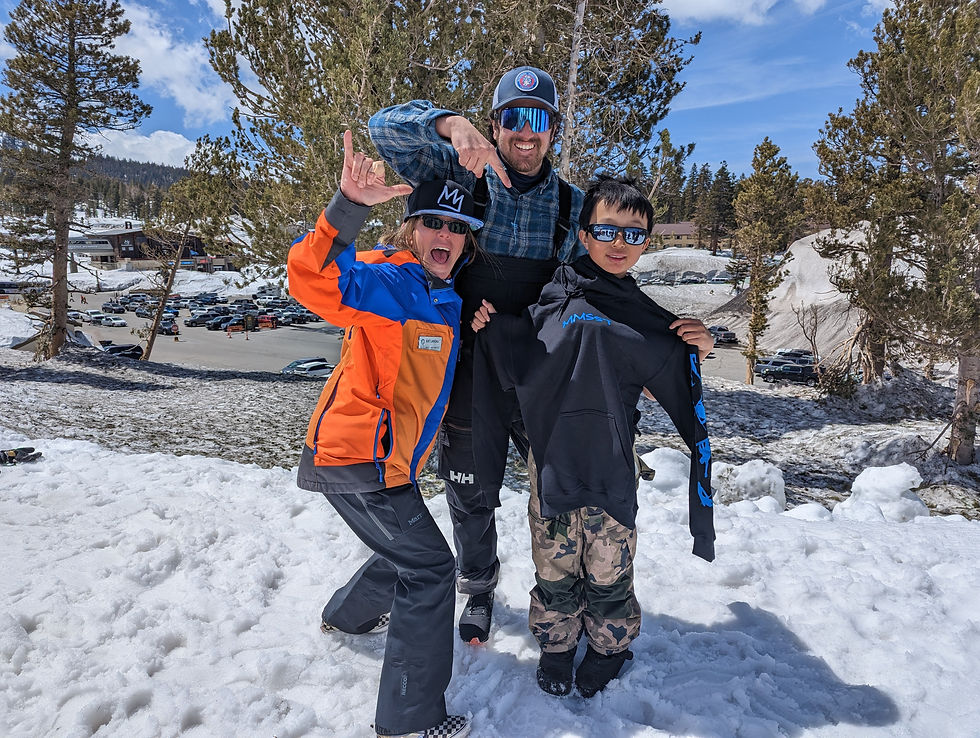
At the time, Alexander was still recovering from a severe autistic burnout following a traumatizing kindergarten experience, which included situational mutism. But he was taken under the wing of Kat, an adaptive instructor who literally took the USSA (U.S.Ski & Snowboard, the official national governing for Olympics and Paralympic skiing and snowboarding in the United States) exam to become a certified race coach solely so she could support him in mainstream competitions. She was Alexander’s light. Frankly, without Kat and Mammoth, we would have walked away from skiing long before he ever made it this far.
Together, we navigated his peaks and valleys. By the end of that season, he was finally able to speak to his coaches and began engaging with his teammates, even if he couldn't remember their names.
It was definitely a paradigm shift for traditional competitive coaches. Gerry, Alexander’s U10 head coach, once came to me feeling confused: "I taught Alexander a technique, but he isn't responding to my directions at all." I explained that Alexander processes information differently. He often has a delayed response. It is like downloading an app, you can’t use it until the download is fully complete. I told Gerry not to simplify his language, but to talk to Alexander just as he would any other athlete, simply removing the expectation of an immediate physical response. Gerry tried. The next season, Alexander suddenly executed the exact technique he had been taught a year prior.
I remember at the end of that season, during Alexander’s first Far West championship, he and Kat were riding the gondola at Northstar. Kat struck up a conversation with a stranger—another ski coach—and shared Alexander's story. The coach burst into tears, sharing her own frustration about her talented son who was excluded from sports because of an OCD diagnosis. Alexander, who rarely spoke to strangers back then, looked at this mother and said briefly: "You should fight for him. He deserves it."

To be honest, this was not a natural path for us. Both my husband and I are academics, and neither of us is athletic enough to be his "parent-coach." But skiing is a sport deeply rooted in family legacy. I didn't even start skiing until Alexander did, and because of his high support needs early on, I wasn't able to get on the snow as frequently as other parents. Fun fact: during Alexander’s first year of racing, I didn't even know what type of skis to buy him.
People are often curious: If this is so hard, why did you choose this path? The truth is, we didn't choose it. Alexander chose it for himself when he was six years old, and we simply followed the spark in his eyes.
He bypassed the traditional learning approach from day one. His first experience with snow was at a small, family-owned resort in Idaho. We signed him up for a week-long group lesson. For the first three days, Alexander refused to follow the progressive steps like the other kids on the magic carpet. He just sat on the snow and played with it with his bare hands. Luckily, the resort didn't give up on him. They found an instructor with a psychology background to shadow him at no cost. This instructor simply played in the snow with Alexander for days. Then, suddenly, in the last few days of the trip, Alexander skipped the magic carpet entirely, headed straight for the lift, and unlocked black diamond terrain within three days. I still remember what that instructor told me before we left: "He will be challenging, but if you can find the right resources, he has immense potential."
Were we excited about this potential? Yes, in the beginning. But what truly convinced me to keep supporting him was his unyielding passion.
When Alexander was younger, navigating the neurotypical world was agonizing. Unwritten social norms, changes in routine, and waiting were unbearable. He would literally have a meltdown on the street if we went to a restaurant and it happened to be closed, despite Google saying it was open. It was not a typical child's tantrum over a missed meal, but a complete nervous system overload because the logical rule he relied on was broken.
These were the very things he couldn't cope with at school, which constantly landed him in the principal's office. Yet, through skiing, Alexander became willing to cope with unpredictable weather, crowded chairlifts, and unexpected cancellations courtesy of Mother Nature. We lived in Mountain View, and every Saturday we had to leave for the resort at 3:00 AM. He always packed his books and toys the night before, woke up on time, stuffed himself into the backseat, and slept all the way up the mountain.
Is Alexander good at skiing? Yes, he is a great skier among his peers. But is he the type of athlete who constantly lands on the podium? No. Frankly, it requires far less cognitive bandwidth for him to excel academically than athletically. But he chooses this path. As he puts it: "I am good at academics. That just means I have a choice, but it doesn’t mean I have to do it."
This mindset can be baffling for traditional coaches who don't understand an athlete who doesn't prioritize "winning." For a long time, Alexander never cared about his ranking or competition points. He would finish his run and declare, "Now I am done with the fun part, let’s go home." It wasn't until this year that he even started asking his coach for performance feedback.
Alexander actually has a long-term plan. He wants to qualify for the FWT (Freeride World Tour). But unlike his peers who are chasing podiums, he simply wants to be there. His strategy is to progress incrementally every year so that by the time he reaches adulthood, he has a high probability of entering the tour.

I once discussed the high dropout rate in youth sports with him, asking what he would do if there were fewer athletes later on, making the sport less appealing to kids. He casually replied: "That is even better. Fewer competitors means I can achieve my FWT goal faster and earlier."
He has simply found an environment that allows him to thrive as an autonomous individual. Unlike many freeride athletes who excel at visually stunning, high-speed aerial tricks, Alexander’s autistic neurotype allows him to hyper-focus on calculating precise lines. He can't process everything at once, so he prioritizes the exact objectives he can master right now. Bit by bit, he adds more.
I recently spoke with his coach, Drew—a two-time world champion—and we marveled at Alexander’s progress. This is a kid who used to be unable to tolerate any tricks that required his skis to leave the snow, but this season, he started catching air. It might not seem like a massive triumph to the neurotypical gaze, but it is a monumental milestone in his personal exploration.
Interestingly, being autistic actually serves as a shield. It's not that peer pressure doesn't exist in extreme sports—it's incredibly intense—but Alexander’s ASD radar simply filters it out. While other athletes are desperate to look visually stunning, Alexander remains grounded, focusing only on the techniques that make logical sense to him.
He is, at least at the time of this writing, incredibly self-content in this sport. He has benefited from highly positive coaching because he started in adaptive skiing, where the environment is naturally more flexible and accommodating. But he also possesses a profound awareness of who he is. He once told me: "I am not the best, but I am a great skier. I will cheer for the people who win. Winning is great, but it is just a bonus for me. Whether I win or not, it doesn't stop me from skiing."
Where does this confidence come from? It comes from years of scaffolding and environmental modification rooted in his special interest. Leaning into his passion has saved us years of often suggested therapy trying to "generalize" social skills. The friction with the environment still exists, but it is vastly easier to navigate when he is intrinsically motivated.
As his parents, we have faced our fair share of criticism on social media: Why would you send a kid with high support needs into high-stakes extreme sports? Perhaps people should look at it this way: Freeriding is indeed physically dangerous, but for Alexander, it is psychologically safe. The environment and the people within it accommodate him, making it a safe space for him to navigate.
I honestly cannot imagine what would happen if we forced him to stay exclusively within a school system that inherently views him as needing to be "fixed." Alexander has received three different types of services from the school, and none of them worked. He once pointedly asked, "I’ve learned enough about how to work with the students at school. Why don’t the teachers teach the neurotypical students how to work with me my way?"
Alexander navigates extreme alpine terrain and manages real competitive pressure, yet his school still expects him to watch videos to decode neurotypical facial expressions, or to endure small talk that actively drains his battery.

Before I wrap up, I want to clarify: I am not suggesting that anyone reading this should immediately throw their neurodivergent child into extreme sports. That is not the point. What I truly mean is that any path can be the right path, as long as you honor their spark. The fundamental question laid in front of parents is this: Are you using their passions as a vehicle toward their own unique version of excellence, or merely as a tool to force them into neurotypical "normality"?
We chose the former.
About the Author
Sibyl JING Wenting, veteran published writer, autism researcher and advocate, a neurodivergent mother to a PDA systemizer son. Follow her substack: https://toemmachow.substack.com/


