
The Scaffolding Gap: Helping Twice-Exceptional Youth Navigate the Bridge to Adulthood

A Familiar Scene
A 19-year-old passes every exam, debates philosophy with professors, and reads at a
college level — but ends the semester with a mediocre grade because half the homework
never got turned in. That same young person forgets to eat lunch, can’t answer an email
that’s been sitting for three weeks, and has a full shutdown when the laundry isn’t done on
time.
How can someone this capable be this stuck?
This is daily life for many twice-exceptional (2e) youth — young people who are intellectually
gifted and navigating ADHD, autism, or another learning difference. Their minds move fast. Their executive-functioning systems, the ones that manage time, initiation, and follow-
through, often move at a different pace entirely. It’s important to note that 2e is not one profile: a gifted autistic teen and a gifted teen with ADHD can have opposite regulation
needs — one may crave novelty, the other may be overwhelmed by it. Everything below is a
starting point for understanding a young person, not a fixed checklist.
The Scaffolding Gap
Adolescence and the transition to adulthood — often called the transitional-age-youth (TAY)
period — break down into two overlapping jobs.
From roughly ages 12 to 18, the goal is to build an identity and begin learning to self-
regulate somewhat separately from family. From roughly 18 to 25, the goal shifts to
deploying that identity into the real world — college, work, bills, relationships.
Here’s the catch: intellectual maturity often masks executive-function gaps. Through the
teen years, invisible scaffolding — parents managing schedules, schools structuring the day
— quietly keeps things afloat. Then, almost overnight around age 18, much of that
scaffolding disappears. Capability stays high. The operational tools needed to run a life
independently are still catching up. That mismatch is the scaffolding gap, and it’s often
where capable young people suddenly look like they’re struggling for no visible reason.
A Brain Built to Learn From Cause and Effect
The teenage and young-adult brain isn’t broken — it’s wired for exactly this stage of life. It
runs hot by design: built for impulsivity, intense emotion, and risk-taking, which, paired
together, drive rapid learning (Casey et al., 2008; Steinberg, 2008).
One mechanism makes this especially relevant to how 2e youth learn from mistakes: the
adolescent brain shows a heightened neural response to the gap between what it expected
to happen and what actually happened — a reward-prediction-error signal in the striatum
that peaks during the teen years (Cohen et al., 2010). In plain terms, the teenage brain is
unusually primed to learn from the difference between “what I thought would happen” and
“what happened.” Cause and effect isn’t just a teaching strategy for this age group — it’s
the brain’s preferred channel for encoding a lesson.
Productive Failure: Why the Struggle Itself Is the Point
That neural wiring is exactly what a learning approach called productive failure is built
around. Productive failure means learners grapple with a complex problem — and often fail
to solve it — before receiving direct instruction. The struggle itself, not the right answer, is
what builds durable understanding (Kapur, 2016).
For 2e youth specifically, the deeper goal isn’t just academic content — it’s practicing
regulation. ADHD is linked to measurably lower frustration tolerance: in one controlled
study, children with ADHD were significantly more likely to quit a frustrating task than their
peers without ADHD (Seymour et al., 2019). So the real skill being built is the capacity to
tolerate distress, not just to solve the problem in front of them. Caregivers build that
capacity through scaffolding — providing external support as a child navigates a hard
emotional moment (Paley & Hajal, 2022). And how the struggle is structured matters: when
researchers tested productive failure with younger students, the benefit didn’t show up
automatically — it depended on whether students were given an explicit step to compare
their own attempt against a model solution (Mazziotti et al., 2019). In other words,
unstructured struggle alone doesn’t teach much; struggle paired with reflection does.
Structured productive failure becomes low-stakes practice for tolerating distress, arguably
the more transferable skill of the two.
Struggle also hits 2e youth harder than it might hit their neurotypical peers. In one study of
online learning, neurodivergent students reported significantly higher extraneous cognitive
load than neurotypical peers — the toll of environment and format, not the difficulty of the
material itself — with no difference in the load created by the material’s actual complexity
(Le Cunff et al., 2024). When demands outweigh capacity, the brain shifts into survival
mode: anxiety, perfectionist paralysis, meltdown, and — without recovery — burnout.
Why 2e Youth Need a Safe Haven, Not a Fixer
This is where physical and emotional scaffolding matters. Adolescents and young adults
naturally return to their caregivers as a secure base for co-regulation — but only if that base
has reliably proven safe (Allen & Miga, 2010; Moretti & Peled, 2004). Home should be the
one place a 2e young person can drop the mask and exist without being evaluated.
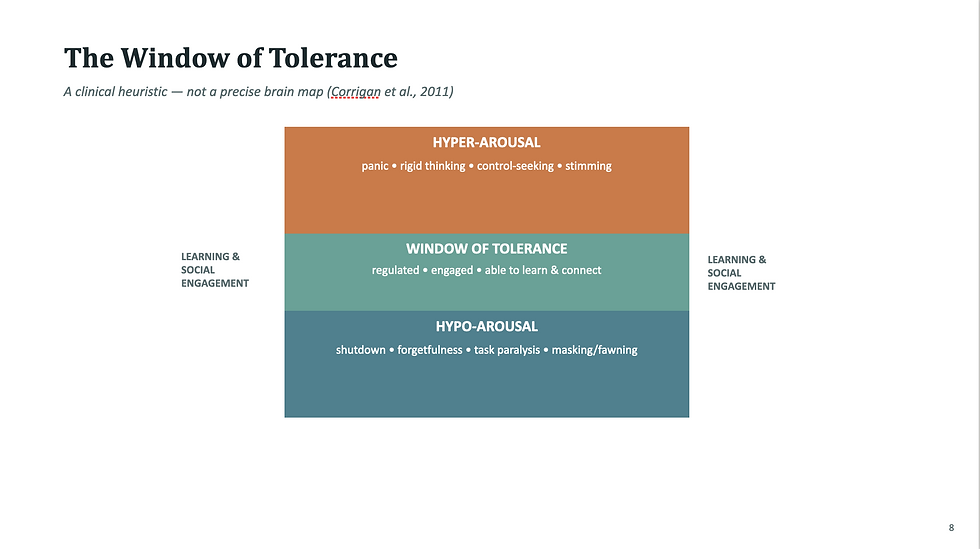
A useful way to picture this is the window of tolerance — a clinical heuristic, not a precise
map of the brain (Corrigan et al., 2011). Inside the window, a young person is regulated,
engaged, and able to learn and connect. Above it is hyper-arousal: panic, rigid thinking,
control-seeking, stimming. Below it is hypo-arousal: shutdown, forgetfulness, task paralysis,
masking or fawning. The goal of a secure base isn’t to keep a young person from ever
leaving the window — it’s to be the reliable place they can return to when they do.
Over-Scaffolding and Under-Supporting
Caregivers tend to drift toward one of two patterns, often on different days:
Over-scaffolding looks like doing tasks the young person is developmentally capable of
attempting, so they rarely experience natural consequences. It can start to feel like you’re their manager, not their parent — and mistakes get met with lectures instead of co-
regulation.
Under-supporting looks like a young person repeatedly overwhelmed with no framework
for asking for help, and no predictable “safe” space built into the day.
Most caregivers land somewhere between the two, and that’s normal. The goal isn’t
perfection — it’s noticing the pattern.
What Parents Can Do Instead
Parents don’t have to fix mistakes or prevent them from happening. What they can do is co-
regulate, engineer the environment, and help their young person account for their energy.
Co-regulation is about offering comfort, not fixing the problem. It starts with matching the
moment, not the fix, to the state. In hyper-arousal: limit sensory input, offer deep pressure
or slow breathing, offer more choice and autonomy. In hypo-arousal: simplify the task,
introduce gentle movement or a change of scenery, break the task into smaller steps. In
either state, predictable routines, transition warnings, and visual timers help. Practically, this
can look like helping a young person set their own alarm instead of reminding them of the
time, or sitting quietly together after a disappointment and debriefing later — without shame
— rather than immediately fixing it.
Environmental engineering means continuously tuning the surroundings — sensory input,
predictability, complexity, novelty, interest, transitions, agency, equilibrium — to support
capacity rather than strain it. This connects to established research on sensory processing
(Dunn, 2001) and self-determination theory, which shows that autonomy, competence, and
connection all fuel intrinsic motivation (Ryan & Deci, 2000).

Energy accounting treats energy — not just time — as the resource that needs managing.
That can look like a simple daily rhythm: a morning check-in, a task block, a genuine interest
anchor, another task block, an exit ritual, and a low-demand evening. The goal is to notice
patterns together without judgment, build in pauses before the crash rather than after it,
match effort to actual capacity that day, and practice planned exits — a simple “two-minute
warning, what’s a good stopping point?” goes a long way. Rest isn’t the reward for
productivity. It’s the input that makes productivity possible.

Reframing Failure as a Data Point
Underneath all of this is one shift in framing: a mistake isn’t proof that something is wrong
with a young person — it’s information. When a caregiver responds to a forgotten
assignment or a blown deadline with curiosity (“I noticed you didn’t give up when that got
hard — let’s look at where it went sideways”) instead of rescue or lecture, the young person
gets to practice treating failure as a data point instead of a verdict. That’s the skill that
transfers into adulthood, long after any single mistake is forgotten.
A Word for Parents
There’s something worth naming here, too. For most families, the Transitional Age Youth
(16–25) years are when a parent is meant to gradually return to themselves — to rediscover
time, identity, and rhythms that got set aside during the years of hands-on parenting. For
parents of 2e youth, that return is often delayed. Instead of stepping back, many find
themselves stepping in more, carrying a heightened watchfulness long after their peers
have exhaled.
It’s alright to grieve that. Grieving the version of this season you expected to have — more
freedom, less worry — doesn’t take anything away from how much you love your child. Both
things can be true at once: you can ache for the return to yourself that hasn’t come yet, and
still show up, fully, for the young person who still needs you. Naming that loss, rather than
pushing past it, is often what makes it possible to keep offering the steady presence they
need.
Conclusion
This stretch of life — early adolescence through the mid-twenties — is messy and chaotic for everyone, and especially so for 2e youth, whose intellectual capability and executive-
functioning tools rarely mature on the same timeline. The path through it is not linear. There will be setbacks that look, in the moment, like proof that nothing is working.
But with consistent scaffolding — a caregiver who co-regulates instead of fixes, an
environment tuned to actual capacity, and a family that treats energy as something to be
managed rather than spent until empty — 2e young people can build the operational skills to
match their intellectual ones. Over time, what once felt like constant friction can start to feel
like flow.
About the Author
Danielle C. Park, MA, ACAS 2e Neurodivergent Coach danielleparkcoaching.com
References
Allen, J. P., & Miga, E. M. (2010). Attachment in adolescence: A move to the level of emotion
regulation. Journal of Social and Personal Relationships, 27(2), 181–190.
Casey, B. J., Jones, R. M., & Hare, T. A. (2008). The adolescent brain. Annals of the New
York Academy of Sciences, 1124(1), 111–126.
Cohen, J. R., Asarnow, R. F., Sabb, F. W., Bilder, R. M., Bookheimer, S. Y., Knowlton, B. J., &
Poldrack, R. A. (2010). A unique adolescent response to reward prediction errors. Nature
Neuroscience, 13(6), 669–671.
Corrigan, F. M., Fisher, J., & Nutt, D. J. (2011). Autonomic dysregulation and the Window of
Tolerance model of the effects of complex emotional trauma. Journal of
Psychopharmacology, 25(1), 17–25.
Dunn, W. (2001). The sensations of everyday life: Empirical, theoretical, and pragmatic
considerations. The American Journal of Occupational Therapy, 55(6), 608–620.
Kapur, M. (2016). Examining productive failure, productive success, unproductive failure,
and unproductive success in learning. Educational Psychologist, 51(2), 289–299.
Le Cunff, A.-L., Giampietro, V., & Dommett, E. (2024). Neurodiversity positively predicts
perceived extraneous load in online learning: A quantitative research study. Education
Sciences, 14(5), 516.
Mazziotti, C., Rummel, N., Deiglmayr, A., & Loibl, K. (2019). Probing boundary conditions of
productive failure and analyzing the role of young students’ collaboration. npj Science of Learning, 4, 3.
Moretti, M. M., & Peled, M. (2004). Adolescent-parent attachment: Bonds that support
healthy development. Paediatrics & Child Health, 9(8), 551–555.
Paley, B., & Hajal, N. J. (2022). Conceptualizing emotion regulation and coregulation as
family-level phenomena. Clinical Child and Family Psychology Review, 25(1), 19–43.
Ryan, R. M., & Deci, E. L. (2000). Self-determination theory and the facilitation of intrinsic
motivation, social development, and well-being. American Psychologist, 55(1), 68–78.
Seymour, K. E., Macatee, R., & Chronis-Tuscano, A. (2019). Frustration tolerance in youth
with ADHD. Journal of Attention Disorders, 23(11), 1229–1239.
Steinberg, L. (2008). A social neuroscience perspective on adolescent risk-taking.
Developmental Review, 28(1), 78–106.
